June to August 2025 shipped
A core XDPoSChain contributor implements Falcon signing and verification for XDPoS 2.0 blocks, votes, quorum certificates and timeouts on the poc_falcon branch, with benchmarks. The branch is not merged. source
Chain profile
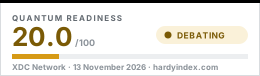
A core XDPoSChain developer has tested Falcon for consensus signatures on an unmerged branch, and XDC Innovation Labs, which calls itself one contributor within a broader ecosystem, publishes a 2026 to 2030 post-quantum roadmap that no XDC governing body has adopted.
No, not today. XDC Network is an EVM chain, and both its accounts and the masternodes that sign its blocks use ECDSA on secp256k1, which a sufficiently large quantum computer breaks. Two pieces of post-quantum work exist. In mid-2025 a long-standing contributor to XDPoSChain, the XDC node software, built a proof of concept that signs and verifies XDPoS 2.0 blocks, votes and timeouts with Falcon, on a branch of the official repository that has not been merged. And XDC Innovation Labs, which describes itself as "one contributor within a broader ecosystem", publishes a four-phase roadmap running from 2026 to 2030 that ends with Falcon consensus signatures and an ECDSA sunset for consensus, with ML-DSA wallets through account abstraction along the way. We found no XDC improvement proposal, foundation statement or governance vote adopting that roadmap, so it is recorded here as research and not as the chain's plan.
Where we are making a judgement call The tier turns on who speaks for XDC. XDC Innovation Labs' roadmap names schemes and dates, and the case for reading it as the core team speaking rests chiefly on its FAQ, which says the migration is "co-led by Ritesh Kakkad (XDC Core)", the XinFin co-founder. On that reading XDC would be Tier 3, with a deployment score of 5 and a Hardy Score of 27.5 instead of 20.0. We did not, because the lab calls itself one contributor within a broader ecosystem, its team page says its profiles are placeholders, the XDC Foundation has published nothing on it, and the XIP-PQ-001 vote its roadmap marks as done has no published text or result. We placed XDC in Tier 4 rather than Tier 5 on the Falcon proof of concept, whose author has contributed to XDPoSChain's main branch since 2021. A reader who gives that unmerged branch no weight would place XDC in Tier 5, with a deployment score of 1 and a Hardy Score of 17.5. The verification score of 2 follows from the same reading of the lab: because it is not treated as XDC's authority, its quantum-safe marketing is not treated as XDC's claim.
ECDSA on secp256k1 for accounts and for XDPoS 2.0 masternode block and vote signatures
Falcon tested for consensus signatures on an unmerged proof-of-concept branch; a third-party lab roadmap adds ML-DSA wallets through account abstraction
FN-DSA (Falcon), FIPS 206 in draft; FIPS 204 (ML-DSA) named in the lab roadmap and nowhere else
Tier 4: Debating. Post-quantum work on the chain’s own signatures is documented by people with authority over it, in a formal improvement proposal or a public research programme, but no scheme is agreed and no timeline is published.
A role not listed is not evidenced either way. Every scheme, and which other chains share it, is in the cryptography registry.
| No. | Dimension | Score | Weight | Contribution |
|---|---|---|---|---|
| 1 | Signature scheme | 0 | 30% | 0.0 |
| 2 | Deployment stage | 2 | 25% | 5.0 |
| 3 | NIST alignment | 4 | 15% | 6.0 |
| 4 | Migration path | 4 | 15% | 6.0 |
| 5 | Exposure | 2 | 10% | 2.0 |
| 6 | Verification | 2 | 5% | 1.0 |
| Hardy Score | 20.0 | |||
Band 0: Classical signatures only on mainnet, with nothing post-quantum protecting live funds. Short-lived devnets and one-off benchmarks sit here: they demonstrate research rather than something a user can hold keys on.
XDC accounts and XDPoS 2.0 block, vote and timeout signatures all use ECDSA on secp256k1: the node recovers each signer with secp256k1 public-key recovery. Nothing post-quantum protects XDC on mainnet. source
Band 2: Tier 4: Debating.
Tier 4: Debating. On the research limb: a core XDPoSChain contributor implemented and benchmarked Falcon consensus signatures on a branch of the official repository, and a forum write-up reporting the same benchmarks sets out a three-layer migration. It is not Tier 3 because the dated roadmap comes from XDC Innovation Labs, which describes itself as one contributor within a broader ecosystem, and we found no XDC improvement proposal or foundation statement adopting it. source
Band 3 to 5: NIST schemes are referenced as candidates without a committed selection, or the work is bespoke research.
The scheme tested against XDC's own consensus signatures is Falcon, selected by NIST for standardisation as FN-DSA in FIPS 206, which is still a draft. The lab roadmap also names ML-DSA, a final standard, for wallets, but that roadmap is not the chain's proposal. source
Placement in the band A 4 rather than a 5: the scheme tested for XDC's consensus signatures awaits a final standard, and the ML-DSA named for wallets comes from a roadmap the chain has not adopted. It is not a 3 because a specific NIST-selected scheme was implemented against XDC's own code.
Band 3 to 5: Migration is acknowledged as a problem with no agreed mechanism, or the mechanism is contested.
Two routes have been described. The developer forum write-up proposes a registry mapping existing addresses to post-quantum keys and a hard fork adding post-quantum transaction types, keeping addresses. The lab roadmap proposes account abstraction for wallets and a 12-month dual-signing period for masternodes before ECDSA consensus signatures are retired. Neither is built, agreed or adopted, and the lab's own pages give different dates for the same phases. source
Placement in the band The middle of the band rather than a 3 or a 5: both descriptions keep holders' addresses, which is the hard part, but neither has been adopted by anyone with authority over XDC, and the conflicting dates show no settled plan.
Band 0 to 2: Public keys are exposed for effectively all accounts, or a large, measured share of total supply sits in exposed addresses.
XDC uses Ethereum's address model: an address is the last 20 bytes of a Keccak-256 hash of the public key, and the key can be recovered from any signature the account makes. An account that has never sent a transaction keeps its key hidden; every account that has transacted has revealed it. source
Placement in the band At the top of the band rather than a 0 or a 1: the hashed address does protect accounts that have never signed. It is not a 3 because almost every account holding value, including the masternodes, has signed and so revealed its key.
Band 0 to 2: No post-quantum component exists, or the claims rest on marketing.
No post-quantum component protects XDC. The Falcon proof of concept is open source but sits on an unmerged branch with compiled binaries committed alongside the C source, runs on no persistent network and has had no outside review. The quantum-safe marketing on xdc.network is XDC Innovation Labs' and not the chain's, and the lab's FAQ says the work is not a claim that XDC is already quantum-proof. source
Placement in the band The top of the band rather than a 0 or a 1: no post-quantum component protects funds, but the profile does not treat the lab as XDC's authority for the tier, so its quantum-safe marketing is not counted as XDC's own claim either, and the chain's position does not rest on marketing.
The deployment dimension is not a separate judgement. It is Tier 4 expressed as a number. See the tier mapping.
The 9 chains XDC sits among, out of 80 rated. The last column is the gap in Hardy points from XDC.
| Rank | Chain | Tier | Hardy | vs XDC |
|---|---|---|---|---|
| 26 | Cosmos Hub | 4: Debating | 23.5 | +3.5 |
| 27 | Kaspa | 4: Debating | 20.5 | +0.5 |
| 28 | BNB Chain | 4: Debating | 20.0 | level |
| 29 | Monad | 4: Debating | 20.0 | level |
| 30 | XDC Network this chain | 4: Debating | 20.0 | |
| 31 | Bittensor | 4: Debating | 19.0 | -1.0 |
| 32 | Monero | 4: Debating | 17.5 | -2.5 |
| 33 | Neo | 4: Debating | 17.0 | -3.0 |
| 34 | Dash | 5: Exposed | 16.5 | -3.5 |
A core XDPoSChain contributor implements Falcon signing and verification for XDPoS 2.0 blocks, votes, quorum certificates and timeouts on the poc_falcon branch, with benchmarks. The branch is not merged. source
A three-layer post-quantum migration for consensus, transactions and applications is written up on the XDC developer forum, reporting block signatures growing from 65 to 652 bytes under Falcon and calling the choice of algorithm premature. source
XDC Innovation Labs launches its post-quantum initiative and publishes a four-phase roadmap to 2030. The roadmap lists an XIP-PQ-001 community vote to ratify it and marks that item as done, but we found no published text or result for the vote. source
Falcon consensus signatures after a 12-month dual-signing period, then an 18-month notice before ECDSA consensus signatures are retired. The lab dates this to 2029 and 2030 on its roadmap and to 2030 and 2031 in its FAQ; neither date is the chain's. source
No stated policy
No XDC governing body has stated a policy for accounts that never move to post-quantum keys. XDC Innovation Labs' FAQ says ECDSA transactions keep working through its Phase 3 and that ECDSA is deprecated once more than 95 per cent of the network upgrades, without saying what happens to the rest.
As of 22 October 2026. source Published beside the score, not in it. Every chain's stance is compared on the commitments page.
Exposure measures how much of the chain's value already sits behind a public key that an attacker can record today and break later. This is the part of the threat that a future upgrade cannot undo.
XDC follows Ethereum's address model, with an xdc prefix in place of 0x. An address is derived from a Keccak-256 hash of the secp256k1 public key, so an account that has never signed keeps its key private, but every signature lets anyone recover the key. Accounts in use, and the masternodes that sign every block, have therefore published their keys, and those balances could be recorded now for a future quantum attack.
What this rating means for you
XDC has acknowledged the threat without agreeing a plan, so nothing is going to change for holders in the near term. That makes address hygiene the part worth attending to.
Editorial guidance from the Hardy Index.
We will email you the day this rating moves, with the changelog note that explains why. Nothing else, and nothing in between.
No. XDC accounts and the masternodes that sign its blocks use ECDSA on secp256k1, which a large enough quantum computer would break. Pages describing XDC as a quantum-safe chain refer to a roadmap; the node software has no post-quantum signature.
XDC Innovation Labs, at xdc.network. It describes itself as "one contributor within a broader ecosystem", and we found no XDC improvement proposal or XDC Foundation statement adopting the roadmap, which is why it is not scored as the chain's plan.
Yes, as a proof of concept. A branch of the XDPoSChain repository signs and verifies blocks, votes and timeouts with Falcon, and the accompanying write-up reports signatures growing from 65 to 652 bytes. The branch has not been merged and runs on no network.
Not under either route described so far. The developer forum write-up maps existing addresses to post-quantum keys, and the lab roadmap uses account abstraction to change how a wallet signs without moving funds. Neither has been adopted or built.
A rating is only true as of the day an editor last reviewed it, so both forms below carry that date and the methodology version, with the date its cited sources were last checked. If you are quoting the score, quote those too.
The Hardy Index (2026). XDC Network: quantum readiness assessment. Hardy Score 20.0 of 100, Tier 4: Debating. Methodology v1.8. Last reviewed 22 October 2026; sources checked 13 November 2026. https://hardyindex.com/chains/xdc-network
@misc{hardyindex_xdc_network_2026,
  author       = {{The Hardy Index}},
  title        = {XDC Network: quantum readiness assessment},
  year         = {2026},
  howpublished = {\url{https://hardyindex.com/chains/xdc-network}},
  note         = {Hardy Score 20.0 of 100, Tier 4: Debating. Methodology v1.8},
  urldate      = {2026-11-13}
}
The whole dataset is reusable under the terms on the about page. A machine-readable version of this page is at /chains/xdc-network.md.
This is a security-readiness assessment, not investment advice.