Hardy Index Quantum readiness, rated and tracked

Chain profile

Filecoin

FIL Exposed

Signs accounts with ECDSA on secp256k1 or BLS on BLS12-381, signs blocks and finality votes with BLS, and has no post-quantum improvement proposal, plan or research programme for any of them.

Is Filecoin quantum-safe?

No. Filecoin has two native account types, and a sufficiently large quantum computer running Shor's algorithm would break both: f1 accounts sign with ECDSA on secp256k1, which is the Lotus wallet's default, and f3 accounts sign with BLS signatures on the BLS12-381 curve. Ethereum-compatible f410 accounts also sign with secp256k1. Storage providers sign blocks with a worker key that the specification requires to be BLS, and the same key signs the BLS-aggregated votes of F3, the fast-finality protocol of FIP-0086. No Filecoin Improvement Proposal, specification section or statement from the core developers addresses post-quantum signatures; the post-quantum items found in the project's GitHub organisation are all grant applications from outside teams. Filecoin's storage proofs use Groth16 SNARKs over BLS12-381, which a quantum computer would also break, but they prove storage rather than authorise spends, so they sit outside what this rating scores.

Where we are making a judgement call Three judgement calls carry this profile. The first is scope. Filecoin's proofs of replication and spacetime are Groth16 SNARKs over BLS12-381, and its randomness comes from drand's BLS threshold signatures; a quantum computer would break both, and forged storage proofs could earn block rewards. Neither authorises a spend, so under v1.8 neither is a fund-protecting signature, and they are recorded but not scored. Counting them would change no score, because nothing post-quantum exists for them either. The second is the tier. The devgrants repository holds several grant applications with post-quantum themes, such as a December 2025 proposal for a post-quantum FIL bridge, but they come from outside teams with no authority over the chain and concern their own products; a reader who counted them as a public research programme would place Filecoin in Tier 4, with a deployment score of 2 and a Hardy Score of 11.0 rather than 8.5. The third is exposure. f3 addresses publish their BLS keys by construction and every block producer's worker key is public, which argues for a 1, and a reader who scores it so would give a Hardy Score of 7.5. We hold it at 2 because f1 and f410 addresses do hide unused keys and no measured share of exposed FIL has been published.

At a glance

On mainnet today

ECDSA on secp256k1 for f1 and Ethereum-compatible f410 accounts; BLS on BLS12-381 for f3 accounts, block signatures by storage providers' worker keys and F3 finality votes

Post-quantum scheme

None selected or proposed

NIST standard

None adopted

Readiness tier

Tier 5: Exposed. The signatures securing funds on mainnet today are quantum-vulnerable, and no public post-quantum plan, proposal or research programme addressing them could be found.

Cryptography in use

A role not listed is not evidenced either way. Every scheme, and which other chains share it, is in the cryptography registry.

Score breakdown

Each dimension scored 0 to 10. The weight beside it is its share of the total score.
Show the weighted arithmetic and the sourced note for each dimension
Filecoin Hardy Score by dimension, with weights and weighted contributions
No. Dimension Score Weight Contribution
1 Signature scheme 0 30% 0.0
2 Deployment stage 1 25% 2.5
3 NIST alignment 0 15% 0.0
4 Migration path 2 15% 3.0
5 Exposure 2 10% 2.0
6 Verification 2 5% 1.0
Hardy Score 8.5

1 Signature scheme 0/10, weighted 30%

Band 0: Classical signatures only on mainnet, with nothing post-quantum protecting live funds. Short-lived devnets and one-off benchmarks sit here: they demonstrate research rather than something a user can hold keys on.

The Filecoin specification lists two signature types, ECDSA over secp256k1 to authenticate user messages and BLS over BLS12-381, and Ethereum-compatible accounts sign with secp256k1 under FIP-0055. All are broken by Shor's algorithm, and nothing post-quantum protects FIL on mainnet. source

2 Deployment stage 1/10, weighted 25%

Band 1: Tier 5: Exposed.

Tier 5: Exposed. The signatures securing FIL are quantum-vulnerable, and no Filecoin Improvement Proposal, specification section or core-developer statement on post-quantum signatures exists: the FIPs repository does not mention quantum computing at all. The post-quantum grant applications filed in the devgrants repository come from outside teams with no authority over the chain. source

3 NIST alignment 0/10, weighted 15%

Band 0 to 2: No post-quantum scheme named for the chain’s fund-protecting signatures, or a proprietary scheme with no public cryptanalysis.

No post-quantum scheme has been named for Filecoin's account, block or finality signatures in any FIP, in the specification or by the core developers, so there is nothing to align with a NIST standard. source

Placement in the band The floor of the band rather than a 1 or a 2: no scheme has been named for Filecoin's own signatures at all, as distinct from a scheme named without commitment. Outside grant applicants naming Dilithium or SPHINCS+ for their own products do not count, because they are not naming it for the chain.

4 Migration path 2/10, weighted 15%

Band 0 to 2: No agreed migration path, or the proposals on the table would strand or freeze holder funds.

No migration plan exists. Filecoin does have real machinery a migration could use: its address format versions signature schemes by a protocol byte, so a new scheme would take a new address protocol, and FIP-0048 added the f4 address class so that new addressing schemes can be added through address manager actors. Nobody with authority has proposed using either for post-quantum keys. source

Placement in the band The top of the band rather than a 0 or a 1: versioned address protocols and the extensible f4 class are working mechanisms for introducing a new account type, and network upgrades through the FIP process routinely change the protocol. Not a 3, because no one with authority over Filecoin has acknowledged migration as a problem to solve.

5 Exposure 2/10, weighted 10%

Band 0 to 2: Public keys are exposed for effectively all accounts, or a large, measured share of total supply sits in exposed addresses.

f1 addresses are a Blake2b-160 hash of the secp256k1 public key and f410 addresses follow Ethereum's key hash, so those keys stay hidden until the account signs. f3 addresses carry the 48-byte BLS public key itself, so every f3 key is public from the address alone, and every storage provider's worker key is a BLS key used to sign blocks. source

Placement in the band The top of the band rather than a 1: the f1 and f410 address types do hide the key of an account that has never sent a message. Not a 3, because f3 addresses publish their keys by construction, every storage provider's worker key is public, and any account that has sent a message has revealed its key; nobody has published a measured share.

6 Verification 2/10, weighted 5%

Band 0 to 2: No post-quantum component exists, or the claims rest on marketing.

No post-quantum component exists for Filecoin: no code, specification or testnet implementation for its signatures was found. Lotus and the proof libraries are open source, but under v1.8 the openness of the classical code earns nothing here. source

Placement in the band The top of the band rather than a 0 or a 1: there is no post-quantum component to verify, but nothing about Filecoin is marketed as quantum-safe by the project, so its position does not rest on marketing.
The deployment dimension is not a separate judgement. It is Tier 5 expressed as a number. See the tier mapping.

How it compares

All 80 rated chains on the 0 to 100 scale. Filecoin is marked. Select any point to open that profile.
Hyperliquid, Hardy Score 5.5 Cronos, Hardy Score 7.0 MemeCore, Hardy Score 7.0 Beldex, Hardy Score 7.5 Ozone Chain, Hardy Score 7.5 0G, Hardy Score 8.5 AIOZ Network, Hardy Score 8.5 Akash Network, Hardy Score 8.5 Arweave, Hardy Score 8.5 Avalanche, Hardy Score 8.5 Bitcoin SV, Hardy Score 8.5 Celestia, Hardy Score 8.5 Chiliz Chain, Hardy Score 8.5 Conflux, Hardy Score 8.5 dYdX Chain, Hardy Score 8.5 eCash, Hardy Score 8.5 Filecoin, Hardy Score 8.5 GateChain, Hardy Score 8.5 Gnosis Chain, Hardy Score 8.5 Injective, Hardy Score 8.5 KCC (KuCoin Community Chain), Hardy Score 8.5 Kite, Hardy Score 8.5 Mina Protocol, Hardy Score 8.5 MultiversX, Hardy Score 8.5 Polygon PoS, Hardy Score 8.5 Provenance Blockchain, Hardy Score 8.5 Theta Network, Hardy Score 8.5 THORChain, Hardy Score 8.5 VeChain, Hardy Score 8.5 WEMIX, Hardy Score 8.5 Whitechain, Hardy Score 8.5 Dogecoin, Hardy Score 9.0 Kaia, Hardy Score 10.0 Vaulta, Hardy Score 10.0 Decred, Hardy Score 10.5 IOTA, Hardy Score 10.5 Litecoin, Hardy Score 10.5 Midnight, Hardy Score 10.5 Qtum, Hardy Score 10.5 TON, Hardy Score 11.0 Ethereum Classic, Hardy Score 13.0 Flare, Hardy Score 13.0 Internet Computer, Hardy Score 13.0 Bitcoin, Hardy Score 14.5 Sonic, Hardy Score 14.5 Terra Classic, Hardy Score 14.5 Dash, Hardy Score 16.5 Neo, Hardy Score 17.0 Monero, Hardy Score 17.5 Bittensor, Hardy Score 19.0 BNB Chain, Hardy Score 20.0 Monad, Hardy Score 20.0 XDC Network, Hardy Score 20.0 Kaspa, Hardy Score 20.5 Cosmos Hub, Hardy Score 23.5 Sei, Hardy Score 24.5 Cardano, Hardy Score 34.0 Tron, Hardy Score 34.5 Polkadot, Hardy Score 36.5 Tezos, Hardy Score 37.5 Zcash, Hardy Score 38.0 Ethereum, Hardy Score 38.5 Aptos, Hardy Score 39.0 Stellar, Hardy Score 39.0 Hedera, Hardy Score 39.5 Sui, Hardy Score 42.0 XRP Ledger, Hardy Score 43.0 Solana, Hardy Score 53.0 Bitcoin Cash, Hardy Score 62.0 Nexus, Hardy Score 73.0 Nervos CKB, Hardy Score 76.0 Algorand, Hardy Score 77.0 NEAR Protocol, Hardy Score 80.0 Abelian, Hardy Score 84.0 QoreChain, Hardy Score 84.5 Mochimo, Hardy Score 89.0 Tidecoin, Hardy Score 89.0 Quantum Resistant Ledger, Hardy Score 92.5 Dilithion, Hardy Score 93.5 Quantus Network, Hardy Score 94.0 Filecoin 8.5

Nearest chains in the ranking

The 9 chains Filecoin sits among, out of 80 rated. The last column is the gap in Hardy points from Filecoin.

Chains ranked immediately around Filecoin, with tier, Hardy Score and the gap to Filecoin
Rank Chain Tier Hardy vs FIL
57 Chiliz Chain 5: Exposed 8.5 level
58 Conflux 5: Exposed 8.5 level
59 dYdX Chain 5: Exposed 8.5 level
60 eCash 5: Exposed 8.5 level
61 Filecoin this chain 5: Exposed 8.5
62 GateChain 5: Exposed 8.5 level
63 Gnosis Chain 5: Exposed 8.5 level
64 Injective 5: Exposed 8.5 level
65 KCC (KuCoin Community Chain) 5: Exposed 8.5 level

Roadmap

  1. 2 October 2022 shipped

    FIP-0048 is created, adding the extensible f4 address class through which new addressing schemes can be introduced. It is now Final, and Ethereum-compatible f410 accounts use it. It does not mention post-quantum keys. source

  2. 18 December 2023 shipped

    FIP-0086, Fast Finality in Filecoin (F3), is created. Now Final and running on mainnet, it adds finality votes signed with storage providers' BLS worker keys and aggregated with BLS on BLS12-381. source

  3. No date published proposed

    No FIP, specification change, implementation or timeline for post-quantum signatures on Filecoin was found. source

If holders never migrate

No stated policy

No FIP, specification section or core-developer statement addresses FIL in accounts that never move to post-quantum keys, since no post-quantum account type has been proposed.

As of 22 October 2026. source Published beside the score, not in it. Every chain's stance is compared on the commitments page.

Exposure

Exposure measures how much of the chain's value already sits behind a public key that an attacker can record today and break later. This is the part of the threat that a future upgrade cannot undo.

Filecoin mixes the two address models. An f1 address is a Blake2b-160 hash of a secp256k1 public key and an f410 address is an Ethereum address derived from a key hash, so both hide the key until the account first signs. An f3 address is the 48-byte BLS public key itself plus a checksum, so an f3 key is public from the moment the address is shared, whether or not it has ever signed. Every storage provider's worker key is a BLS key that signs its blocks, so the keys that produce Filecoin's blocks and F3 finality votes are all public. FIL held in storage providers' miner actors, including pledge collateral, is administered and withdrawn by owner keys. No measurement of the share of FIL behind revealed keys has been published.

What this rating means for you

If you hold Filecoin

Filecoin runs quantum-vulnerable signatures with no published post-quantum plan that we could find. Nothing here is urgent today, and there is also nothing scheduled to change it.

Editorial guidance from the Hardy Index.

Embed this rating

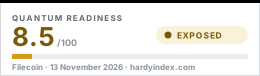
Paste this anywhere to show Filecoin's current rating. It renders live from the index, so it updates when the rating does, and the review date is written into the image. There is nothing to sign up for and nothing to pay.

<a href="https://hardyindex.com/chains/filecoin"><img src="https://hardyindex.com/badge/filecoin.svg" width="260" height="76" alt="Quantum readiness rated by the Hardy Index"></a>

The image is /badge/filecoin.svg. It is a plain SVG with no script and no tracking, it sets no cookie, and it records nothing about whoever loads it.

Questions

Is Filecoin quantum-safe?

No. Filecoin accounts sign with ECDSA on secp256k1 or with BLS on BLS12-381, and storage providers sign blocks and finality votes with BLS. A sufficiently large quantum computer would break all of them, and there is no post-quantum improvement proposal or plan for Filecoin.

Are Filecoin f3 addresses more exposed than f1 addresses?

Yes. An f1 address is a hash of a secp256k1 key, so the key stays hidden until the account signs a message. An f3 address contains the BLS public key itself, so the key is visible to anyone who sees the address, even if the account has never signed.

Do Filecoin's storage proofs need to become post-quantum too?

Eventually, yes. Proofs of replication and spacetime are Groth16 SNARKs over BLS12-381, which a quantum computer could forge. They prove that storage exists rather than authorising spends, so this rating does not score them, but a post-quantum Filecoin would need replacements for them as well as for its signatures.

What would move Filecoin up the index?

A FIP or a public research programme from Filecoin's core developers on post-quantum account or block signatures would meet the Tier 4 floor. A published plan naming the scheme would meet Tier 3. Filecoin's versioned address protocols and the f4 address class already give it a way to add a new account type.

Sources

  1. Signatures Filecoin Spec · primary · checked 22 October 2026
  2. Address Filecoin Spec · primary · checked 22 October 2026
  3. Key Store Filecoin Spec · primary · checked 22 October 2026
  4. Address types Filecoin documentation · primary · checked 22 October 2026
  5. Lotus wallet commands (cli/wallet.go) Lotus (GitHub) · primary · checked 22 October 2026
  6. Filecoin Improvement Proposals Filecoin (GitHub) · primary · checked 22 October 2026
  7. FIP-0048: f4 Address Class Filecoin (GitHub) · primary · checked 22 October 2026
  8. FIP-0055: Supporting Ethereum Accounts, Addresses, and Transactions Filecoin (GitHub) · primary · checked 22 October 2026
  9. FIP-0063: Switching to new Drand mainnet network Filecoin (GitHub) · primary · checked 22 October 2026
  10. FIP-0086: Fast Finality in Filecoin (F3) Filecoin (GitHub) · primary · checked 22 October 2026
  11. bellperson: zk-SNARK library (Groth16 over BLS12-381) Filecoin (GitHub) · primary · checked 22 October 2026
  12. Open Grant Proposal: QSN Post-Quantum Bridge for Filecoin Filecoin devgrants (GitHub) · secondary · checked 22 October 2026
Cite this rating

A rating is only true as of the day an editor last reviewed it, so both forms below carry that date and the methodology version, with the date its cited sources were last checked. If you are quoting the score, quote those too.

Plain text

The Hardy Index (2026). Filecoin: quantum readiness assessment. Hardy Score 8.5 of 100, Tier 5: Exposed. Methodology v1.8. Last reviewed 22 October 2026; sources checked 13 November 2026. https://hardyindex.com/chains/filecoin

BibTeX
@misc{hardyindex_filecoin_2026,
  author       = {{The Hardy Index}},
  title        = {Filecoin: quantum readiness assessment},
  year         = {2026},
  howpublished = {\url{https://hardyindex.com/chains/filecoin}},
  note         = {Hardy Score 8.5 of 100, Tier 5: Exposed. Methodology v1.8},
  urldate      = {2026-11-13}
}

The whole dataset is reusable under the terms on the about page. A machine-readable version of this page is at /chains/filecoin.md.

This is a security-readiness assessment, not investment advice.