January 2019 shipped
Beldex mainnet begins with its own genesis block, using Monero's protocol rules from the start rather than Monero's ledger. source
Chain profile
A Monero-derived privacy chain whose CLSAG ring signatures, stealth addresses and master node keys all rest on the Ed25519 curve, with no published post-quantum plan, proposal or research.
No. Beldex is a privacy chain built on Monero's code, and its README describes it as a private cryptocurrency based on Monero. It also carries code from Oxen, another Monero-derived chain: the README credits portions to The Oxen Project, and Beldex's master nodes, Flash instant transactions and proof of stake come from renamed Oxen service node, Blink and Pulse code. Its spends are authorised with CLSAG ring signatures over the Ed25519 group, its outputs go to one-time stealth addresses on the same curve, and the master nodes that run its proof-of-stake consensus sign with Curve25519 keys. A sufficiently large quantum computer breaks all of them. Like Monero, Beldex has two things to lose: an attacker could spend outputs, and could also identify the true input inside historical ring signatures, unmasking senders after the fact. Unlike Monero, Beldex has published no post-quantum research, proposal or roadmap that we could find.
Where we are making a judgement call Three judgement calls. First, exposure scores 1, as Monero's does, because the structure is the same: a one-time public key for every output. A reader who holds that a published key for every output is the floor itself would score 0, which lowers the Hardy Score from 7.5 to 6.5. Second, migration scores 2 for Beldex's record of shipping hard forks, including a change of consensus mechanism; a reader who gives that record no weight without a quantum plan would score it 1, a Hardy Score of 6.0. Third, the inheritance rule is not applied: Beldex took Monero's code and protocol rules but started its own ledger in 2019, so no Monero output exists on Beldex. The absence of a post-quantum position is a finding about Beldex's repository, documentation and the searches we ran on 22 October 2026, not a claim that nobody connected to the project has discussed it.
CLSAG linkable ring signatures, stealth addresses and Bulletproofs+ over the Ed25519 group, inherited from Monero; Curve25519 and Ed25519 keys for master nodes
None proposed. No Beldex post-quantum work was found.
None adopted. NIST has standardised no linkable ring signature or confidential transaction scheme.
Tier 5: Exposed. The signatures securing funds on mainnet today are quantum-vulnerable, and no public post-quantum plan, proposal or research programme addressing them could be found.
A role not listed is not evidenced either way. Every scheme, and which other chains share it, is in the cryptography registry.
| No. | Dimension | Score | Weight | Contribution |
|---|---|---|---|---|
| 1 | Signature scheme | 0 | 30% | 0.0 |
| 2 | Deployment stage | 1 | 25% | 2.5 |
| 3 | NIST alignment | 0 | 15% | 0.0 |
| 4 | Migration path | 2 | 15% | 3.0 |
| 5 | Exposure | 1 | 10% | 1.0 |
| 6 | Verification | 2 | 5% | 1.0 |
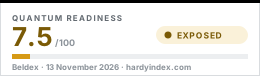
| Hardy Score | 7.5 | |||
Band 0: Classical signatures only on mainnet, with nothing post-quantum protecting live funds. Short-lived devnets and one-off benchmarks sit here: they demonstrate research rather than something a user can hold keys on.
Beldex's transaction code defines CLSAG ring signatures as the signature type for current RingCT transactions, inherited from Monero and built on the Ed25519 group. No post-quantum signature is available on mainnet in any form. source
Band 1: Tier 5: Exposed.
Tier 5: Exposed. The signatures protecting BDX are quantum-vulnerable, and no post-quantum proposal, roadmap or research programme was found in Beldex's repository or documentation. source
Band 0 to 2: No post-quantum scheme named for the chain’s fund-protecting signatures, or a proprietary scheme with no public cryptanalysis.
No post-quantum scheme has been named for Beldex's ring signatures, stealth addresses or master node keys, so there is nothing to assess against a NIST standard. source
Placement in the band The floor of the band rather than a 1 or a 2: no scheme has been named for Beldex at all, so there is nothing to assess, as distinct from something assessed and found wanting.
Band 0 to 2: No agreed migration path, or the proposals on the table would strand or freeze holder funds.
No migration path exists. Beldex has a record of scheduled hard forks on mainnet, including the move to proof of stake in 2021 and Bulletproofs+ in 2025, so it can enact consensus changes. Replacing ring signatures, stealth addresses and range proofs together would be a far larger change than any of those, and none has been proposed. source
Placement in the band At the top of the band rather than a 0 or a 1: the hard fork table shows Beldex shipping substantial consensus changes, including a change of consensus mechanism. It cannot reach 3 because migration has not been acknowledged as a problem by the project.
Band 0 to 2: Public keys are exposed for effectively all accounts, or a large, measured share of total supply sits in exposed addresses.
The same structure as Monero. Every output carries a one-time public key on the Ed25519 curve, so there is no unspent-and-unrevealed category, and a public address is itself two public keys, the spend key and the view key. A quantum break would also expose true inputs inside historical ring signatures. source
Placement in the band Not a 0, matching Monero: breaking Beldex still needs work against the ring signature and stealth address construction rather than simply reading a key off an address. Not a 2, because a one-time public key is published for every output.
Band 0 to 2: No post-quantum component exists, or the claims rest on marketing.
No post-quantum component protects Beldex, so there is nothing to verify. The Beldex client is open source and derives from Monero's reviewed codebase, but under v1.8 the openness of the classical code earns nothing here. source
Placement in the band The top of the band rather than a 0 or a 1: there is no post-quantum component to verify, but nothing about Beldex is marketed as quantum-safe that we found, so its position does not rest on marketing.
The deployment dimension is not a separate judgement. It is Tier 5 expressed as a number. See the tier mapping.
The 9 chains Beldex sits among, out of 80 rated. The last column is the gap in Hardy points from Beldex.
| Rank | Chain | Tier | Hardy | vs BDX |
|---|---|---|---|---|
| 72 | THORChain | 5: Exposed | 8.5 | +1.0 |
| 73 | VeChain | 5: Exposed | 8.5 | +1.0 |
| 74 | WEMIX | 5: Exposed | 8.5 | +1.0 |
| 75 | Whitechain | 5: Exposed | 8.5 | +1.0 |
| 76 | Beldex this chain | 5: Exposed | 7.5 | |
| 77 | Ozone Chain | 5: Exposed | 7.5 | level |
| 78 | Cronos | 5: Exposed | 7.0 | -0.5 |
| 79 | MemeCore | 5: Exposed | 7.0 | -0.5 |
| 80 | Hyperliquid | 5: Exposed | 5.5 | -2.0 |
Beldex mainnet begins with its own genesis block, using Monero's protocol rules from the start rather than Monero's ledger. source
A hard fork moves Beldex to proof of stake run by master nodes. Not post-quantum work, but evidence that Beldex can activate substantial consensus changes. source
No post-quantum roadmap, proposal or research programme for Beldex was found at the time of writing. source
No stated policy
No Beldex policy on outputs that never move to post-quantum keys has been published.
As of 22 October 2026. Published beside the score, not in it. Every chain's stance is compared on the commitments page.
Exposure measures how much of the chain's value already sits behind a public key that an attacker can record today and break later. This is the part of the threat that a future upgrade cannot undo.
Beldex began its own ledger in January 2019 with a genesis block different from Monero's, so it shares no transaction history with Monero and the exposure inheritance rule does not apply. Its exposure comes from structure instead, and the structure is Monero's. Every output carries a one-time public key on-chain, so the share of outputs with a key already visible is effectively all of them, and no hygiene a holder practises can avoid it. Because the ring signatures and their key images rest on the same curve, a quantum adversary could also go back through the recorded chain and pick out the true input of each ring, unmasking senders in transactions that were private when made. Moving funds later can restore custody but not privacy already spent.
What this rating means for you
Beldex runs quantum-vulnerable signatures with no published post-quantum plan that we could find. Nothing here is urgent today, and there is also nothing scheduled to change it.
Editorial guidance from the Hardy Index.
We will email you the day this rating moves, with the changelog note that explains why. Nothing else, and nothing in between.
No. Beldex's CLSAG ring signatures, stealth addresses and master node keys all rest on the Ed25519 curve, which a sufficiently large quantum computer breaks. No post-quantum scheme is deployed or proposed for Beldex.
Yes, for the same reason as Monero. The key images that make ring signatures linkable sit on the same curve, so a quantum adversary could work out which ring member was the true input and unmask the sender. The chain is permanent, so that break would reach back to transactions made before any quantum computer existed.
In principle. Beldex shares Monero's transaction design, so lattice-based replacements analysed in Monero's 2020 research programme would be relevant to it. Beldex has not said it will follow that work, and Monero itself has selected no scheme.
Of its code, not its ledger. Beldex's source carries Monero's copyright and its README calls it a private cryptocurrency based on Monero, but its mainnet started from its own genesis block in January 2019. No coins or history carried over from Monero. Much of what Beldex adds to Monero comes from Oxen: the README credits portions of the code to The Oxen Project, the master node list was renamed from service_node_list in 2019, and a 2021 commit renamed Oxen's Pulse and Blink files to Beldex's POS and Flash.
A rating is only true as of the day an editor last reviewed it, so both forms below carry that date and the methodology version, with the date its cited sources were last checked. If you are quoting the score, quote those too.
The Hardy Index (2026). Beldex: quantum readiness assessment. Hardy Score 7.5 of 100, Tier 5: Exposed. Methodology v1.8. Last reviewed 22 October 2026; sources checked 13 November 2026. https://hardyindex.com/chains/beldex
@misc{hardyindex_beldex_2026,
  author       = {{The Hardy Index}},
  title        = {Beldex: quantum readiness assessment},
  year         = {2026},
  howpublished = {\url{https://hardyindex.com/chains/beldex}},
  note         = {Hardy Score 7.5 of 100, Tier 5: Exposed. Methodology v1.8},
  urldate      = {2026-11-13}
}
The whole dataset is reusable under the terms on the about page. A machine-readable version of this page is at /chains/beldex.md.
This is a security-readiness assessment, not investment advice.