1 Signature scheme 0/10, weighted 30%
Band 0: Classical signatures only on mainnet, with nothing post-quantum protecting live funds. Short-lived devnets and one-off benchmarks sit here: they demonstrate research rather than something a user can hold keys on.
The Bitcoin SV node verifies spends with libsecp256k1's ECDSA, and the BSV Academy documentation states that BSV transactions use ECDSA on secp256k1. Mining is proof of work, so there are no validator signatures. Nothing post-quantum protects BSV on mainnet: a Lamport contract can be written in script, but no released wallet uses one.
source
2 Deployment stage 1/10, weighted 25%
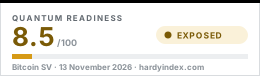
Band 1: Tier 5: Exposed.
Tier 5: Exposed. The signatures securing BSV are quantum-vulnerable, and neither the node repository nor the BSV Association's published material holds a post-quantum proposal, plan or research programme for them. BRC-220 names post-quantum schemes for notarising document hashes, which is not the chain's own signatures. See the caveat below on why this is a judgement call.
source
3 NIST alignment 0/10, weighted 15%
Band 0 to 2: No post-quantum scheme named for the chain’s fund-protecting signatures, or a proprietary scheme with no public cryptanalysis.
No post-quantum scheme has been named for the signatures that authorise BSV spends. BRC-220 lists ML-DSA under FIPS 204 and SLH-DSA under FIPS 205 as signature options for notarisation certificates anchored on BSV, a use that v1.8 places outside this dimension because it protects no funds.
source
Placement in the band The floor of the band rather than a 1 or a 2: nothing has been named for the fund-protecting signatures at all, and the one standard that names NIST schemes, BRC-220, applies them to document hashes rather than to spends.
4 Migration path 2/10, weighted 15%
Band 0 to 2: No agreed migration path, or the proposals on the table would strand or freeze holder funds.
No migration plan exists. Bitcoin SV has shown it can coordinate consensus changes: the Genesis upgrade activated at block 620,538 in February 2020, and the Chronicle hard fork, which restored further original opcodes, at block 943,816 on 7 April 2026. Neither touched the signature scheme, and the node repository describes its aim as restoring the original protocol and keeping it stable.
source
Placement in the band The top of the band rather than a 0 or a 1: two coordinated hard forks in six years, Chronicle among them in 2026, are direct evidence that the chain can ship protocol changes. Not a 3, because nobody with authority over the chain has acknowledged quantum migration as a problem to solve.
5 Exposure 2/10, weighted 10%
Band 0 to 2: Public keys are exposed for effectively all accounts, or a large, measured share of total supply sits in exposed addresses.
Under v1.8's inheritance rule, published measurements of the history Bitcoin SV shares with Bitcoin apply to it until one specific to Bitcoin SV exists. Its chain carries Bitcoin's blocks to August 2017 and Bitcoin Cash's to November 2018, including the original pay-to-public-key outputs that Deloitte puts at about 2 million coins, roughly a tenth of supply, with keys already on-chain.
source
Placement in the band The top of the band rather than a 1: the pre-fork pay-to-public-key share is the part inherited with certainty, while Deloitte's figure of 2.5 million coins in reused addresses was measured on Bitcoin's later history and does not transfer. Not a 3, because a measured tenth of supply with keys on-chain is a large share.
6 Verification 2/10, weighted 5%
Band 0 to 2: No post-quantum component exists, or the claims rest on marketing.
No post-quantum component protects BSV. The sCrypt Lamport contract is sample code in a boilerplate repository, not a released wallet or a deployed component, and BRC-220's post-quantum options sign documents rather than spends. Under v1.8 the openness of the classical node earns nothing here.
source
Placement in the band The top of the band rather than a 0 or a 1: there is no post-quantum component to verify, but nothing about Bitcoin SV is marketed as quantum-safe, so its position does not rest on marketing.