Hardy Index Quantum readiness, rated and tracked

Chain profile

Ozone Chain

OZO Exposed Claims unverified

Ozone Chain markets itself as a quantum-resistant blockchain, but its mainnet runs stock Hyperledger Besu, and accounts and validators sign with ECDSA on secp256k1; its post-quantum cryptography is described for links between nodes, not for the signatures that protect funds.

Is Ozone Chain quantum-safe?

No. Ozone Chain calls itself a "Quantum Resistant Blockchain" and says it "integrates stronger cryptographic solutions designed for quantum resistance", but the signatures that protect OZO are classical. The mainnet, chain ID 4000, runs an unmodified release of Hyperledger Besu, version 26.9.0, which the official node scripts download from the Besu project, with QBFT proof-of-authority consensus among four validators. Besu signs and verifies with ECDSA on secp256k1 unless a chain configures secp256r1, and Ozone's genesis configures neither, so accounts and validators both use secp256k1; a transaction read from the chain carries an ordinary EIP-155 v, r and s signature. A sufficiently large quantum computer running Shor's algorithm would break it. The quantum features Ozone describes sit elsewhere. Quantum random numbers from a laser source are written into each node's Linux entropy pool, which improves randomness but does nothing against Shor's algorithm. The post-quantum cryptography, CRYSTALS-Kyber in Ozone's whitepaper, is for "quantum tunnels" between nodes, which encrypt traffic rather than authorise spends, no code for them is published, and Ozone's own roadmap lists setting them up for Q1 2027. The only post-quantum signature item found is ORC-1001, a research-track row in Ozone's standards roadmap for application-layer verification in enterprise contracts, with no document, scheme or date.

Claims unverified This chain markets itself as quantum-safe, but no primary source confirms a post-quantum scheme protecting its funds. Its tier records what the evidence supports, not what the project claims. See the methodology.

Where we are making a judgement call The profile carries the Claims unverified flag. Ozone markets itself as quantum-resistant: its home page is titled "Quantum Resistant Blockchain" and describes the chain as the "World's first Quantum Resistant Blockchain", and a page of 5 September 2026 on digital signature risks says Ozone "integrates stronger cryptographic solutions designed for quantum resistance". No primary source confirms a post-quantum signature, and the node scripts, the genesis and a transaction read from the chain all show ECDSA on secp256k1, so the chain sits on the rung that evidence supports. Three judgement calls follow. The first is the tier. ORC-1001 appears in an improvement-proposal framework that Ozone runs, but it is a roadmap row with no proposal text, scheme or date, and it covers application-layer verification for enterprise contracts rather than the chain's own signatures; the website roadmap's "Exploring new post quantum signature schemes" names nothing. A reader who counts either as a formal proposal or a public research programme would put Ozone in Tier 4 and add 2.5 points. The second is migration: a reader who counts the October relaunch and Besu upgrades as a record of coordinated upgrades would score 2 and add 1.5 points. The third is scope. Ozone's validator guide calls it "a private blockchain network" whose nodes are "restricted to select nodes that is agreed to by Ozone Chain DAO", and the four validators are admitted through a permissions file in Ozone's repository that allows only four nodes, node1 to node4.ozonechain.io, so Ozone runs every validator. It is rated because it runs its own QBFT consensus and anyone can hold and send OZO through its public RPC and explorer, and it is in scope twice over: by its quantum-resistance claim, and by scale, sitting within the seventy-five largest layer 1s, 59th in CoinGecko's layer-1 category when read for this review; a reader who requires an open validator set would leave it out rather than score it differently. Two facts no score turns on. The chain served today began on 15 October 2026 from a genesis that gives the whole supply to one account, so anything held on the network before that date appears only as later transfers from that account. And whoever holds that account's ECDSA key controls about nine tenths of OZO, while Ozone runs every validator and controls admission to the set.

At a glance

On mainnet today

ECDSA on secp256k1 for accounts and for QBFT validator signatures, through stock Hyperledger Besu

Post-quantum scheme

None for signatures. CRYSTALS-Kyber (ML-KEM) is described for encrypted node-to-node "quantum tunnels", with no published code; ORC-1001 lists post-quantum signature verification as exploratory research.

NIST standard

None adopted for signatures. Kyber is standardised as ML-KEM in FIPS 203, a key-encapsulation standard.

Readiness tier

Tier 5: Exposed. The signatures securing funds on mainnet today are quantum-vulnerable, and no public post-quantum plan, proposal or research programme addressing them could be found.

Cryptography in use

  • Account signatures ECDSA on secp256k1 Mainnet, default Read through the mainnet RPC on 22 October 2026: a legacy transaction with r, s and an EIP-155 v of 0x1f64 for chain ID 4000. Read on-chain
  • Validator consensus ECDSA on secp256k1 Mainnet, mandatory QBFT genesis with no ecCurve setting, so Besu's default secp256k1 applies to the four validators' block seals. Source code or release

A role not listed is not evidenced either way. Every scheme, and which other chains share it, is in the cryptography registry.

Score breakdown

Each dimension scored 0 to 10. The weight beside it is its share of the total score.
Show the weighted arithmetic and the sourced note for each dimension
Ozone Hardy Score by dimension, with weights and weighted contributions
No. Dimension Score Weight Contribution
1 Signature scheme 0 30% 0.0
2 Deployment stage 1 25% 2.5
3 NIST alignment 1 15% 1.5
4 Migration path 1 15% 1.5
5 Exposure 2 10% 2.0
6 Verification 0 5% 0.0
Hardy Score 7.5

1 Signature scheme 0/10, weighted 30%

Band 0: Classical signatures only on mainnet, with nothing post-quantum protecting live funds. Short-lived devnets and one-off benchmarks sit here: they demonstrate research rather than something a user can hold keys on.

Ozone's mainnet runs the stock Besu 26.9.0 release, whose signature factory uses secp256k1 by default and offers only secp256r1 as an alternative; Ozone's genesis sets no curve. A mainnet transfer read on 22 October 2026 carries an EIP-155 ECDSA signature with v of 0x1f64, the value for chain ID 4000. Nothing post-quantum protects OZO. source

2 Deployment stage 1/10, weighted 25%

Band 1: Tier 5: Exposed.

Tier 5: Exposed. The signatures securing Ozone Chain are quantum-vulnerable. The one post-quantum signature item found, ORC-1001 in Ozone's standards roadmap, is a row marked "Exploratory research" with no proposal document, scheme or date, and it concerns application-layer verification for enterprise contracts rather than the chain's own signatures. See the caveat. source

3 NIST alignment 1/10, weighted 15%

Band 0 to 2: No post-quantum scheme named for the chain’s fund-protecting signatures, or a proprietary scheme with no public cryptanalysis.

No post-quantum scheme is named for Ozone's account or validator signatures. The whitepaper names CRYSTALS-Kyber, standardised as ML-KEM, for encrypted links between nodes, and mentions Dilithium only as the other half of the CRYSTALS suite. Kyber is a key-encapsulation mechanism and signs nothing. source

Placement in the band A 1 rather than a 0: Ozone's own whitepaper does name a NIST suite, and its roadmap twice lists exploring post-quantum signature schemes. Not a 2, because no scheme has been named for the signatures that protect funds, even as a candidate.

4 Migration path 1/10, weighted 15%

Band 0 to 2: No agreed migration path, or the proposals on the table would strand or freeze holder funds.

No migration path or published position exists for moving holders to post-quantum keys. Ozone runs all four validators, node1 to node4.ozonechain.io, and can change every node's software at once: the chain served today began producing blocks on 15 October 2026 from a genesis committed to Ozone's node repository that day. source

Placement in the band A 1 rather than a 2: the record is of restarts and maintenance pauses on a four-validator network, not of in-place protocol upgrades carried through a running chain's governance. Above a 0, because an operator that runs every validator can deploy a change quickly if it chooses to.

5 Exposure 2/10, weighted 10%

Band 0 to 2: Public keys are exposed for effectively all accounts, or a large, measured share of total supply sits in exposed addresses.

Ozone keeps Ethereum's account model, so an address is a hash of the key and an account that has never sent a transaction keeps its key private. Any account that has signed has published its key, and the genesis account, which held 896,139,189 of the 1,000,000,000 OZO supply on 22 October 2026, has sent three transactions. source

Placement in the band The top of the band rather than a 1: never-signed addresses keep their keys hidden, and no published measurement of the exposed share exists. Not a 3, because the single account holding about nine tenths of supply has already exposed its key.

6 Verification 0/10, weighted 5%

Band 0 to 2: No post-quantum component exists, or the claims rest on marketing.

No post-quantum component protects funds on Ozone Chain, and the quantum-resistance claim rests on marketing. The node repository contains Besu configuration and a quantum random number client and nothing post-quantum: the Kyber tunnels described in the whitepaper have no published code anywhere in Ozone's public repositories. source

Placement in the band The floor of the band rather than a 1 or a 2: the chain is marketed as quantum-resistant while the one post-quantum component it names is unpublished and, by its own roadmap, not yet set up. The TÜV and NIST SP 800-22 tests Ozone cites are of its random number source, which no quantum attack on signatures depends on.
The deployment dimension is not a separate judgement. It is Tier 5 expressed as a number. See the tier mapping.

How it compares

All 80 rated chains on the 0 to 100 scale. Ozone Chain is marked. Select any point to open that profile.
Hyperliquid, Hardy Score 5.5 Cronos, Hardy Score 7.0 MemeCore, Hardy Score 7.0 Beldex, Hardy Score 7.5 Ozone Chain, Hardy Score 7.5 0G, Hardy Score 8.5 AIOZ Network, Hardy Score 8.5 Akash Network, Hardy Score 8.5 Arweave, Hardy Score 8.5 Avalanche, Hardy Score 8.5 Bitcoin SV, Hardy Score 8.5 Celestia, Hardy Score 8.5 Chiliz Chain, Hardy Score 8.5 Conflux, Hardy Score 8.5 dYdX Chain, Hardy Score 8.5 eCash, Hardy Score 8.5 Filecoin, Hardy Score 8.5 GateChain, Hardy Score 8.5 Gnosis Chain, Hardy Score 8.5 Injective, Hardy Score 8.5 KCC (KuCoin Community Chain), Hardy Score 8.5 Kite, Hardy Score 8.5 Mina Protocol, Hardy Score 8.5 MultiversX, Hardy Score 8.5 Polygon PoS, Hardy Score 8.5 Provenance Blockchain, Hardy Score 8.5 Theta Network, Hardy Score 8.5 THORChain, Hardy Score 8.5 VeChain, Hardy Score 8.5 WEMIX, Hardy Score 8.5 Whitechain, Hardy Score 8.5 Dogecoin, Hardy Score 9.0 Kaia, Hardy Score 10.0 Vaulta, Hardy Score 10.0 Decred, Hardy Score 10.5 IOTA, Hardy Score 10.5 Litecoin, Hardy Score 10.5 Midnight, Hardy Score 10.5 Qtum, Hardy Score 10.5 TON, Hardy Score 11.0 Ethereum Classic, Hardy Score 13.0 Flare, Hardy Score 13.0 Internet Computer, Hardy Score 13.0 Bitcoin, Hardy Score 14.5 Sonic, Hardy Score 14.5 Terra Classic, Hardy Score 14.5 Dash, Hardy Score 16.5 Neo, Hardy Score 17.0 Monero, Hardy Score 17.5 Bittensor, Hardy Score 19.0 BNB Chain, Hardy Score 20.0 Monad, Hardy Score 20.0 XDC Network, Hardy Score 20.0 Kaspa, Hardy Score 20.5 Cosmos Hub, Hardy Score 23.5 Sei, Hardy Score 24.5 Cardano, Hardy Score 34.0 Tron, Hardy Score 34.5 Polkadot, Hardy Score 36.5 Tezos, Hardy Score 37.5 Zcash, Hardy Score 38.0 Ethereum, Hardy Score 38.5 Aptos, Hardy Score 39.0 Stellar, Hardy Score 39.0 Hedera, Hardy Score 39.5 Sui, Hardy Score 42.0 XRP Ledger, Hardy Score 43.0 Solana, Hardy Score 53.0 Bitcoin Cash, Hardy Score 62.0 Nexus, Hardy Score 73.0 Nervos CKB, Hardy Score 76.0 Algorand, Hardy Score 77.0 NEAR Protocol, Hardy Score 80.0 Abelian, Hardy Score 84.0 QoreChain, Hardy Score 84.5 Mochimo, Hardy Score 89.0 Tidecoin, Hardy Score 89.0 Quantum Resistant Ledger, Hardy Score 92.5 Dilithion, Hardy Score 93.5 Quantus Network, Hardy Score 94.0 Ozone 7.5

Nearest chains in the ranking

The 9 chains Ozone sits among, out of 80 rated. The last column is the gap in Hardy points from Ozone.

Chains ranked immediately around Ozone Chain, with tier, Hardy Score and the gap to Ozone Chain
Rank Chain Tier Hardy vs OZO
72 THORChain 5: Exposed 8.5 +1.0
73 VeChain 5: Exposed 8.5 +1.0
74 WEMIX 5: Exposed 8.5 +1.0
75 Whitechain 5: Exposed 8.5 +1.0
76 Beldex 5: Exposed 7.5 level
77 Ozone Chain this chain 5: Exposed 7.5
78 Cronos 5: Exposed 7.0 -0.5
79 MemeCore 5: Exposed 7.0 -0.5
80 Hyperliquid 5: Exposed 5.5 -2.0

Roadmap

  1. Q4 2025 and Q4 2026 proposed

    Ozone's roadmap lists "Exploring new post quantum signature schemes" in Q4 2025 and again in Q4 2026; in October 2026 it showed Q3 2025 and Q2 2026, and in June 2024 Q3 2024 and Q1 2025. No schemes, research output or proposal were found. source

  2. 25 August 2026 proposed

    Ozone publishes its ORC standards framework, whose roadmap carries ORC-1001, "Post-Quantum Signature Verification", on a research track for application-layer verification in enterprise contracts, with status "Exploratory research". source

  3. 15 October 2026 shipped

    The mainnet served by Ozone's published RPC begins producing blocks from a new genesis on Besu 26.9.0, with accounts and validators on ECDSA secp256k1. source

  4. Q1 2027 planned

    Ozone's roadmap lists "Setup Quantum Tunnels between the Nodes", the post-quantum encrypted links its whitepaper describes. These would protect traffic between nodes, not the signatures on funds. The roadmap first gave Q4 2024, a date it still showed in January 2026; by 11 March 2026 the item had moved to Q3 2026, by 21 May 2026 to Q4 2026, and by 4 November 2026 to Q1 2027. source

    Target Q1 2027, moved from Q4 2024, Q3 2026, Q4 2026. Open

If holders never migrate

No stated policy

Ozone has published nothing about moving accounts to post-quantum keys, and so nothing about accounts that never move.

As of 22 October 2026. Published beside the score, not in it. Every chain's stance is compared on the commitments page.

Exposure

Exposure measures how much of the chain's value already sits behind a public key that an attacker can record today and break later. This is the part of the threat that a future upgrade cannot undo.

Ozone Chain uses Ethereum's address model: an address is the last twenty bytes of the Keccak hash of the public key, so an account that has received OZO but never sent a transaction has not published its key, and the first signature publishes it permanently. Because Ozone accepts Ethereum keys and addresses, a key that has signed on any EVM chain is equally visible for the same address here. Supply is concentrated: on 22 October 2026 the genesis allocation account, 0x7A96Df3281b63be1DA2d802a6bb6919e1a98E39b, held 896,139,189 OZO of a total of 1,000,000,000, read from the explorer API, and its three outgoing transactions have published its key. The four validators sign every block seal, so their keys are public too. No measured share of exposed supply has been published by anyone.

What this rating means for you

If you hold Ozone

Ozone runs quantum-vulnerable signatures with no published post-quantum plan that we could find. Nothing here is urgent today, and there is also nothing scheduled to change it.

Editorial guidance from the Hardy Index.

Embed this rating

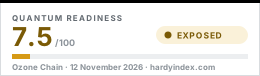
Paste this anywhere to show Ozone Chain's current rating. It renders live from the index, so it updates when the rating does, and the review date is written into the image. There is nothing to sign up for and nothing to pay.

<a href="https://hardyindex.com/chains/ozone"><img src="https://hardyindex.com/badge/ozone.svg" width="260" height="76" alt="Quantum readiness rated by the Hardy Index"></a>

The image is /badge/ozone.svg. It is a plain SVG with no script and no tracking, it sets no cookie, and it records nothing about whoever loads it.

Questions

Is Ozone Chain quantum-safe?

No. Ozone markets itself as quantum-resistant, but its accounts and validators sign with ECDSA on secp256k1 through stock Hyperledger Besu, and a sufficiently large quantum computer would break that. Its quantum random numbers and its planned post-quantum links between nodes do not change the signatures that protect OZO.

Do quantum random numbers make Ozone's keys quantum-resistant?

No. Ozone feeds random numbers from a laser-based quantum source into each node's Linux entropy pool. Better randomness prevents keys from being guessed by a classical attacker, but Shor's algorithm recovers an ECDSA private key from its public key however randomly the key was generated, so the quantum exposure is unchanged.

What does Ozone use post-quantum cryptography for?

For what its whitepaper calls quantum tunnels: links between nodes encrypted with CRYSTALS-Kyber, a key-encapsulation mechanism standardised as ML-KEM. That would protect traffic between nodes, not authorise spends. No code for the tunnels is published, and Ozone's roadmap lists setting them up between the nodes for Q1 2027.

Why does this profile carry the Claims unverified flag?

Because Ozone presents itself as quantum-resistant while no primary source confirms a post-quantum signature on its mainnet, and the evidence shows the live signature is ECDSA on secp256k1. The flag tells a reader that the tier records what the evidence supports, not what the project claims.

What would move Ozone Chain up the index?

A written proposal or a public research programme from Ozone on post-quantum signatures for its own accounts or validators would meet the Tier 4 floor, and a published plan naming the scheme would meet Tier 3. Code for a post-quantum signature check on an Ozone test network would also lift the NIST alignment and verification scores.

Sources

  1. Ozone Chain: Quantum Resistant Blockchain Ozone Chain · primary · checked 22 October 2026
  2. Digital Signature Risks Ozone Chain · primary · checked 22 October 2026
  3. Post Quantum Cryptography Ozone Chain · primary · checked 22 October 2026
  4. Mainnet Ozone Chain · primary · checked 22 October 2026
  5. Roadmap Ozone Chain · primary · checked 22 October 2026
  6. Roadmap (Wayback Machine snapshot, 15 June 2024) Ozone Chain (Internet Archive) · primary · checked 22 October 2026
  7. Roadmap (Wayback Machine snapshot, 11 March 2026) Ozone Chain (Internet Archive) · primary · checked 22 October 2026
  8. Roadmap (Wayback Machine snapshot, 21 May 2026) Ozone Chain (Internet Archive) · primary · checked 22 October 2026
  9. Validator Node Ozone Chain · primary · checked 22 October 2026
  10. Standards compliant Ozone Chain · primary · checked 22 October 2026
  11. Ozone Chain Whitepaper: Quantum Tunnels Ozone Chain · primary · checked 22 October 2026
  12. Ozone Chain Whitepaper: Blockchain Internals Ozone Chain · primary · checked 22 October 2026
  13. ozonechain_quantum node repository Ozone Chain (GitHub) · primary · checked 22 October 2026
  14. Mainnet genesis (ozonechain/config/genesis.json) Ozone Chain (GitHub) · primary · checked 22 October 2026
  15. Node permissions (ozonechain/config/permissions_config.toml) Ozone Chain (GitHub) · primary · checked 22 October 2026
  16. Node installation script (run-3.sh) Ozone Chain (GitHub) · primary · checked 22 October 2026
  17. Quantum random number client (quantum/qrn_code/main.py) Ozone Chain (GitHub) · primary · checked 22 October 2026
  18. ORC Standards Roadmap Ozone Chain (GitHub) · primary · checked 22 October 2026
  19. Besu signature algorithm factory (SignatureAlgorithmFactory.java) Besu (GitHub) · primary · checked 22 October 2026
  20. Ozone Chain mainnet transaction 0x004c3bb6 Ozone Scan · primary · checked 22 October 2026
  21. Genesis account balance (Ozone Scan API) Ozone Scan · primary · checked 22 October 2026
  22. FIPS 203: Module-Lattice-Based Key-Encapsulation Mechanism Standard (ML-KEM) NIST · primary · checked 22 October 2026
  23. Layer 1 (L1) category CoinGecko · secondary · checked 22 October 2026
Cite this rating

A rating is only true as of the day an editor last reviewed it, so both forms below carry that date and the methodology version, with the date its cited sources were last checked. If you are quoting the score, quote those too.

Plain text

The Hardy Index (2026). Ozone Chain: quantum readiness assessment. Hardy Score 7.5 of 100, Tier 5: Exposed. Methodology v1.8. Last reviewed 4 November 2026; sources checked 12 November 2026. https://hardyindex.com/chains/ozone

BibTeX
@misc{hardyindex_ozone_2026,
  author       = {{The Hardy Index}},
  title        = {Ozone Chain: quantum readiness assessment},
  year         = {2026},
  howpublished = {\url{https://hardyindex.com/chains/ozone}},
  note         = {Hardy Score 7.5 of 100, Tier 5: Exposed. Methodology v1.8},
  urldate      = {2026-11-12}
}

The whole dataset is reusable under the terms on the about page. A machine-readable version of this page is at /chains/ozone.md.

This is a security-readiness assessment, not investment advice.