1 Signature scheme 0/10, weighted 30%
Band 0: Classical signatures only on mainnet, with nothing post-quantum protecting live funds. Short-lived devnets and one-off benchmarks sit here: they demonstrate research rather than something a user can hold keys on.
Nothing post-quantum protects funds or state. The documentation names BLS for consensus, response certification, cross-subnet messaging and randomness, and threshold ECDSA over secp256k1 plus threshold Schnorr over bip340secp256k1 and ed25519 for chain-key signatures. User identities sign with Ed25519 or ECDSA. Every scheme in use falls to Shor's algorithm.
source
2 Deployment stage 1/10, weighted 25%
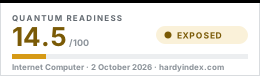
Band 1: Tier 5: Exposed.
Tier 5: Exposed. The signatures securing mainnet are quantum-vulnerable throughout, and the only published position is a forum answer rather than a formal proposal or a research programme. See the caveat below on what that finding does and does not establish.
source
3 NIST alignment 0/10, weighted 15%
Band 0 to 2: No named post-quantum scheme, or a proprietary scheme with no public cryptanalysis.
No post-quantum scheme has been named or selected for any layer of the protocol, so there is nothing to assess against a NIST standard. The chain-key documentation names its curves precisely and none of them is post-quantum.
source
Placement in the band The floor of the band rather than a 1 or a 2, because no candidate has been named at all. Naming a scheme and declining to adopt it would sit higher than this; ICP has not reached the point of naming one.
4 Migration path 3/10, weighted 15%
Band 3 to 5: Migration is acknowledged as a problem with no agreed mechanism, or the mechanism is contested.
The problem is acknowledged by someone with authority and no mechanism exists. DFINITY's chief scientist has cited crypto agility and said replacement algorithms would be proposed to the NNS at the appropriate time, while also noting that the Internet Computer's public key would need to change. That last point is the hard part: clients verify responses against a root key they hold, so rotating it reaches beyond the network into everything that has ever embedded it.
source
Placement in the band At the floor of the band rather than a 4 or a 5, because acknowledgement is all there is. No mechanism has been designed, no NNS proposal has been raised, and the one structural obstacle that has been named publicly, changing the root key, has had no solution offered for it.
5 Exposure 5/10, weighted 10%
Band 3 to 5: Most active accounts have revealed a public key, or the chain has no live supply to assess.
Ledger accounts are identifiers derived by hashing, and a self-authenticating principal is itself a hash of a public key, so an account that has never transacted does not publish the key protecting it. Signing reveals it. Separately and unavoidably, the subnet public keys are published by design, because verifying a certified response without trusting a node is the entire point of the architecture.
source
Placement in the band At the top of the band rather than a 4 or a 3, because the hashed principal genuinely protects a never-used account, which is more than chains at the floor of this band offer. It cannot rise into the band above, because the subnet keys that certify all state are public by construction and cannot be withheld without breaking the design.
6 Verification 5/10, weighted 5%
Band 3 to 5: Some independent verification exists, but the headline quantum-safety claim itself is not verified.
The cryptography is documented to the curve and the variant, the implementation is open source, and the chain-key design has been described in public research. That makes the current position checkable. There is no post-quantum claim to verify, and no published position beyond a forum answer to hold against future statements.
source
Placement in the band At the top of the band rather than a 4 or a 3, because the schemes in use are named precisely enough to be audited by a reader. It cannot reach the band above, which credits verification of a post-quantum claim, and ICP has made none.