22 September 2025 shipped
0G announces that its "long-awaited Aristotle Mainnet is now live". The chain's first block, read from the mainnet RPC, is dated 23 August 2025. Accounts sign with ECDSA on secp256k1. source
Chain profile
0G Chain, an EVM-compatible layer 1 built for AI applications, signs accounts with ECDSA on secp256k1 and its validators sign consensus votes with BLS12-381 keys, and no post-quantum plan, proposal or research programme for its signatures could be found.
No. 0G Chain is an EVM-compatible layer 1 built for AI applications, alongside 0G's storage and data-availability networks. Its mainnet, Aristotle, launched in September 2025 with EVM chain ID 16661. The chain separates consensus from execution: 0G's documentation describes "a highly optimized version of CometBFT (formerly Tendermint)" run by the 0gchaind consensus client, with blocks executed by 0G's forks of go-ethereum or reth. Accounts sign transactions with ECDSA on the secp256k1 curve, recovered by the go-ethereum signer in 0g-geth, and validators sign CometBFT consensus votes with BLS12-381 keys, the only validator key type the mainnet genesis file in 0G's Aristotle release allows. A sufficiently large quantum computer running Shor's algorithm would break both. We found no post-quantum position from 0G: no proposal, roadmap, named scheme or research programme for the chain's signatures in its documentation, its blog or its public repositories.
Where we are making a judgement call Two judgement calls. The first concerns scope rather than score, and follows the reasoning applied to Polygon PoS. 0G Chain is rated as a layer 1 because its own validators run its own CometBFT consensus and sign its blocks, on a mainnet with its own state and its own chain ID. One feature cuts the other way: 0G's validator guide says stake held in Symbiotic contracts on Ethereum also takes part in 0G's consensus, and that validators must read Ethereum contract state to generate and verify blocks. A reader who treats that as 0G being secured partly by Ethereum would leave it out of the index rather than score it differently: every signature this profile scores is 0G's own, and each is classical. The second is the migration score of 2, which rests on four scheduled hard forks carried on the live mainnet between October 2025 and June 2026. A reader who weighs that record at nothing while 0G has no quantum plan would score migration 1 and lower the Hardy Score from 8.5 to 7.0. The tier itself is not a judgement call: nothing post-quantum on the chain's signatures was found from 0G, so no reading of the record lifts it to Tier 4. A limit on the evidence: the validator scheme is read from the genesis file in 0G's mainnet release, which sets BLS12-381 as the only validator key type, because the 0gchaind consensus client is published as a binary without source. Genesis sets the initial parameters, and an upgrade could change them. A note on the trust model, which no score turns on: read with eth_call on 22 October 2026, the staking contract at 0xea224dBB52F57752044c0C86aD50930091F561B9, through which validators are created and stake is delegated, is a beacon proxy whose beacon at 0x0e9cc1be1060e3dd036f16977a186a8185acc513 is owned by 0x7a0cceb3b172ec11eaff88715ef7246a1abbb4d2, an account with no contract code. A single ECDSA key can therefore replace the staking contract's code.
ECDSA on secp256k1 for accounts; BLS12-381 for validator consensus votes
None. No post-quantum scheme has been proposed, selected or tested for 0G Chain.
None adopted.
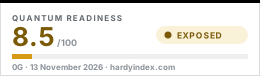
Tier 5: Exposed. The signatures securing funds on mainnet today are quantum-vulnerable, and no public post-quantum plan, proposal or research programme addressing them could be found.
A role not listed is not evidenced either way. Every scheme, and which other chains share it, is in the cryptography registry.
| No. | Dimension | Score | Weight | Contribution |
|---|---|---|---|---|
| 1 | Signature scheme | 0 | 30% | 0.0 |
| 2 | Deployment stage | 1 | 25% | 2.5 |
| 3 | NIST alignment | 0 | 15% | 0.0 |
| 4 | Migration path | 2 | 15% | 3.0 |
| 5 | Exposure | 2 | 10% | 2.0 |
| 6 | Verification | 2 | 5% | 1.0 |
| Hardy Score | 8.5 | |||
Band 0: Classical signatures only on mainnet, with nothing post-quantum protecting live funds. Short-lived devnets and one-off benchmarks sit here: they demonstrate research rather than something a user can hold keys on.
0G transactions are Ethereum transactions: 0g-geth, one of the chain's two execution clients, recovers each sender from an ECDSA signature on secp256k1, and mainnet transactions read on 22 October 2026 carried EIP-155 signatures for chain ID 16661. Validators sign CometBFT consensus votes with BLS12-381 keys: the genesis file in 0G's Aristotle v1.0.8 release sets bls12_381 as the only validator key type. Nothing post-quantum protects 0G or any asset on 0G Chain. source
Band 1: Tier 5: Exposed.
Tier 5: Exposed. The signatures protecting funds and the BLS12-381 keys validators sign consensus votes with are quantum-vulnerable, and no 0G proposal, roadmap, publication or research programme on post-quantum signatures was found in its documentation, its blog or its public repositories. source
Band 0 to 2: No post-quantum scheme named for the chain’s fund-protecting signatures, or a proprietary scheme with no public cryptanalysis.
No post-quantum scheme has been named for 0G Chain's account or validator signatures, so there is nothing to assess against a NIST standard. source
Placement in the band The floor of the band rather than a 1 or a 2: no scheme has been named at all, even as an example, by anyone with authority over 0G Chain, so there is no choice to align with a standard.
Band 0 to 2: No agreed migration path, or the proposals on the table would strand or freeze holder funds.
No migration plan or published position exists. 0G does carry coordinated upgrades on its live mainnet: four hard forks since launch, activated on 30 October 2025 (release 1.0.2), 20 November 2025 (1.0.3), 28 January 2026 (1.0.4) and 26 June 2026 (v1.0.6, the Slashing fork). The last required every node operator to upgrade both the consensus and execution clients, and changed the block layout and added on-chain slashing. That is the route a new signature check would also need. source
Placement in the band The top of the band rather than a 0 or a 1: 0G has scheduled and carried four hard forks on its live mainnet in its first year, which shows its operators can deliver coordinated protocol changes. Not a 3, because 0G has not acknowledged the quantum problem in public, let alone described a route for holders.
Band 0 to 2: Public keys are exposed for effectively all accounts, or a large, measured share of total supply sits in exposed addresses.
0G Chain keeps Ethereum's account model: an address is a hash of the public key, so an account that has never signed keeps its key private. Every account that has sent a transaction has published its key, and because 0G accepts the same keys and addresses as Ethereum, a key published on any EVM chain exposes the same address on 0G. Validator BLS keys are public by design. source
Placement in the band The top of the band rather than a 1: never-signed addresses keep their keys hidden. Not a 3, because almost all economically active 0G sits behind a key that has signed, on 0G Chain or on another EVM chain, and no measurement of the unexposed share has been published.
Band 0 to 2: No post-quantum component exists, or the claims rest on marketing.
No post-quantum component exists for 0G Chain: no code, specification or testnet implementation was found in its documentation or its public repositories. The execution clients are open source, but the mainnet release repository publishes the 0gchaind consensus client as a binary only. Under v1.8 neither fact moves this score, which verifies the post-quantum component that protects funds. source
Placement in the band The top of the band rather than a 0 or a 1: there is nothing post-quantum to verify, but 0G does not market the chain as quantum-safe, so its position does not rest on marketing.
The deployment dimension is not a separate judgement. It is Tier 5 expressed as a number. See the tier mapping.
The 9 chains 0G sits among, out of 80 rated. The last column is the gap in Hardy points from 0G.
| Rank | Chain | Tier | Hardy | vs 0G |
|---|---|---|---|---|
| 46 | Qtum | 5: Exposed | 10.5 | +2.0 |
| 47 | Kaia | 5: Exposed | 10.0 | +1.5 |
| 48 | Vaulta | 5: Exposed | 10.0 | +1.5 |
| 49 | Dogecoin | 5: Exposed | 9.0 | +0.5 |
| 50 | 0G this chain | 5: Exposed | 8.5 | |
| 51 | AIOZ Network | 5: Exposed | 8.5 | level |
| 52 | Akash Network | 5: Exposed | 8.5 | level |
| 53 | Arweave | 5: Exposed | 8.5 | level |
| 54 | Avalanche | 5: Exposed | 8.5 | level |
0G announces that its "long-awaited Aristotle Mainnet is now live". The chain's first block, read from the mainnet RPC, is dated 23 August 2025. Accounts sign with ECDSA on secp256k1. source
The first hard fork on Aristotle mainnet activates, delivered by release 1.0.2, which added block and miner rewards. Further hard forks followed on 20 November 2025 (1.0.3) and 28 January 2026 (1.0.4). None changed a signature scheme. source
The Slashing fork activates on Aristotle mainnet, delivered by release v1.0.6, which every node operator had to install for both clients. It is the fourth hard fork since launch, adds double-sign slashing and changes no signature scheme. source
No post-quantum proposal, roadmap, research programme or testnet implementation for 0G Chain's signatures was found from 0G at the time of writing. source
No stated policy
0G has published nothing about post-quantum migration, so nothing has been said about accounts that never move to post-quantum keys.
As of 22 October 2026. Published beside the score, not in it. Every chain's stance is compared on the commitments page.
Exposure measures how much of the chain's value already sits behind a public key that an attacker can record today and break later. This is the part of the threat that a future upgrade cannot undo.
0G Chain uses Ethereum's address model: an address is the last twenty bytes of the Keccak hash of the public key, so an account that has received 0G but never sent a transaction has not published its key. The first signature publishes it permanently. Because 0G accepts the same keys and addresses as Ethereum, a holder who has signed with the same key on Ethereum or any other EVM chain has a published key on 0G too, even if the 0G account has never sent a transaction. Validators register their BLS public keys in the staking contract, where they are public by design. No measurement of the exposed share of 0G's supply has been published, so the score rests on the address model.
What this rating means for you
0G runs quantum-vulnerable signatures with no published post-quantum plan that we could find. Nothing here is urgent today, and there is also nothing scheduled to change it.
Editorial guidance from the Hardy Index.
We will email you the day this rating moves, with the changelog note that explains why. Nothing else, and nothing in between.
No. 0G Chain accounts sign with ECDSA on secp256k1 and its validators sign consensus votes with BLS12-381 keys, and a sufficiently large quantum computer would break both. 0G has published no post-quantum plan, proposal or research programme.
Two layers. The 0gchaind consensus client runs what 0G's documentation calls a highly optimised version of CometBFT, and an execution client, 0G's fork of go-ethereum or of reth, runs the EVM. Transactions are ordinary Ethereum transactions signed with secp256k1 keys, on chain ID 16661.
For almost all 0G in use, yes. A 0G address is a hash of the key and hides it until the account signs, but active accounts have signed, and a key that has signed on Ethereum or any other EVM chain is equally visible for the same address on 0G. Those keys can be recorded now and attacked later.
A published proposal or a public research programme by 0G on post-quantum signatures for its accounts or validators would meet the Tier 4 floor. A plan from 0G naming the scheme it will adopt would meet Tier 3. A post-quantum signature check on a 0G test network would also lift the verification and NIST alignment scores.
A rating is only true as of the day an editor last reviewed it, so both forms below carry that date and the methodology version, with the date its cited sources were last checked. If you are quoting the score, quote those too.
The Hardy Index (2026). 0G: quantum readiness assessment. Hardy Score 8.5 of 100, Tier 5: Exposed. Methodology v1.8. Last reviewed 22 October 2026; sources checked 13 November 2026. https://hardyindex.com/chains/0g
@misc{hardyindex_0g_2026,
  author       = {{The Hardy Index}},
  title        = {0G: quantum readiness assessment},
  year         = {2026},
  howpublished = {\url{https://hardyindex.com/chains/0g}},
  note         = {Hardy Score 8.5 of 100, Tier 5: Exposed. Methodology v1.8},
  urldate      = {2026-11-13}
}
The whole dataset is reusable under the terms on the about page. A machine-readable version of this page is at /chains/0g.md.
This is a security-readiness assessment, not investment advice.