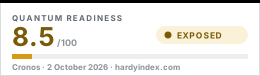
No published position proposed
No post-quantum roadmap, improvement proposal, research programme or testnet implementation from Cronos Labs or Crypto.com was found at the time of writing. source
Chain profile
An Ethereum-compatible chain on the Cosmos SDK, signing with ECDSA on secp256k1 at both layers, with no published post-quantum position from Cronos Labs or Crypto.com.
No. Cronos is an Ethereum Virtual Machine chain built on the Cosmos SDK through Ethermint, which means it inherits two quantum-vulnerable signature schemes rather than one: ECDSA on secp256k1 for Ethereum-style accounts and transactions, and the Cosmos SDK's secp256k1 for native accounts, with Ed25519 for validator consensus identities. Shor's algorithm breaks all of them. We found no post-quantum roadmap, improvement proposal, research programme or testnet implementation published by Cronos Labs or by Crypto.com, despite the chain being one of the larger layer 1s by market capitalisation and sitting alongside a regulated exchange business that has its own compliance timelines to meet. That absence is the finding. Cronos is in this index because it is inside the top twenty-five layer 1s by size, and a chain of that scale with no published position is exactly the kind of row a ranking by market value alone would leave unexamined.
Where we are making a judgement call Our finding is that we could not locate a published post-quantum position, not that we have confirmed none exists. Tier 5 records quantum-vulnerable signatures alongside the absence of a plan we could find. The rung speaks to disclosed readiness and to nothing else, and it is not a judgement on Cronos as a network or on the business alongside it. If Cronos Labs or Crypto.com has published a position, the primary source is the fastest way to correct this profile.
ECDSA on secp256k1 for EVM accounts, Cosmos SDK secp256k1 for native accounts, Ed25519 for validator consensus identities
None. No scheme has been named or proposed.
None adopted and none named as a candidate.
Tier 5: Exposed. The signatures securing funds on mainnet today are quantum-vulnerable, and no public post-quantum plan, proposal or research programme addressing them could be found.
| No. | Dimension | Score | Weight | Contribution |
|---|---|---|---|---|
| 1 | Signature scheme | 0 | 30% | 0.0 |
| 2 | Deployment stage | 1 | 25% | 2.5 |
| 3 | NIST alignment | 0 | 15% | 0.0 |
| 4 | Migration path | 1 | 15% | 1.5 |
| 5 | Exposure | 2 | 10% | 2.0 |
| 6 | Verification | 5 | 5% | 2.5 |
| Hardy Score | 8.5 | |||
Band 0: Classical signatures only on mainnet, with nothing post-quantum protecting live funds. Short-lived devnets and one-off benchmarks sit here: they demonstrate research rather than something a user can hold keys on.
Cronos runs the Ethereum Virtual Machine on the Cosmos SDK via Ethermint, so accounts are secured by ECDSA on secp256k1 in the Ethereum style, with the Cosmos SDK's own secp256k1 for native accounts and Ed25519 for validator identities. Nothing post-quantum protects funds at either layer. source
Band 1: Tier 5: Exposed.
Tier 5: Exposed. The signatures securing mainnet balances are quantum-vulnerable and we found no roadmap, improvement proposal, research programme or testnet implementation from Cronos Labs or Crypto.com. See the caveat below on what that finding does and does not establish. source
Band 0 to 2: No named post-quantum scheme, or a proprietary scheme with no public cryptanalysis.
No post-quantum scheme has been named or selected at protocol level, so there is nothing to assess against a NIST standard. source
Placement in the band The floor of the band rather than a 1 or a 2, because no candidate scheme has been named at all. A chain that had named an algorithm and then declined to adopt it would sit above this.
Band 0 to 2: No agreed migration path, or the proposals on the table would strand or freeze holder funds.
No migration plan, mechanism or published position was found. Cosmos SDK chains can in principle add a signature algorithm through a coordinated upgrade, which is a lighter governance burden than a Bitcoin-style soft fork, but nothing has been proposed to put through it and no account-migration route for existing holders has been described. source
Placement in the band A 1 rather than a 0, because the Cosmos SDK upgrade path is a real mechanism a proposal could use, which chains at the true floor of this band lack. It cannot reach a 3 or above, because that requires the problem to be acknowledged publicly and Cronos has not acknowledged it.
Band 0 to 2: Public keys are exposed for effectively all accounts, or a large, measured share of total supply sits in exposed addresses.
Ethereum-style addresses are hashes of public keys, so a funded address that has never signed keeps its key private, and Cosmos-style bech32 addresses on this chain are likewise derived by hashing. In practice an EVM chain used for trading and DeFi sees essentially every account of consequence sign repeatedly, so the key protecting almost all live value is already on-chain. source
Placement in the band At the top of the band rather than a 1 or a 0, because the hashed address does protect a never-signed account in principle, which chains that publish the key at creation cannot offer. It stays in this band because on a chain of this type nearly every account with a meaningful balance has signed, and no measured share of unexposed supply has been published.
Band 3 to 5: Some independent verification exists, but the headline quantum-safety claim itself is not verified.
The node implementation is open source and the chain's architecture is documented, so the current cryptographic position is checkable. There is no post-quantum claim to verify, and no published position to hold against future statements. source
Placement in the band At the top of the band rather than a 4 or a 3, because the implementation is public and the schemes follow documented Ethereum and Cosmos standards. It cannot reach the band above, which credits verification of a post-quantum claim, and Cronos has made none.
The deployment dimension is not a separate judgement. It is Tier 5 expressed as a number. See the tier mapping.
The 9 chains Cronos sits among, out of 31 rated. The last column is the gap in Hardy points from Cronos.
| Rank | Chain | Tier | Hardy | vs CRO |
|---|---|---|---|---|
| 23 | Internet Computer | 5: Exposed | 14.5 | +6.0 |
| 24 | TON | 5: Exposed | 13.0 | +4.5 |
| 25 | Litecoin | 5: Exposed | 12.5 | +4.0 |
| 26 | Bittensor | 5: Exposed | 11.0 | +2.5 |
| 27 | Dogecoin | 5: Exposed | 11.0 | +2.5 |
| 28 | Avalanche | 5: Exposed | 10.5 | +2.0 |
| 29 | Cronos this chain | 5: Exposed | 8.5 | |
| 30 | MemeCore | 5: Exposed | 8.5 | level |
| 31 | Hyperliquid | 5: Exposed | 7.0 | -1.5 |
No post-quantum roadmap, improvement proposal, research programme or testnet implementation from Cronos Labs or Crypto.com was found at the time of writing. source
Exposure measures how much of the chain's value already sits behind a public key that an attacker can record today and break later. This is the part of the threat that a future upgrade cannot undo.
Cronos carries the standard exposure profile of an Ethereum-compatible chain, which is better in theory than in practice. Addresses at both layers are derived by hashing rather than by publishing the key, so an account that has received funds and never signed keeps its public key off-chain and is not harvestable today. That protection ends at the first outbound transaction, and on a chain whose purpose is exchange-adjacent trading and DeFi, almost every account holding meaningful value has signed many times. Nobody has published a measurement of exposed supply for Cronos, so this profile scores the address model rather than a count, which is a limitation this rubric states openly. The realistic reading is that the large majority of live value on the chain sits behind a key that is already recorded.
What this rating means for you
Cronos runs quantum-vulnerable signatures with no published post-quantum plan that we could find. Nothing here is urgent today, and there is also nothing scheduled to change it.
Editorial guidance from the Hardy Index. Nothing on this profile is sponsored and nothing on it is an affiliate link. The guides carry disclosed affiliate links, which never affect a rating. How we make money.
From the newsroom
We will email you the day this rating moves, with the changelog note that explains why. Nothing else, and nothing in between.
No. Cronos signs with ECDSA on secp256k1 for its Ethereum-compatible accounts and with the Cosmos SDK's secp256k1 for native accounts, with Ed25519 for validator identities. Shor's algorithm breaks all of them. No post-quantum scheme has been named or proposed, and we found no roadmap or research programme from Cronos Labs or Crypto.com.
No. Cronos is built with the Cosmos SDK and runs the Ethereum Virtual Machine, but neither relationship transfers a post-quantum upgrade automatically. Ethereum's post-quantum roadmap governs Ethereum's own consensus and execution layers, not other chains running the same virtual machine, and the Cosmos Hub has no adopted post-quantum proposal to inherit in the first place. A chain has to make and ship the change itself.
Because coverage is decided by a published rule, and one of its three tests is scale: a chain inside the twenty-five largest layer 1s by market capitalisation is assessed whether or not it has said anything. Market value decides who gets assessed and never how they score. A large chain with no published position is one of the more informative rows in the index, because the absence is itself the finding.
Technically lighter than for Bitcoin, and unplanned. Cosmos SDK chains can add a signature algorithm through a coordinated upgrade rather than a contentious soft fork, so the governance obstacle is smaller. Nothing has been proposed to put through that mechanism, and no route has been described for moving existing holders to new keys, which is the harder half of any migration.
A rating is only true as of the day it was reviewed, so both forms below carry the review date and the methodology version. If you are quoting the score, quote those too.
The Hardy Index (2026). Cronos: quantum readiness assessment. Hardy Score 8.5 of 100, Tier 5: Exposed. Methodology v1.4. Reviewed 2 October 2026. https://hardyindex.com/chains/cronos
@misc{hardyindex_cronos_2026,
  author       = {{The Hardy Index}},
  title        = {Cronos: quantum readiness assessment},
  year         = {2026},
  howpublished = {\url{https://hardyindex.com/chains/cronos}},
  note         = {Hardy Score 8.5 of 100, Tier 5: Exposed. Methodology v1.4},
  urldate      = {2026-10-02}
}
The whole dataset is reusable under the terms on the about page. A machine-readable version of this page is at /chains/cronos.md.
This is a security-readiness assessment, not investment advice.