17 October 2018 shipped
Neo Global Development announces a research partnership with Arqit to accelerate NeoQS, a lattice-based cryptographic mechanism. Nothing from NeoQS was deployed. source
Chain profile
Neo N3 signs accounts and consensus with ECDSA on secp256r1, and post-quantum signatures are an open research item on the Neo 4 milestone with no scheme selected and no date.
No. Neo N3 accounts and the dBFT consensus committee sign with ECDSA on the secp256r1 curve, also known as P-256, and smart contracts can also check secp256k1 signatures through the native CryptoLib contract. A sufficiently large quantum computer would break both. Post-quantum work on Neo is at the research stage. Co-founder Erik Zhang's Neo 4 roadmap, opened in September 2025, lists research and integration of quantum-resistant primitives, and an open issue in the core repository, filed on the Neo 4.0 milestone, sets out the tasks: compare Dilithium and Falcon, define an upgrade path, prototype and draft a Neo Enhancement Proposal. Developers have discussed ML-DSA and Falcon-512, and a pull request adding ML-DSA-65 was closed unmerged after Erik Zhang said the solution had to be finalised before any code. No scheme has been selected, no proposal has been drafted and no date has been published. NeoQS, a lattice-based research project announced in 2018, was never deployed.
Where we are making a judgement call Tier 4 rests on reading a tracked issue in the core repository, filed on the Neo 4.0 milestone and referenced from co-founder Erik Zhang's roadmap, as a public research programme by people with authority over the chain. It is not a formal Neo Enhancement Proposal, and none has been drafted. A reader who requires a formal proposal would place Neo in Tier 5, with a deployment score of 1 and a Hardy Score of 14.5 instead of 17.0. Separately, verification scores 2 because Neo does not market itself as quantum-safe today; a reader who counts the 2018 NeoQS announcements as quantum-safety marketing would score it 1, which lowers the Hardy Score by 0.5.
ECDSA on secp256r1 (P-256) for accounts and dBFT consensus; contracts can also verify secp256k1 signatures through CryptoLib
None selected. Dilithium (ML-DSA) and Falcon are research candidates in the Neo 4 issue, and an ML-DSA-65 pull request was closed unmerged.
None adopted
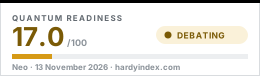
Tier 4: Debating. Post-quantum work on the chain’s own signatures is documented by people with authority over it, in a formal improvement proposal or a public research programme, but no scheme is agreed and no timeline is published.
A role not listed is not evidenced either way. Every scheme, and which other chains share it, is in the cryptography registry.
| No. | Dimension | Score | Weight | Contribution |
|---|---|---|---|---|
| 1 | Signature scheme | 0 | 30% | 0.0 |
| 2 | Deployment stage | 2 | 25% | 5.0 |
| 3 | NIST alignment | 3 | 15% | 4.5 |
| 4 | Migration path | 3 | 15% | 4.5 |
| 5 | Exposure | 2 | 10% | 2.0 |
| 6 | Verification | 2 | 5% | 1.0 |
| Hardy Score | 17.0 | |||
Band 0: Classical signatures only on mainnet, with nothing post-quantum protecting live funds. Short-lived devnets and one-off benchmarks sit here: they demonstrate research rather than something a user can hold keys on.
Neo N3's System.Crypto.CheckSig, which standard accounts use, verifies ECDSA on secp256r1, and multi-signature checks use the same curve. No post-quantum signature is implemented on mainnet or on any test network. source
Band 2: Tier 4: Debating.
Tier 4: Debating. Post-quantum cryptography is a tracked research item on the Neo 4.0 milestone in the core repository, opened by a neo-project member and referenced from co-founder Erik Zhang's Neo 4 roadmap. It is not Tier 3: neither names a scheme, and no plan or proposal has been adopted. source
Band 3 to 5: NIST schemes are referenced as candidates without a committed selection, or the work is bespoke research.
The research issue names NIST schemes as candidates, Dilithium and Falcon, and the discussion has weighed ML-DSA against Falcon-512 without a decision. A pull request adding ML-DSA-65 was closed unmerged. source
Placement in the band The bottom of the band rather than a 4 or a 5: the candidates are NIST schemes, but the Falcon-512 recommendation and the ML-DSA-65 pull request came from the same contributor, Wi1l-B0t, and members have leaned without deciding, with vncoelho calling Dilithium "a first good start" and raising Falcon's floating-point arithmetic, and Erik Zhang pointing to threshold Dilithium. No one has selected a scheme.
Band 3 to 5: Migration is acknowledged as a problem with no agreed mechanism, or the mechanism is contested.
Defining upgrade paths and backward compatibility is listed as a task in the Neo 4 research issue, and contributors have discussed a new wallet type and a two-step address hash for post-quantum keys. No mechanism has been agreed. source
Placement in the band A 3 rather than a 2 or a 4: the problem is acknowledged on the core repository's milestone with options on the table, but nothing has been chosen, and a contributor has warned that weak hardware-wallet support could make migration unworkable.
Band 0 to 2: Public keys are exposed for effectively all accounts, or a large, measured share of total supply sits in exposed addresses.
A Neo N3 address is the hash of a verification script that contains the public key, so the key stays private until the account signs. Every transaction carries the verification script as a witness, so an account that has spent has published its key, and the consensus committee's keys are public by design. source
Placement in the band At the top of the band rather than a 0 or a 1: hashing the verification script protects accounts that have never signed, a structural protection the floor of this band lacks, though almost no active supply benefits from it.
Band 0 to 2: No post-quantum component exists, or the claims rest on marketing.
No post-quantum component exists to verify: the one implementation offered, ML-DSA-65 support in pull request 4307, was closed without being merged. The NeoQS lattice project announced in 2018 produced no deployed component. source
Placement in the band The top of the band rather than a 0 or a 1: there is nothing post-quantum to verify, but Neo's current material does not market the chain as quantum-safe, and the 2018 NeoQS announcement was presented as research rather than a deployed feature.
The deployment dimension is not a separate judgement. It is Tier 4 expressed as a number. See the tier mapping.
The 9 chains Neo sits among, out of 80 rated. The last column is the gap in Hardy points from Neo.
| Rank | Chain | Tier | Hardy | vs NEO |
|---|---|---|---|---|
| 29 | Monad | 4: Debating | 20.0 | +3.0 |
| 30 | XDC Network | 4: Debating | 20.0 | +3.0 |
| 31 | Bittensor | 4: Debating | 19.0 | +2.0 |
| 32 | Monero | 4: Debating | 17.5 | +0.5 |
| 33 | Neo this chain | 4: Debating | 17.0 | |
| 34 | Dash | 5: Exposed | 16.5 | -0.5 |
| 35 | Bitcoin | 4: Debating | 14.5 | -2.5 |
| 36 | Sonic | 5: Exposed | 14.5 | -2.5 |
| 37 | Terra Classic | 5: Exposed | 14.5 | -2.5 |
Neo Global Development announces a research partnership with Arqit to accelerate NeoQS, a lattice-based cryptographic mechanism. Nothing from NeoQS was deployed. source
Erik Zhang opens the Neo 4 roadmap, which lists research and integration of quantum-resistant primitives for the execution layer. It names no scheme and no date. source
The [N4] Post-Quantum Cryptography issue is opened on the Neo 4.0 milestone, tasking research into NIST schemes, a 512-bit hash, upgrade paths, prototypes and a draft Neo Enhancement Proposal. source
A selected scheme, a draft Neo Enhancement Proposal and any deployment. A pull request adding ML-DSA-65 was closed unmerged in November 2025, and the Neo 4.0 milestone carries no due date. source
No stated policy
Neither the Neo 4 roadmap nor the post-quantum research issue states what would happen to accounts that never move to post-quantum keys. Upgrade paths are listed as a research task.
As of 22 October 2026. source Published beside the score, not in it. Every chain's stance is compared on the commitments page.
Exposure measures how much of the chain's value already sits behind a public key that an attacker can record today and break later. This is the part of the threat that a future upgrade cannot undo.
Neo N3 derives an address from a hash of a verification script, which for a standard account is a CheckSig script containing the compressed secp256r1 public key. An account that has been funded but has never signed has not revealed that script or the key in it. Every transaction an account signs carries its verification script in the witness, so once an account has spent, its public key is on-chain for good, and the keys of the consensus committee are published by design. NEO holders claim GAS and vote for committee members through signed transactions, so active holders have generally revealed their keys, and those keys can be recorded today against a future quantum computer.
What this rating means for you
Neo has acknowledged the threat without agreeing a plan, so nothing is going to change for holders in the near term. That makes address hygiene the part worth attending to.
Editorial guidance from the Hardy Index.
We will email you the day this rating moves, with the changelog note that explains why. Nothing else, and nothing in between.
No. Neo N3 accounts and its dBFT consensus committee sign with ECDSA on secp256r1, which a sufficiently large quantum computer would break. Post-quantum signatures are a research item for Neo 4, with no scheme selected and no date published.
NeoQS, short for Neo Quantum Safe, was a lattice-based cryptography research project that Neo Global Development promoted in 2018, including a research partnership with Arqit. It was never deployed on any Neo network, and the current Neo 4 work starts again from the NIST standards.
None has been chosen. The Neo 4 research issue names Dilithium, standardised as ML-DSA, and Falcon. One contributor recommended Falcon-512 for its smaller signatures and later wrote a pull request adding ML-DSA-65, which was closed after Erik Zhang said the solution had to be finalised before any code. Members have leaned towards Dilithium, one calling it a first good start and raising Falcon's floating-point arithmetic as a concern, and Erik Zhang pointing to threshold Dilithium, but no scheme has been selected.
Once an account has signed, yes. A Neo address is a hash of a verification script containing the public key, so a never-used account keeps its key private, but every signed transaction includes that script, and claiming GAS or voting both need signed transactions.
A rating is only true as of the day an editor last reviewed it, so both forms below carry that date and the methodology version, with the date its cited sources were last checked. If you are quoting the score, quote those too.
The Hardy Index (2026). Neo: quantum readiness assessment. Hardy Score 17.0 of 100, Tier 4: Debating. Methodology v1.8. Last reviewed 22 October 2026; sources checked 13 November 2026. https://hardyindex.com/chains/neo
@misc{hardyindex_neo_2026,
  author       = {{The Hardy Index}},
  title        = {Neo: quantum readiness assessment},
  year         = {2026},
  howpublished = {\url{https://hardyindex.com/chains/neo}},
  note         = {Hardy Score 17.0 of 100, Tier 4: Debating. Methodology v1.8},
  urldate      = {2026-11-13}
}
The whole dataset is reusable under the terms on the about page. A machine-readable version of this page is at /chains/neo.md.
This is a security-readiness assessment, not investment advice.