2022 shipped
Abelian runs lattice-based signatures and a key encapsulation mechanism on mainnet, making post-quantum protection native rather than retrofitted. source
Chain profile
A lattice-based privacy chain that has run post-quantum signatures and key encapsulation on mainnet since 2022, built on primitives inspired by CRYSTALS-Dilithium and Kyber.
Yes, on the measure this index uses, with a qualification about standards. Abelian is a post-quantum privacy chain built on lattice cryptography from the start, and it has run lattice-based signatures and a key encapsulation mechanism on mainnet since 2022. That places it in the small group where post-quantum protection is native rather than retrofitted. The qualification is important: the primitives Abelian launched with were inspired by CRYSTALS-Dilithium and CRYSTALS-Kyber rather than being the finalised NIST versions, because they predate the FIPS 203 and 204 publications of August 2024. Abelian also pairs its lattice signatures with lattice-based zero-knowledge proofs and linkable ring signatures for privacy, which is a genuinely unusual combination: most privacy chains achieve privacy with elliptic-curve cryptography that a quantum computer would break.
Where we are making a judgement call Abelian ranks high on quantum readiness and this says nothing about the chain in any other respect. It is a small network by liquidity, ecosystem and developer activity, and it has attracted far less adversarial review than the major chains below it. Our verification score of 5 reflects that directly: we could confirm the design and the public code, but not independent audit of the specific constructions. Readers who weight independent cryptanalysis heavily should treat this placement as provisional.
Lattice-based post-quantum signatures, mandatory for all transactions
Signature and key encapsulation primitives inspired by CRYSTALS-Dilithium and CRYSTALS-Kyber, with lattice-based zero-knowledge proofs and linkable ring signatures for privacy
Lattice family matching FIPS 204 and FIPS 203, but deployed ahead of those publications and not confirmed identical to them
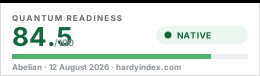
Tier 1: Native. Post-quantum secure at mainnet today, with quantum-resistant signatures built in from genesis.
| No. | Dimension | Score | Weight | Contribution |
|---|---|---|---|---|
| 1 | Signature scheme | 9 | 30% | 27.0 |
| 2 | Deployment stage | 10 | 25% | 25.0 |
| 3 | NIST alignment | 6 | 15% | 9.0 |
| 4 | Migration path | 8 | 15% | 12.0 |
| 5 | Exposure | 9 | 10% | 9.0 |
| 6 | Verification | 5 | 5% | 2.5 |
| Hardy Score | 84.5 | |||
Band 7 to 9: A post-quantum signature is available on mainnet at the protocol level as a first-class account type.
Lattice-based post-quantum signatures have secured Abelian mainnet since 2022 and are the scheme protecting funds, not an optional add-on. source
Placement in the band The top of the band: post-quantum signatures are the only scheme on Abelian mainnet, with no classical alternative, which is what puts this at 9 rather than 7 or 8. It is held out of the band above because the deployed primitives are Dilithium-inspired rather than the finalised standardised version.
Band 10: Tier 1: Native.
Tier 1: Native. Post-quantum cryptography has protected the chain from launch rather than being added later, so there is no legacy of classical keys to migrate away from. source
Band 6 to 8: The scheme is NIST-selected but the standard is not yet final, or a NIST-approved scheme is named but not yet deployed.
The design follows the lattice family that NIST standardised, using schemes inspired by CRYSTALS-Dilithium for signatures and CRYSTALS-Kyber for key encapsulation. source
Placement in the band At the floor of the band rather than a 7 or an 8: Abelian deployed before FIPS 203 and 204 existed, so what runs is lattice cryptography in the standardised family but not any published parameter set, and certified conformance is not available.
Band 6 to 8: A credible published plan exists with a mechanism identified, but key parts are unbuilt or undated.
There is no classical legacy to migrate, which removes the hardest problem other chains face. source
Placement in the band The top of the band rather than a 6 or a 7, because there is no classical legacy to move at all. It stops short of 9 because a different migration is still ahead: moving from Dilithium-inspired primitives to the finalised NIST parameter sets, which we could not confirm has been completed.
Band 9 to 10: No quantum-vulnerable public keys are exposed on-chain, or the exposed keys protect nothing.
Abelian has no harvest-now-decrypt-later exposure in the usual sense, because its signature security does not rest on the discrete logarithm problem. Recording every public key today gains an attacker nothing from a future quantum computer. source
Placement in the band Not a 10, for the same reason the NIST score sits at the floor of its band: the primitives are Dilithium-inspired rather than standardised, so the claim that no exposed key is a quantum liability rests on constructions that have had less cryptanalysis than the published parameter sets.
Band 3 to 5: Some independent verification exists, but the headline quantum-safety claim itself is not verified.
The implementation is open source and has run publicly since 2022, which is real evidence. source
Placement in the band The top of the band rather than a 3 or a 4: the implementation is open source and has run publicly since 2022, which is real evidence. It cannot reach 6 because we found no named third-party cryptanalysis of Abelian's specific constructions, so the headline quantum-safety claim is itself unverified.
The deployment dimension is not a separate judgement. It is Tier 1 expressed as a number. See the tier mapping.
The 9 chains Abelian sits among, out of 31 rated. The last column is the gap in Hardy points from Abelian.
| Rank | Chain | Tier | Hardy | vs ABEL |
|---|---|---|---|---|
| 1 | Quantum Resistant Ledger | 1: Native | 92.0 | +7.5 |
| 2 | Mochimo | 1: Native | 90.0 | +5.5 |
| 3 | Abelian this chain | 1: Native | 84.5 | |
| 4 | NEAR Protocol | 2: Shipping | 81.5 | -3.0 |
| 5 | Algorand | 2: Shipping | 77.5 | -7.0 |
| 6 | Nervos CKB | 2: Shipping | 75.5 | -9.0 |
| 7 | Bitcoin Cash | 2: Shipping | 66.0 | -18.5 |
| 8 | Solana | 2: Shipping | 54.5 | -30.0 |
| 9 | XRP Ledger | 3: Committed | 46.5 | -38.0 |
Abelian runs lattice-based signatures and a key encapsulation mechanism on mainnet, making post-quantum protection native rather than retrofitted. source
NIST finalises ML-DSA and ML-KEM as FIPS 204 and FIPS 203, creating a standards target that Abelian's earlier primitives predate. source
Alignment of the deployed primitives with the finalised NIST parameter sets. We could not confirm whether or when this has been completed. source
Exposure measures how much of the chain's value already sits behind a public key that an attacker can record today and break later. This is the part of the threat that a future upgrade cannot undo.
Abelian carries effectively no harvest-now-decrypt-later exposure. Its signature security rests on lattice problems rather than on the discrete logarithm problem, so an attacker who records every public key on the chain today gains nothing from a future quantum computer. The privacy layer adds a second, independent reason there is little to collect: transaction details are hidden behind lattice-based zero-knowledge proofs and linkable ring signatures rather than being published and then obscured. The residual risk is not quantum but cryptographic maturity, since lattice constructions deployed before standardisation have had less public cryptanalysis than the finalised parameter sets.
What this rating means for you
Abelian already runs post-quantum signatures for every account on mainnet, so there is no migration for you to make here. The habits that still matter are address hygiene and keeping your own keys.
Editorial guidance from the Hardy Index. Nothing on this profile is sponsored and nothing on it is an affiliate link. The guides carry disclosed affiliate links, which never affect a rating. How we make money.
We will email you the day this rating moves, with the changelog note that explains why. Nothing else, and nothing in between.
On the measure this index uses, yes. Abelian has run lattice-based post-quantum signatures on mainnet since 2022, and lattice problems are not broken by Shor's algorithm. The qualification is that the deployed primitives were inspired by CRYSTALS-Dilithium rather than being the finalised NIST standard, which matters for anyone who needs certified conformance.
Yes, and that is unusual. Most privacy chains build their privacy on elliptic-curve cryptography, which a quantum computer would break, so privacy and quantum safety come apart. Abelian uses lattice-based zero-knowledge proofs and lattice-based linkable ring signatures, so both properties rest on the same post-quantum foundation.
Both are native post-quantum chains, and they made opposite bets. QRL uses XMSS, a hash-based scheme whose security rests on hash preimage resistance, approved by NIST in SP 800-208 and stateful. Abelian uses lattice constructions, which are stateless and more compact, but were deployed before the corresponding standards were published.
Open source is necessary but not sufficient. We found limited independent audit or third-party cryptanalysis of Abelian's specific lattice constructions, and the network's scale means far fewer adversarial eyes have examined it than have examined Bitcoin or Ethereum. The score reflects the amount of external scrutiny, not the openness of the code.
A rating is only true as of the day it was reviewed, so both forms below carry the review date and the methodology version. If you are quoting the score, quote those too.
The Hardy Index (2026). Abelian: quantum readiness assessment. Hardy Score 84.5 of 100, Tier 1: Native. Methodology v1.4. Reviewed 2 October 2026. https://hardyindex.com/chains/abelian
@misc{hardyindex_abelian_2026,
  author       = {{The Hardy Index}},
  title        = {Abelian: quantum readiness assessment},
  year         = {2026},
  howpublished = {\url{https://hardyindex.com/chains/abelian}},
  note         = {Hardy Score 84.5 of 100, Tier 1: Native. Methodology v1.4},
  urldate      = {2026-10-02}
}
The whole dataset is reusable under the terms on the about page. A machine-readable version of this page is at /chains/abelian.md.
This is a security-readiness assessment, not investment advice.