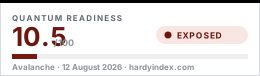
No published position proposed
No post-quantum roadmap, named scheme or research programme was found from Avalanche or Ava Labs at the time of writing. source
Chain profile
Signs with ECDSA on secp256k1 across its chains, with no published post-quantum roadmap found at the time of writing.
No. Avalanche secures accounts with ECDSA on the secp256k1 curve across its C-Chain, X-Chain and P-Chain, and a sufficiently large quantum computer would break it. We could not find a published post-quantum roadmap, a named replacement scheme, or a research programme from Avalanche or Ava Labs at the time of writing. That absence is the finding, and it is worth stating plainly rather than softening: a chain with no published position has not yet begun the work that the chains ranked above it have started. Avalanche's subnet architecture means individual subnets can in principle adopt their own signature rules, which is a genuine structural flexibility, but we found no evidence of that being used for post-quantum signatures.
Where we are making a judgement call Tier 5 records a published position, or rather the absence of one. We found no roadmap, named scheme or research programme for Avalanche, and its signatures on mainnet today are quantum-vulnerable. That is a finding about what Avalanche has published, not a judgement of its engineering, and not a claim that no internal work exists. If Avalanche publishes a post-quantum position, the primary source is the fastest way to move this row.
ECDSA on secp256k1 across the C-Chain, X-Chain and P-Chain
None selected. No post-quantum scheme was found in published Avalanche material.
None adopted
Tier 5: Exposed. The signatures securing funds on mainnet today are quantum-vulnerable, and no public post-quantum plan, proposal or research programme addressing them could be found.
| No. | Dimension | Score | Weight | Contribution |
|---|---|---|---|---|
| 1 | Signature scheme | 0 | 30% | 0.0 |
| 2 | Deployment stage | 1 | 25% | 2.5 |
| 3 | NIST alignment | 0 | 15% | 0.0 |
| 4 | Migration path | 2 | 15% | 3.0 |
| 5 | Exposure | 2 | 10% | 2.0 |
| 6 | Verification | 6 | 5% | 3.0 |
| Hardy Score | 10.5 | |||
Band 0: Classical signatures only on mainnet, with nothing post-quantum protecting live funds. Short-lived devnets and one-off benchmarks sit here: they demonstrate research rather than something a user can hold keys on.
Avalanche uses ECDSA on secp256k1 across its primary network chains. Nothing post-quantum protects AVAX or assets on Avalanche today. source
Band 1: Tier 5: Exposed.
Tier 5: Exposed. Avalanche signs with ECDSA on secp256k1 and we found no published roadmap, named scheme or research programme, which is the bottom rung of the spine: quantum-vulnerable signatures and no public post-quantum plan. source
Band 0 to 2: No named post-quantum scheme, or a proprietary scheme with no public cryptanalysis.
No post-quantum scheme has been named or selected, so there is nothing to align with a NIST standard. source
Placement in the band The floor of the band rather than a 1 or a 2: no scheme has been named at all, as distinct from a scheme named without commitment, so there is nothing whatever to align against a standard.
Band 0 to 2: No agreed migration path, or the proposals on the table would strand or freeze holder funds.
No migration plan exists. Avalanche's subnet architecture does give it real optionality, because a subnet can define its own validation rules without the primary network changing, which is a mechanism a future migration could use. No such use has been published. source
Placement in the band A 2 rather than a 0: subnet architecture is a real mechanism a future migration could use without the primary network changing. It goes no higher because no such use has been published and no plan exists.
Band 0 to 2: Public keys are exposed for effectively all accounts, or a large, measured share of total supply sits in exposed addresses.
C-Chain addresses are hashes of public keys in the Ethereum style, so a funded account that has never transacted keeps its key private. In practice nearly all economically active accounts have signed and published their keys. source
Placement in the band At the top of the band rather than a 0 or a 1: the hashed-address model protects never-transacted accounts, a structural advantage the floor of this band lacks, though almost no active supply still benefits from it.
Band 6 to 8: Open source with public review or a named third-party audit of the relevant component.
AvalancheGo is open source, so the signature scheme is directly verifiable from the code. There is no post-quantum claim to verify, which is neither a strength nor a failure of verification, simply an absence. source
Placement in the band The floor of the band: AvalancheGo is open source so the signature scheme is directly verifiable, but there is no post-quantum claim to review and no audit of one, which is what a 7 or an 8 credits.
The deployment dimension is not a separate judgement. It is Tier 5 expressed as a number. See the tier mapping.
The 9 chains Avalanche sits among, out of 31 rated. The last column is the gap in Hardy points from Avalanche.
| Rank | Chain | Tier | Hardy | vs AVAX |
|---|---|---|---|---|
| 23 | Internet Computer | 5: Exposed | 14.5 | +4.0 |
| 24 | TON | 5: Exposed | 13.0 | +2.5 |
| 25 | Litecoin | 5: Exposed | 12.5 | +2.0 |
| 26 | Bittensor | 5: Exposed | 11.0 | +0.5 |
| 27 | Dogecoin | 5: Exposed | 11.0 | +0.5 |
| 28 | Avalanche this chain | 5: Exposed | 10.5 | |
| 29 | Cronos | 5: Exposed | 8.5 | -2.0 |
| 30 | MemeCore | 5: Exposed | 8.5 | -2.0 |
| 31 | Hyperliquid | 5: Exposed | 7.0 | -3.5 |
No post-quantum roadmap, named scheme or research programme was found from Avalanche or Ava Labs at the time of writing. source
Exposure measures how much of the chain's value already sits behind a public key that an attacker can record today and break later. This is the part of the threat that a future upgrade cannot undo.
Avalanche's C-Chain follows Ethereum's address model, deriving an address from a hash of the public key, so an account funded but never spent from has not revealed its key. The protection ends at first signature. Because the C-Chain carries the overwhelming majority of Avalanche's activity and value, and because active accounts sign frequently, the practical position is that most economically meaningful AVAX sits behind a key that is already published on-chain and can be collected today against a future quantum computer.
What this rating means for you
Avalanche runs quantum-vulnerable signatures with no published post-quantum plan that we could find. Nothing here is urgent today, and there is also nothing scheduled to change it.
Editorial guidance from the Hardy Index. Nothing on this profile is sponsored and nothing on it is an affiliate link. The guides carry disclosed affiliate links, which never affect a rating. How we make money.
We will email you the day this rating moves, with the changelog note that explains why. Nothing else, and nothing in between.
No. Avalanche uses ECDSA on the secp256k1 curve across its chains, which a sufficiently large quantum computer would break. We found no published post-quantum roadmap or named replacement scheme at the time of writing.
None that we could find. We searched for a roadmap, a named scheme, a research programme and a testnet implementation, and found no published position from Avalanche or Ava Labs. If one exists and we have missed it, sending us the primary source is the fastest way to correct this profile.
In principle yes, and that is a real structural advantage. A subnet can define its own validation rules without the primary network changing, which would let a post-quantum subnet exist without a network-wide fork. We found no evidence of this being used for post-quantum signatures, so it counts as optionality rather than progress.
Because two dimensions measure things other than post-quantum deployment. Avalanche scores on exposure, since its address model hashes public keys rather than publishing them directly, and on verification, since the client is open source and the cryptography can be checked from the code.
A rating is only true as of the day it was reviewed, so both forms below carry the review date and the methodology version. If you are quoting the score, quote those too.
The Hardy Index (2026). Avalanche: quantum readiness assessment. Hardy Score 10.5 of 100, Tier 5: Exposed. Methodology v1.4. Reviewed 2 October 2026. https://hardyindex.com/chains/avalanche
@misc{hardyindex_avalanche_2026,
  author       = {{The Hardy Index}},
  title        = {Avalanche: quantum readiness assessment},
  year         = {2026},
  howpublished = {\url{https://hardyindex.com/chains/avalanche}},
  note         = {Hardy Score 10.5 of 100, Tier 5: Exposed. Methodology v1.4},
  urldate      = {2026-10-02}
}
The whole dataset is reusable under the terms on the about page. A machine-readable version of this page is at /chains/avalanche.md.
This is a security-readiness assessment, not investment advice.