2024 shipped
The Blueshift Winternitz Vault goes live on Solana mainnet, using Winternitz one-time signatures over a truncated Keccak256 hash offering 224 bits of preimage resistance. source
Chain profile
A quantum-resistant Winternitz vault has run on Solana mainnet for over two years, but protocol-level migration to Falcon is explicitly conditional and carries no published dates.
Not by default, though Solana is one of the few chains where a quantum-resistant primitive is already running on mainnet. The Blueshift Winternitz Vault, which uses Winternitz one-time signatures over a truncated Keccak256 hash, has been live on Solana for over two years and was cited by Google's Quantum AI team in 2026 as a notable quantum resilience solution. It is also opt-in, experimental, and was used by fewer than 300 accounts on mainnet-beta as of April 2026. Ordinary Solana accounts use Ed25519, and because a Solana address is the public key, every account's key is exposed on-chain from the start. In April 2026 the Solana Foundation published a quantum readiness roadmap co-authored with Anza and Jump Crypto's Firedancer team, converging on Falcon as the chosen post-quantum scheme, with both client teams having built initial implementations. That roadmap is conditional by design: it commits to adopting a post-quantum scheme only 'if quantum becomes a credible threat', and it names no dates.
Where we are making a judgement call Solana's Tier 2 placement is among the most contestable calls in this index. The tier requires post-quantum features live on mainnet and a migration underway. Solana clearly satisfies the first condition and clearly does not satisfy the second: its own roadmap makes protocol-level adoption conditional on quantum becoming a credible threat and publishes no dates. We placed Solana by the visible mainnet artefact and took the deduction in the migration and NIST dimensions instead of in the tier. A reader who weights a dated commitment above a live experimental primitive would reasonably place Solana in Tier 3.
Ed25519 for all standard accounts
Winternitz one-time signatures (Blueshift vault, application-level, live); Falcon selected for protocol-level adoption, not deployed
Falcon, selected by NIST for standardisation as FN-DSA; standard not final at time of writing
Tier 2: Shipping. Post-quantum signature features are live on mainnet and a migration for existing holders is underway.
| No. | Dimension | Score | Weight | Contribution |
|---|---|---|---|---|
| 1 | Signature scheme | 4 | 30% | 12.0 |
| 2 | Deployment stage | 8 | 25% | 20.0 |
| 3 | NIST alignment | 6 | 15% | 9.0 |
| 4 | Migration path | 5 | 15% | 7.5 |
| 5 | Exposure | 2 | 10% | 2.0 |
| 6 | Verification | 8 | 5% | 4.0 |
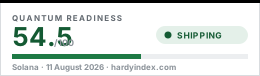
| Hardy Score | 54.5 | |||
Band 4 to 6: A post-quantum signature is available on mainnet only as an opt-in, application-level or experimental primitive.
The Winternitz Vault is a genuine quantum-resistant primitive protecting real funds on mainnet, but it is an application-level program rather than a protocol feature, is described by Solana as experimental, and was used by fewer than 300 accounts as of April 2026. Falcon implementations exist in Anza and Firedancer but are not deployed. source
Placement in the band At the floor of the band: the Winternitz Vault is opt-in, application-level and described by Solana as experimental, and fewer than 300 accounts had used it by April 2026. A 5 or a 6 would need it to be a protocol primitive or in meaningful use.
Band 8: Tier 2: Shipping.
Tier 2: Shipping, on the strength of a quantum-resistant primitive live on mainnet and in use. This is a generous placement and the caveat below explains why a reader might reasonably score it lower. source
Band 6 to 8: The scheme is NIST-selected but the standard is not yet final, or a NIST-approved scheme is named but not yet deployed.
Falcon, the scheme Anza and Firedancer independently converged on, is NIST-selected but not yet finalised as FN-DSA. The primitive actually deployed on mainnet, Winternitz one-time signatures, is a well-understood hash-based construction but is not itself a NIST-standardised scheme. source
Placement in the band At the bottom of the band, because neither half of the picture is a finalised standard in use. Falcon is NIST-selected but unfinished as FN-DSA and undeployed, and the Winternitz scheme actually running on mainnet is well understood but is not a NIST parameter set.
Band 3 to 5: Migration is acknowledged as a problem with no agreed mechanism, or the mechanism is contested.
Two independent validator client teams reached the same conclusion on Falcon and both have working implementations, which is real engineering capacity. The published plan is nonetheless explicitly conditional, committing only to adopt a post-quantum scheme 'if quantum becomes a credible threat', and it contains no dates for either new-wallet adoption or existing-wallet migration. source
Placement in the band The top of the band rather than a 3 or a 4: two independent client teams hold working Falcon implementations, which is well past acknowledging a problem. It cannot reach 6 because the published commitment is conditional on quantum becoming a credible threat and carries no dates.
Band 0 to 2: Public keys are exposed for effectively all accounts, or a large, measured share of total supply sits in exposed addresses.
Solana is an account-model chain where the address is the Ed25519 public key. Every account's public key is therefore on-chain from creation, so effectively all classical SOL and SPL balances are harvestable today regardless of transaction history. source
Placement in the band At the top of the band rather than lower: Solana meets it on the structural limb, where the address is the public key itself, but no measured share of at-risk supply has been published, and the Winternitz Vault gives holders a route that chains at the floor of this band lack.
Band 6 to 8: Open source with public review or a named third-party audit of the relevant component.
The Winternitz Vault is open source and independently recognised: Google's Quantum AI team cited it in 2026 as a notable quantum resilience solution. The roadmap is public and co-authored with Anza and the Firedancer team rather than issued unilaterally by a foundation. source
Placement in the band The top of the band: the deployed component is open source and was cited by Google's Quantum AI team, which is external recognition of the primitive itself rather than of a plan. It stops short of 9 because no named third-party audit of the Vault was found.
The deployment dimension is not a separate judgement. It is Tier 2 expressed as a number. See the tier mapping.
The 9 chains Solana sits among, out of 31 rated. The last column is the gap in Hardy points from Solana.
| Rank | Chain | Tier | Hardy | vs SOL |
|---|---|---|---|---|
| 4 | NEAR Protocol | 2: Shipping | 81.5 | +27.0 |
| 5 | Algorand | 2: Shipping | 77.5 | +23.0 |
| 6 | Nervos CKB | 2: Shipping | 75.5 | +21.0 |
| 7 | Bitcoin Cash | 2: Shipping | 66.0 | +11.5 |
| 8 | Solana this chain | 2: Shipping | 54.5 | |
| 9 | XRP Ledger | 3: Committed | 46.5 | -8.0 |
| 10 | Sui | 3: Committed | 45.5 | -9.0 |
| 11 | Hedera | 3: Committed | 42.0 | -12.5 |
| 12 | Stellar | 3: Committed | 41.0 | -13.5 |
The Blueshift Winternitz Vault goes live on Solana mainnet, using Winternitz one-time signatures over a truncated Keccak256 hash offering 224 bits of preimage resistance. source
The Solana Foundation publishes a quantum readiness roadmap co-authored with Anza and Jump Crypto's Firedancer team, converging on Falcon. source
Continue quantum research and keep evaluating Falcon and its alternatives. source
If quantum becomes a credible threat, adopt a post-quantum scheme for new wallets, then migrate existing wallets to it. source
Exposure measures how much of the chain's value already sits behind a public key that an attacker can record today and break later. This is the part of the threat that a future upgrade cannot undo.
A Solana address is an Ed25519 public key encoded in base58. There is no hashing step, so every account's public key is legible on-chain the moment the address is used or funded, and an attacker can begin harvesting today against a future quantum computer. Never transacting does not help, unlike on Bitcoin or Cardano. The Winternitz Vault is the available mitigation, and fewer than 300 mainnet-beta accounts had adopted it as of April 2026.
What this rating means for you
Solana has post-quantum signatures live on mainnet, but they are not the default, so holders have to opt in. That makes this one of the few chains where you can act today rather than wait.
Editorial guidance from the Hardy Index. Nothing on this profile is sponsored and nothing on it is an affiliate link. The guides carry disclosed affiliate links, which never affect a rating. How we make money.
From the newsroom
We will email you the day this rating moves, with the changelog note that explains why. Nothing else, and nothing in between.
Not by default. Standard Solana accounts use Ed25519, which a sufficiently large quantum computer would break, and the address is the public key so the key is exposed from the start. Solana does have a quantum-resistant option on mainnet, the Blueshift Winternitz Vault, but it is opt-in and experimental, with fewer than 300 accounts using it as of April 2026.
It is an on-chain program that holds lamports under a Winternitz one-time signature scheme rather than Ed25519. It uses a truncated Keccak256 hash offering 224 bits of preimage resistance, which stays robust against Grover's algorithm. Because it is hash-based rather than elliptic-curve based, Shor's algorithm does not break it. Google's Quantum AI team cited it in 2026 as a notable quantum resilience solution.
It has converged on one without committing to a date. Anza and Firedancer, Solana's two main validator client teams, independently selected Falcon and both have built initial implementations. The Solana Foundation's April 2026 roadmap frames adoption as conditional: new wallets would move to a post-quantum scheme 'if quantum becomes a credible threat'. It gives no timeline for either step.
Because the Tier 2 test is a post-quantum signature live on mainnet, and Solana has one protecting real funds. We took the deduction for the undated, conditional roadmap in the migration dimension, which scores 5, rather than in the tier. This is a judgement call and we state it openly on the profile: a reader who weights dated commitments more heavily would place Solana in Tier 3.
A rating is only true as of the day it was reviewed, so both forms below carry the review date and the methodology version. If you are quoting the score, quote those too.
The Hardy Index (2026). Solana: quantum readiness assessment. Hardy Score 54.5 of 100, Tier 2: Shipping. Methodology v1.4. Reviewed 2 October 2026. https://hardyindex.com/chains/solana
@misc{hardyindex_solana_2026,
  author       = {{The Hardy Index}},
  title        = {Solana: quantum readiness assessment},
  year         = {2026},
  howpublished = {\url{https://hardyindex.com/chains/solana}},
  note         = {Hardy Score 54.5 of 100, Tier 2: Shipping. Methodology v1.4},
  urldate      = {2026-10-02}
}
The whole dataset is reusable under the terms on the about page. A machine-readable version of this page is at /chains/solana.md.
This is a security-readiness assessment, not investment advice.