Hardy Index Quantum readiness, rated and tracked

Chain profile

Midnight

NIGHT Exposed

Midnight's ledger authorises unshielded spends, NIGHT among them, with BIP-340 Schnorr signatures on secp256k1, and its shielded spends rest on a pairing-based proof system; no post-quantum plan for either has been published.

Is Midnight quantum-safe?

No. Midnight is a privacy-focused Cardano partner chain, and privacy is not quantum safety. On Midnight's own ledger, unshielded tokens, NIGHT among them, are authorised by Schnorr signatures over secp256k1 as specified in BIP-340, and a sufficiently large quantum computer running Shor's algorithm breaks them. Shielded spends work differently: the spending key is a 256-bit secret whose SHA-256 hash is the public key, and ownership is shown inside a zero-knowledge proof rather than by a signature. That proof system is a Plonk-family zk-SNARK with KZG commitments over the BLS12-381 curve, which rests on elliptic-curve assumptions Midnight's own documentation says are not considered quantum-resistant. Block production is run by a permissioned committee of federated node operators, which authors blocks with sr25519 and finalises them with Ed25519 through GRANDPA. NIGHT was minted as a Cardano native asset, and Midnight's documentation says it is today held mostly on Cardano as cNIGHT, under Cardano's Ed25519 keys; this row describes Midnight's own ledger. Input Output Research has said it is researching a move to lattice-based cryptography for confidential data, and a Midnight problem statement asks for quantum security in a future light-client design, but nothing published addresses the signatures and proofs that protect funds.

Where we are making a judgement call Five judgement calls. On scope: NIGHT was minted as a Cardano native asset, and Midnight's documentation says it is today held mostly on Cardano as cNIGHT under Cardano's Ed25519 keys. This row scores Midnight's own ledger, and a holder whose NIGHT sits on Cardano should read Cardano's profile for that risk. On the tier: MPS-0048 is a formal problem statement in Midnight's own process that asks for quantum security in a construction resting on validator-signed attestations, and it sits closer to fund protection than its light-client subject suggests. It sets its requirements against MIP-0023, a proposed committee bridge on secp256k1 ECDSA through which a Cardano contract trusts committee-signed Midnight roots, and MIP-0023 says the Block Production Rewards MIP pays NIGHT on Cardano on the strength of those committee-signed facts. MPS-0048 also names the bridge that MPS-0033 calls for, from NIGHT on Midnight back to cNIGHT, as a party that would check the same proof. We still read it as Tier 5, because a problem statement sets a requirement and prescribes nothing: it names no scheme, no construction and no date, and it is not adopted. A reader who counts it as post-quantum work on validator signatures would place Midnight in Tier 4, raising the deployment score from 1 to 2 and the Hardy Score from 10.5 to 13.0. On authority: Input Output Research's March 2026 article says "IOR is researching how to transition Midnight toward lattice-based cryptography", and the same article credits IOR with designing Midnight's token model, so we treat it as speaking for Midnight's research rather than as an outsider. It does not lift the tier because the article ties that research to harvest-now-decrypt-later attacks on confidential data, not to the signatures and proofs that protect funds. A reader who takes the sentence as a research programme covering all of Midnight's cryptography would also place Midnight in Tier 4, with the same Hardy Score of 13.0. On exposure: it is scored 4, as for Cardano's hashed-key UTXO model, crediting shielded coins that publish no spending key. A reader who applies the score of 2 given to key-hash account chains would put the Hardy Score at 8.5; one who credits the shielded design as fully as Zcash's would score exposure 5 and the Hardy Score 11.5. On block production: it is permissioned, run by federated node operators, as Hedera's is by its council. That is scored like any other chain's validator set: the rubric does not score centralisation, and the migration score of 2 rather than 1, a Hardy Score of 9.0 at 1, rests partly on how cheaply that small set could coordinate a change.

At a glance

On mainnet today

Schnorr over secp256k1 (BIP-340) for unshielded spends, including NIGHT on Midnight; shielded spends by Plonk proofs with KZG commitments over BLS12-381; sr25519 block authoring and Ed25519 GRANDPA finality for validators

Post-quantum scheme

None selected or proposed for spend signatures, shielded proofs or validator keys

NIST standard

None named

Readiness tier

Tier 5: Exposed. The signatures securing funds on mainnet today are quantum-vulnerable, and no public post-quantum plan, proposal or research programme addressing them could be found.

Cryptography in use

  • Account signatures Schnorr signatures on secp256k1 BIP-340 Mainnet, default Authorises unshielded UTXO spends on Midnight's ledger. Shielded spends use a zero-knowledge proof instead, and NIGHT held on Cardano as cNIGHT is under Cardano's Ed25519 keys. Specification or proposal
  • Validator consensus sr25519 Mainnet, mandatory Aura block-authoring keys. MIP-0010, with status Proposed, would move block production to BABE, also on sr25519. Read at the node-1.0.400 release tag, which Midnight's release notes tell every Mainnet node to run; its runtime is spec version 1.0.300. Source code or release
  • Validator consensus Ed25519 Mainnet, mandatory GRANDPA finality keys. Read at the node-1.0.400 release tag, which Midnight's release notes tell every Mainnet node to run; its runtime is spec version 1.0.300. Source code or release

A role not listed is not evidenced either way. Every scheme, and which other chains share it, is in the cryptography registry.

Score breakdown

Each dimension scored 0 to 10. The weight beside it is its share of the total score.
Show the weighted arithmetic and the sourced note for each dimension
Midnight Hardy Score by dimension, with weights and weighted contributions
No. Dimension Score Weight Contribution
1 Signature scheme 0 30% 0.0
2 Deployment stage 1 25% 2.5
3 NIST alignment 0 15% 0.0
4 Migration path 2 15% 3.0
5 Exposure 4 10% 4.0
6 Verification 2 5% 1.0
Hardy Score 10.5

1 Signature scheme 0/10, weighted 30%

Band 0: Classical signatures only on mainnet, with nothing post-quantum protecting live funds. Short-lived devnets and one-off benchmarks sit here: they demonstrate research rather than something a user can hold keys on.

Midnight's ledger specification states that it uses Schnorr over secp256k1 as specified in BIP-340, and every unshielded UTXO spend, including NIGHT on Midnight, must carry such a signature over the transaction intent. Shielded spends are proven in a Plonk proof over BLS12-381. Nothing post-quantum authorises spends on mainnet. source

2 Deployment stage 1/10, weighted 25%

Band 1: Tier 5: Exposed.

Tier 5: Exposed. The two post-quantum statements found do not address the fund-protecting cryptography. MPS-0048, a Midnight problem statement with status Proposed, asks that a future light-client construction be secure against a quantum adversary and prescribes no scheme. Input Output Research's March 2026 article describes research into lattice-based encryption for confidential data. Neither is a plan, proposal or research programme for spend signatures, shielded proofs or validator keys. source

3 NIST alignment 0/10, weighted 15%

Band 0 to 2: No post-quantum scheme named for the chain’s fund-protecting signatures, or a proprietary scheme with no public cryptanalysis.

No post-quantum scheme has been named for Midnight's spend signatures, its shielded proof system or its validator keys. The Input Output Research article names lattice-based cryptography as a family and fully homomorphic encryption as an application, for protecting confidential data, and names no algorithm. source

Placement in the band The floor of the band rather than a 1 or a 2: no scheme has been named for any fund-protecting role, and the one family mentioned is for encryption of data, which v1.8 does not count towards this dimension.

4 Migration path 2/10, weighted 15%

Band 0 to 2: No agreed migration path, or the proposals on the table would strand or freeze holder funds.

No migration path for holders has been published. Two features would make one easier to deliver. Midnight upgrades its runtime in place through governance actions by its council and technical committee, as node v1.0.0 did, so a new signature type needs no new chain. And an unshielded address is a hash of the verifying key, so a holder could move funds from an unspent output to a new key type without the old key having been exposed. source

Placement in the band The top of the band rather than a 1: forkless runtime upgrades under a small federated governance make a coordinated change cheaper than on a chain with thousands of independent operators, and hashed addresses leave unspent outputs movable. It cannot reach 3, because nothing Midnight has published acknowledges migrating holders' funds as a problem.

5 Exposure 4/10, weighted 10%

Band 3 to 5: Most active accounts have revealed a public key, or the chain has no live supply to assess.

Midnight's ledger specification defines an unshielded address as a hash of the verifying key, and a spend carries the key itself, so an unshielded output's key is published when it is spent and not before. Shielded coins publish no spending public key at all: the public key is a SHA-256 hash of the secret, which the spender proves knowledge of inside a proof. Scored on the address model: no measurement of Midnight's exposed share has been published. source

Placement in the band A 4 rather than a 3, because unspent unshielded outputs and every shielded coin keep their spending keys off the chain. Not a 5, because a spend reveals the unshielded key permanently, no measurement exists, and the shielded proofs rest on curve assumptions a quantum adversary would break whether or not a key is published.

6 Verification 2/10, weighted 5%

Band 0 to 2: No post-quantum component exists, or the claims rest on marketing.

No post-quantum component protects Midnight's funds, so there is nothing to verify. Midnight's own documentation says the zk-SNARK family it uses relies on elliptic-curve assumptions and is not considered quantum-resistant, and the proof system it describes is Plonk with KZG commitments over BLS12-381. Under v1.8 the openness of the classical code earns nothing here. source

Placement in the band The top of the band rather than a 0 or a 1: there is no post-quantum component to verify, but Midnight does not market itself as quantum-safe, and its documentation is explicit that its proofs are not quantum-resistant.
The deployment dimension is not a separate judgement. It is Tier 5 expressed as a number. See the tier mapping.

How it compares

All 80 rated chains on the 0 to 100 scale. Midnight is marked. Select any point to open that profile.
Hyperliquid, Hardy Score 5.5 Cronos, Hardy Score 7.0 MemeCore, Hardy Score 7.0 Beldex, Hardy Score 7.5 Ozone Chain, Hardy Score 7.5 0G, Hardy Score 8.5 AIOZ Network, Hardy Score 8.5 Akash Network, Hardy Score 8.5 Arweave, Hardy Score 8.5 Avalanche, Hardy Score 8.5 Bitcoin SV, Hardy Score 8.5 Celestia, Hardy Score 8.5 Chiliz Chain, Hardy Score 8.5 Conflux, Hardy Score 8.5 dYdX Chain, Hardy Score 8.5 eCash, Hardy Score 8.5 Filecoin, Hardy Score 8.5 GateChain, Hardy Score 8.5 Gnosis Chain, Hardy Score 8.5 Injective, Hardy Score 8.5 KCC (KuCoin Community Chain), Hardy Score 8.5 Kite, Hardy Score 8.5 Mina Protocol, Hardy Score 8.5 MultiversX, Hardy Score 8.5 Polygon PoS, Hardy Score 8.5 Provenance Blockchain, Hardy Score 8.5 Theta Network, Hardy Score 8.5 THORChain, Hardy Score 8.5 VeChain, Hardy Score 8.5 WEMIX, Hardy Score 8.5 Whitechain, Hardy Score 8.5 Dogecoin, Hardy Score 9.0 Kaia, Hardy Score 10.0 Vaulta, Hardy Score 10.0 Decred, Hardy Score 10.5 IOTA, Hardy Score 10.5 Litecoin, Hardy Score 10.5 Midnight, Hardy Score 10.5 Qtum, Hardy Score 10.5 TON, Hardy Score 11.0 Ethereum Classic, Hardy Score 13.0 Flare, Hardy Score 13.0 Internet Computer, Hardy Score 13.0 Bitcoin, Hardy Score 14.5 Sonic, Hardy Score 14.5 Terra Classic, Hardy Score 14.5 Dash, Hardy Score 16.5 Neo, Hardy Score 17.0 Monero, Hardy Score 17.5 Bittensor, Hardy Score 19.0 BNB Chain, Hardy Score 20.0 Monad, Hardy Score 20.0 XDC Network, Hardy Score 20.0 Kaspa, Hardy Score 20.5 Cosmos Hub, Hardy Score 23.5 Sei, Hardy Score 24.5 Cardano, Hardy Score 34.0 Tron, Hardy Score 34.5 Polkadot, Hardy Score 36.5 Tezos, Hardy Score 37.5 Zcash, Hardy Score 38.0 Ethereum, Hardy Score 38.5 Aptos, Hardy Score 39.0 Stellar, Hardy Score 39.0 Hedera, Hardy Score 39.5 Sui, Hardy Score 42.0 XRP Ledger, Hardy Score 43.0 Solana, Hardy Score 53.0 Bitcoin Cash, Hardy Score 62.0 Nexus, Hardy Score 73.0 Nervos CKB, Hardy Score 76.0 Algorand, Hardy Score 77.0 NEAR Protocol, Hardy Score 80.0 Abelian, Hardy Score 84.0 QoreChain, Hardy Score 84.5 Mochimo, Hardy Score 89.0 Tidecoin, Hardy Score 89.0 Quantum Resistant Ledger, Hardy Score 92.5 Dilithion, Hardy Score 93.5 Quantus Network, Hardy Score 94.0 Midnight 10.5

Nearest chains in the ranking

The 9 chains Midnight sits among, out of 80 rated. The last column is the gap in Hardy points from Midnight.

Chains ranked immediately around Midnight, with tier, Hardy Score and the gap to Midnight
Rank Chain Tier Hardy vs NIGHT
41 TON 5: Exposed 11.0 +0.5
42 Decred 5: Exposed 10.5 level
43 IOTA 5: Exposed 10.5 level
44 Litecoin 5: Exposed 10.5 level
45 Midnight this chain 5: Exposed 10.5
46 Qtum 5: Exposed 10.5 level
47 Kaia 5: Exposed 10.0 -0.5
48 Vaulta 5: Exposed 10.0 -0.5
49 Dogecoin 5: Exposed 9.0 -1.5

Roadmap

  1. 6 March 2026 shipped

    Input Output Research publishes an article saying it is researching how to transition Midnight towards lattice-based cryptography, against harvest-now-decrypt-later attacks on confidential data. It names no algorithm, no date and no deliverable, and addresses encryption rather than signatures. source

  2. October 2026 shipped

    Midnight's documentation records that contract deployment on mainnet is now permissionless, with no Midnight Foundation review before a contract is deployed. Block production remains permissioned. source

  3. 15 October 2026 proposed

    MPS-0048, Enabling Light Clients on Midnight, is filed with status Proposed. One of its goals is that the light-client construction be secure against a quantum adversary, even at the cost of cheap verification on Cardano. It prescribes no construction and does not address spend signatures. source

  4. No plan published proposed

    A post-quantum replacement for Midnight's Schnorr spend signatures, its BLS12-381 proof system or its validator keys. No improvement proposal, research programme or date for any of them was found. source

If holders never migrate

No stated policy

Neither the Midnight Foundation nor any Midnight improvement proposal has said what happens to unshielded outputs or shielded coins that never move to post-quantum protection.

As of 22 October 2026. Published beside the score, not in it. Every chain's stance is compared on the commitments page.

Exposure

Exposure measures how much of the chain's value already sits behind a public key that an attacker can record today and break later. This is the part of the threat that a future upgrade cannot undo.

Midnight has two kinds of token and they expose different things. Unshielded tokens, NIGHT among them, sit in UTXOs whose owner is a hash of a Schnorr verifying key, so the key goes on-chain when an output is spent and stays there. Shielded coins never publish a spending public key: the public key is a SHA-256 hash of a secret, and the spender proves knowledge of the secret inside a zero-knowledge proof. That is a real reduction in what can be harvested, but it is not quantum safety, because the proof system rests on BLS12-381, and Midnight's documentation says the zk-SNARK family it uses relies on elliptic-curve assumptions that are not considered quantum-resistant. The shielded note encryption uses Diffie-Hellman over the proof system's embedded curve, so a quantum adversary could also read shielded history after the fact. Two limits on the score: Midnight's documentation says NIGHT is today held mostly on Cardano as cNIGHT, where Cardano's address model applies, and no measurement of Midnight's own exposed share has been published.

What this rating means for you

If you hold Midnight

Midnight runs quantum-vulnerable signatures with no published post-quantum plan that we could find. Nothing here is urgent today, and there is also nothing scheduled to change it.

Editorial guidance from the Hardy Index.

Embed this rating

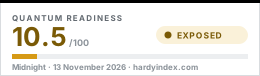
Paste this anywhere to show Midnight's current rating. It renders live from the index, so it updates when the rating does, and the review date is written into the image. There is nothing to sign up for and nothing to pay.

<a href="https://hardyindex.com/chains/midnight"><img src="https://hardyindex.com/badge/midnight.svg" width="260" height="76" alt="Quantum readiness rated by the Hardy Index"></a>

The image is /badge/midnight.svg. It is a plain SVG with no script and no tracking, it sets no cookie, and it records nothing about whoever loads it.

Questions

Is Midnight quantum-safe?

No. Unshielded spends on Midnight, including NIGHT on Midnight's ledger, are authorised by Schnorr signatures over secp256k1, and shielded spends rest on a Plonk proof system over the BLS12-381 curve. A sufficiently large quantum computer running Shor's algorithm breaks the assumptions under both. No post-quantum replacement has been proposed.

Does Midnight's zero-knowledge privacy make it quantum-resistant?

No. Shielded coins do avoid publishing a spending public key, which leaves less for an attacker to collect today. But the proofs that authorise shielded spends rest on elliptic-curve assumptions, and Midnight's own documentation says the zk-SNARK family it uses is not considered quantum-resistant. Privacy hides who paid whom; it does not stop a quantum adversary forging the proof.

My NIGHT is on Cardano. Does this rating apply to it?

Not directly. NIGHT was minted as a Cardano native asset, and Midnight's documentation says it is today held mostly on Cardano as cNIGHT, where it is protected by Cardano's Ed25519 keys and Cardano's address model. This row describes Midnight's own ledger. Cardano's profile describes the cryptography protecting cNIGHT.

Has Midnight said anything about quantum computing?

Twice, neither about the cryptography protecting funds. Input Output Research wrote in March 2026 that it is researching a move to lattice-based cryptography to protect confidential data, and MPS-0048, filed in October 2026, asks that a future light-client design be secure against a quantum adversary. Neither names a scheme or a date for spend signatures, shielded proofs or validator keys.

Sources

  1. Midnight ledger specification: preliminaries Midnight (GitHub) · primary · checked 22 October 2026
  2. Midnight ledger specification: Night and other unshielded tokens Midnight (GitHub) · primary · checked 22 October 2026
  3. Midnight ledger specification: Zswap Midnight (GitHub) · primary · checked 22 October 2026
  4. Midnight ZK: proof system and curves Midnight (GitHub) · primary · checked 22 October 2026
  5. zk-SNARK vs zk-STARK: key differences Midnight documentation (GitHub) · primary · checked 22 October 2026
  6. Midnight node runtime at release node-1.0.400 Midnight (GitHub) · primary · checked 22 October 2026
  7. Midnight nodes overview Midnight documentation (GitHub) · primary · checked 22 October 2026
  8. Node v1.0.0 release notes Midnight documentation (GitHub) · primary · checked 22 October 2026
  9. Node v1.0.400 release notes Midnight documentation (GitHub) · primary · checked 22 October 2026
  10. Networks and environments Midnight documentation (GitHub) · primary · checked 22 October 2026
  11. How to work together to get your app deployed Midnight documentation (GitHub) · primary · checked 22 October 2026
  12. MPS-0048: Enabling Light Clients on Midnight Midnight Improvement Proposals (GitHub) · primary · checked 22 October 2026
  13. MIP-0023: Committee Bridge Consensus Integration Midnight Improvement Proposals (GitHub) · primary · checked 22 October 2026
  14. MPS-0033: mNIGHT to cNIGHT Midnight Improvement Proposals (GitHub) · primary · checked 22 October 2026
  15. MPS-0035: Shielded Spend Authorization Requires Exposing the Spend Key Midnight Improvement Proposals (GitHub) · primary · checked 22 October 2026
  16. Midnight Improvement Proposals Midnight Improvement Proposals (GitHub) · primary · checked 22 October 2026
  17. From research to reality: building Midnight on peer-reviewed foundations Input | Output (IOG) · primary · checked 22 October 2026
  18. BIP-340: Schnorr Signatures for secp256k1 Bitcoin Improvement Proposals · primary · checked 22 October 2026
Cite this rating

A rating is only true as of the day an editor last reviewed it, so both forms below carry that date and the methodology version, with the date its cited sources were last checked. If you are quoting the score, quote those too.

Plain text

The Hardy Index (2026). Midnight: quantum readiness assessment. Hardy Score 10.5 of 100, Tier 5: Exposed. Methodology v1.8. Last reviewed 22 October 2026; sources checked 13 November 2026. https://hardyindex.com/chains/midnight

BibTeX
@misc{hardyindex_midnight_2026,
  author       = {{The Hardy Index}},
  title        = {Midnight: quantum readiness assessment},
  year         = {2026},
  howpublished = {\url{https://hardyindex.com/chains/midnight}},
  note         = {Hardy Score 10.5 of 100, Tier 5: Exposed. Methodology v1.8},
  urldate      = {2026-11-13}
}

The whole dataset is reusable under the terms on the about page. A machine-readable version of this page is at /chains/midnight.md.

This is a security-readiness assessment, not investment advice.