8 February 2016 shipped
Decred's mainnet genesis block. Decred began its own ledger, so it shares no transaction history with Bitcoin and the exposure inheritance rule does not apply. source
Chain profile
Protects coins with ECDSA, Ed25519 and Schnorr signatures on elliptic curves, with no post-quantum proposal for any of them, although its mixing protocol already uses a post-quantum key exchange to protect privacy.
No. Decred's node, dcrd, supports three signature suites for spending DCR, ECDSA on secp256k1 by default plus Ed25519 and Decred's own Schnorr variant on secp256k1, and a sufficiently large quantum computer running Shor's algorithm would break all three. Treasury spends are signed with Schnorr by one of two Politeia keys published in the chain parameters, and stakeholders vote through tickets whose votes carry ordinary signatures. We found no Decred Change Proposal, Politeia proposal or research programme to replace these signatures. Decred does use post-quantum cryptography in one place: StakeShuffle, its mixing protocol, combines a secp256k1 key exchange with Streamlined NTRU Prime 4591761, so the privacy of mixed coins holds against a quantum attacker. That protects who owns which coins, not the coins themselves. Decred's documentation says adding a quantum-secure signature scheme by soft fork would be trivial through its OP_CHECKSIGALT opcode, and its stakeholders have approved every one of its thirteen Decred Change Proposals in on-chain votes, but nobody has proposed that change.
Where we are making a judgement call Four judgement calls. First, the tier. Decred's own documentation says that through OP_CHECKSIGALT it is trivial to add new signature schemes in a soft fork, such as those that are quantum secure, and a reader who counts that as documented post-quantum work would place Decred in Tier 4, raising the deployment score from 1 to 2 and the Hardy Score from 10.5 to 13.0. We do not, because the sentence sits in a research page about elliptic curves, names no scheme, and is not a Decred Change Proposal, a Politeia proposal or a research programme. Second, migration scores 2 on Decred's thirteen stakeholder-approved consensus proposals, DCP-0001 to DCP-0013. A reader who also credits the signature type slot in OP_CHECKSIGALT as a mechanism that exists would score 3, for a Hardy Score of 12.0; we do not, because a slot for a scheme is not a route for holders to move coins to one. Third, verification. StakeShuffle's NTRU Prime key exchange is a real post-quantum component, merged and live on mainnet, and Decred's site advertises post-quantum secure cryptography for its privacy. We score 2 because v1.8 reads only components that protect funds and the claim is scoped to privacy. A reader who treats the homepage line as marketing the chain as quantum-safe would score 0, taking 1.0 off; one who credits the mixing component would score 3 to 5, adding up to 1.5. Fourth, exposure scores 4 on the address model. The treasury's Politeia keys are public by design, but spending from the treasury also needs a stakeholder vote; a reader who counts the treasury's roughly 5% of mined supply as exposed, or a measurement of reused addresses, could take exposure lower, and at 3 the Hardy Score would fall by 1.0 to 9.5.
ECDSA on secp256k1 by default, with Ed25519 and EC-Schnorr-DCRv0 on secp256k1 available through OP_CHECKSIGALT; Schnorr signatures by Politeia keys for treasury spends; hybrid proof of work and proof of stake, with ticket votes signed like ordinary spends
None deployed or proposed for signatures. StakeShuffle mixing uses a hybrid secp256k1 and Streamlined NTRU Prime 4591761 key exchange to protect mix privacy.
None adopted. Streamlined NTRU Prime is not a NIST standard, and it is a key encapsulation, not a signature.
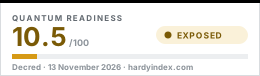
Tier 5: Exposed. The signatures securing funds on mainnet today are quantum-vulnerable, and no public post-quantum plan, proposal or research programme addressing them could be found.
A role not listed is not evidenced either way. Every scheme, and which other chains share it, is in the cryptography registry.
| No. | Dimension | Score | Weight | Contribution |
|---|---|---|---|---|
| 1 | Signature scheme | 0 | 30% | 0.0 |
| 2 | Deployment stage | 1 | 25% | 2.5 |
| 3 | NIST alignment | 0 | 15% | 0.0 |
| 4 | Migration path | 2 | 15% | 3.0 |
| 5 | Exposure | 4 | 10% | 4.0 |
| 6 | Verification | 2 | 5% | 1.0 |
| Hardy Score | 10.5 | |||
Band 0: Classical signatures only on mainnet, with nothing post-quantum protecting live funds. Short-lived devnets and one-off benchmarks sit here: they demonstrate research rather than something a user can hold keys on.
dcrd defines three signature types for transaction scripts: ECDSA over secp256k1, Ed25519, and Schnorr over secp256k1. All are elliptic-curve and broken by Shor's algorithm. The post-quantum key exchange in StakeShuffle mixing protects privacy, not spends, so nothing post-quantum protects DCR on mainnet. source
Band 1: Tier 5: Exposed.
Tier 5: Exposed. The signatures securing DCR are quantum-vulnerable, the Decred Change Proposal index lists thirteen consensus proposals, DCP-0001 to DCP-0013, and none concerns post-quantum signatures, and no Politeia proposal on the subject was found. A sentence in Decred's documentation saying quantum-secure schemes could be added by soft fork is neither a proposal nor a research programme. See the caveat below. source
Band 0 to 2: No post-quantum scheme named for the chain’s fund-protecting signatures, or a proprietary scheme with no public cryptanalysis.
No post-quantum scheme has been named for Decred's fund-protecting signatures. The one post-quantum primitive in dcrd, Streamlined NTRU Prime 4591761, is a key encapsulation used in StakeShuffle mixing, which v1.8 places outside this dimension because it authorises no spend. source
Placement in the band The floor of the band rather than a 1 or a 2: nothing has been named for spends, treasury signatures or ticket votes, and the post-quantum key exchange in mixing is neither a signature nor a NIST standard.
Band 0 to 2: No agreed migration path, or the proposals on the table would strand or freeze holder funds.
No migration plan exists. Decred has a strong record of coordinated upgrades: the DCP process requires stakeholders to approve every consensus change in an on-chain vote, and the thirteen consensus proposals listed, DCP-0001 to DCP-0013, are all active, including the decentralised treasury in May 2021 and the switch to BLAKE3 proof of work in August 2023. OP_CHECKSIGALT takes a signature type byte, so a new scheme has a slot to occupy, but none has been proposed. source
Placement in the band The top of the band rather than a 0 or a 1: thirteen Decred Change Proposals have become active through on-chain stakeholder votes, which is direct evidence that Decred can ship one. Not a 3, because no one has proposed a post-quantum scheme or a route for holders to move coins to one, and the documentation's remark that adding one would be trivial is not an acknowledged plan.
Band 3 to 5: Most active accounts have revealed a public key, or the chain has no live supply to assess.
Decred follows Bitcoin's UTXO model: a standard address is a key hash and the key is published when an output is spent, so never-spent coins have published no key while reuse and spending reveal keys. Treasury spends are signed by one of two Politeia public keys written into the chain parameters, so those keys are public by design, though a spend also needs stakeholder approval. source
Placement in the band A 4 rather than a 5, on the same address-model reasoning as Litecoin and Dogecoin: reuse and spending reveal keys and nobody has measured the share of DCR behind them. Not a 3, because the treasury's published keys cannot spend without a stakeholder vote, and a measurement could take exposure either way.
Band 0 to 2: No post-quantum component exists, or the claims rest on marketing.
No post-quantum component protects DCR. StakeShuffle's NTRU Prime key exchange is merged, open source and running on mainnet, but it protects the privacy of mixes, not funds, so v1.8 does not count it here. Decred markets its privacy as post-quantum secure, not its coins, and the openness of the classical code earns nothing. source
Placement in the band The top of the band rather than a 0 or a 1: there is no fund-protecting post-quantum component to verify, and the post-quantum claim Decred does make is scoped to mixing privacy and matches the code, so the position does not rest on marketing.
The deployment dimension is not a separate judgement. It is Tier 5 expressed as a number. See the tier mapping.
The 9 chains Decred sits among, out of 80 rated. The last column is the gap in Hardy points from Decred.
| Rank | Chain | Tier | Hardy | vs DCR |
|---|---|---|---|---|
| 38 | Ethereum Classic | 5: Exposed | 13.0 | +2.5 |
| 39 | Flare | 5: Exposed | 13.0 | +2.5 |
| 40 | Internet Computer | 5: Exposed | 13.0 | +2.5 |
| 41 | TON | 5: Exposed | 11.0 | +0.5 |
| 42 | Decred this chain | 5: Exposed | 10.5 | |
| 43 | IOTA | 5: Exposed | 10.5 | level |
| 44 | Litecoin | 5: Exposed | 10.5 | level |
| 45 | Midnight | 5: Exposed | 10.5 | level |
| 46 | Qtum | 5: Exposed | 10.5 | level |
Decred's mainnet genesis block. Decred began its own ledger, so it shares no transaction history with Bitcoin and the exposure inheritance rule does not apply. source
DCP-0006, the decentralised treasury, activates at block 552,448 after a stakeholder vote. Treasury spends are signed with Schnorr by sanctioned Politeia keys and need stakeholder approval. Not post-quantum work, but evidence of governance capability. source
Decred 1.7 adds post-quantum secure mixing to StakeShuffle, protecting the privacy of mixed coins against quantum computers. It does not change the signatures that protect coins. source
DCP-0011 activates at block 794,368 after a stakeholder vote, changing proof of work to BLAKE3 with ASERT difficulty. Not post-quantum work, but a hard fork delivered through on-chain voting. source
No Decred Change Proposal, Politeia proposal or research programme to replace Decred's elliptic-curve signatures was found at the time of writing. source
No stated policy
No Decred Change Proposal, Politeia proposal or statement from Decred's developers addresses coins that never move to post-quantum keys.
As of 22 October 2026. Published beside the score, not in it. Every chain's stance is compared on the commitments page.
Exposure measures how much of the chain's value already sits behind a public key that an attacker can record today and break later. This is the part of the threat that a future upgrade cannot undo.
Decred began its own ledger with a genesis block on 8 February 2016, so it shares no transaction history with Bitcoin and inherits no measurement from it. Within that ledger it follows Bitcoin's UTXO model: a standard address is a hash of a public key, the key is revealed when an output is spent, and address reuse erodes the protection. Two Decred features add to the picture. The treasury, which held about 884,192 DCR of 17,657,816 mined, or roughly 5%, on dcrdata on 22 October 2026, is debited by spends signed with one of two Politeia public keys written into the chain parameters, so those keys are public by design; a spend also needs stakeholder approval through ticket votes, which a broken key alone does not provide. Ticket votes reveal the voting key when they are cast, and the staked coins are then returned to a commitment address that is a key hash. No measurement of the share of DCR behind revealed keys was found, so the score reflects the address model rather than a measured figure.
What this rating means for you
Decred runs quantum-vulnerable signatures with no published post-quantum plan that we could find. Nothing here is urgent today, and there is also nothing scheduled to change it.
Editorial guidance from the Hardy Index.
We will email you the day this rating moves, with the changelog note that explains why. Nothing else, and nothing in between.
No. DCR is protected by ECDSA on secp256k1 by default, with Ed25519 and a Decred Schnorr variant also available, and treasury spends and ticket votes use the same family of elliptic-curve signatures. A sufficiently large quantum computer would break all of them. No post-quantum signature is deployed or proposed for Decred.
For mixing, yes in the sense claimed. StakeShuffle combines a secp256k1 key exchange with Streamlined NTRU Prime 4591761, so a quantum attacker who recorded the mix traffic should not be able to unlink mixed coins later. It does not protect the coins themselves: the outputs a mix produces are still spent with elliptic-curve signatures that a quantum computer would break.
Its design makes room for one. OP_CHECKSIGALT verifies signatures by a type byte, which is how Ed25519 and Schnorr sit beside ECDSA, and Decred's documentation says quantum-secure schemes could be added by soft fork. Decred's stakeholders have also approved thirteen Decred Change Proposals in on-chain votes. What is missing is the proposal: no scheme has been chosen and no Decred Change Proposal or Politeia proposal has been filed.
No. Decred follows Bitcoin's transaction model, but its ledger began with its own genesis block on 8 February 2016, so no Bitcoin output exists on Decred. Its exposure comes from its own history: address reuse, ordinary spending and the treasury's published Politeia keys.
A rating is only true as of the day an editor last reviewed it, so both forms below carry that date and the methodology version, with the date its cited sources were last checked. If you are quoting the score, quote those too.
The Hardy Index (2026). Decred: quantum readiness assessment. Hardy Score 10.5 of 100, Tier 5: Exposed. Methodology v1.8. Last reviewed 22 October 2026; sources checked 13 November 2026. https://hardyindex.com/chains/decred
@misc{hardyindex_decred_2026,
  author       = {{The Hardy Index}},
  title        = {Decred: quantum readiness assessment},
  year         = {2026},
  howpublished = {\url{https://hardyindex.com/chains/decred}},
  note         = {Hardy Score 10.5 of 100, Tier 5: Exposed. Methodology v1.8},
  urldate      = {2026-11-13}
}
The whole dataset is reusable under the terms on the about page. A machine-readable version of this page is at /chains/decred.md.
This is a security-readiness assessment, not investment advice.