1 Signature scheme 0/10, weighted 30%
Band 0: Classical signatures only on mainnet, with nothing post-quantum protecting live funds. Short-lived devnets and one-off benchmarks sit here: they demonstrate research rather than something a user can hold keys on.
go-flare's secp256k1 package signs and recovers keys with the decred secp256k1 ECDSA implementation, used for P-chain transactions, and the C-chain recovers EVM senders with ECDSA on secp256k1. Nothing post-quantum protects FLR or any asset on Flare today.
source
2 Deployment stage 1/10, weighted 25%
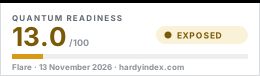
Band 1: Tier 5: Exposed.
Tier 5: Exposed. The signatures securing Flare are quantum-vulnerable. The one post-quantum item, a 2022 Flare Research paper proposing a hybrid Dilithium transaction type for the EVM, was not taken into Flare's FIP or STP governance process, and no implementation or later work followed. See the caveat below on why this is a judgement call.
source
3 NIST alignment 3/10, weighted 15%
Band 3 to 5: NIST schemes are referenced as candidates without a committed selection, or the work is bespoke research.
The Flare Research paper selects one scheme for EVM transaction signatures in general, not for Flare's own: deterministic CRYSTALS-Dilithium Level 2, the pre-standard round-three form of the scheme NIST later standardised as ML-DSA in FIPS 204. Flare has not adopted it or any other scheme for its own accounts or validators.
source
Placement in the band The floor of the band rather than a 4 or a 5: the paper names round-three Dilithium for the EVM in general rather than for Flare's own signatures, and Flare never proposed or adopted it. Above a 2, because Flare's own research team published it and it selects a single scheme and security level.
4 Migration path 2/10, weighted 15%
Band 0 to 2: No agreed migration path, or the proposals on the table would strand or freeze holder funds.
The paper sketches a mechanism: new hybrid addresses derived from both an ECDSA and a Dilithium key, with a possible cutoff after which addresses created later may only send hybrid transactions. Existing addresses would keep signing with ECDSA alone, so holders would have to move funds to gain protection.
source
Placement in the band The top of the band rather than a 0 or a 1: Flare's own research team has published a concrete hybrid-address design for EVM accounts. Not a 3, because the paper is written for the EVM in general rather than for Flare, it was never proposed to Flare governance, it leaves the P-chain and validator keys unaddressed, and no one with authority over Flare has acknowledged migration as Flare's problem.
5 Exposure 2/10, weighted 10%
Band 0 to 2: Public keys are exposed for effectively all accounts, or a large, measured share of total supply sits in exposed addresses.
Both Flare address formats are key hashes: a C-chain address is the Ethereum-style Keccak hash of the public key, and a P-chain address is RIPEMD-160 of SHA-256 of the key, so an account that has never signed keeps its key private. Accounts in active use have signed and published their keys.
source
Placement in the band The top of the band rather than a 0 or a 1: the hashed-address model protects never-signed accounts on both chains. Not a 3, because the accounts that hold economically meaningful FLR have signed, staking and delegation included, and no measured share of exposed supply has been published.
6 Verification 2/10, weighted 5%
Band 0 to 2: No post-quantum component exists, or the claims rest on marketing.
No post-quantum component exists for Flare: the 2022 paper specifies a design, and no code, governance proposal or testnet implementation was found in Flare's public repositories. Under v1.8 a design paper is not a component, and the openness of the classical node earns nothing here.
source
Placement in the band The top of the band rather than a 0 or a 1: there is nothing to verify, but Flare does not market the chain as quantum-safe, and the paper presents its scheme as a proposal for the EVM rather than as something Flare runs.