1 Signature scheme 0/10, weighted 30%
Band 0: Classical signatures only on mainnet, with nothing post-quantum protecting live funds. Short-lived devnets and one-off benchmarks sit here: they demonstrate research rather than something a user can hold keys on.
Every account type usable on Tezos mainnet is classical: tz1 Ed25519, tz2 secp256k1, tz3 P-256 and tz4 BLS12-381. The ML-DSA-44 tz5 account type is present in the active protocol, but the constant tz5_account_enable reads false on mainnet, so nothing post-quantum protects XTZ. tz5 accounts are enabled on Quantumnet, but Tezos Commons describes it as an engineering playground not intended for production use, and it is not listed among the Tezos test networks at teztnets.com, so it is not the persistent test network a higher score needs.
source
2 Deployment stage 5/10, weighted 25%
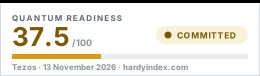
Band 5: Tier 3: Committed.
Tier 3: Committed. Tezos core developers, in a piece by co-founder Arthur Breitman published by Trilitech, set out a plan for Tezos to become fully post-quantum through protocol amendments, naming ML-DSA-44 for tz5 accounts, and the tz5 code already sits in the adopted Ushuaia amendment. Nothing post-quantum is live on mainnet.
source
3 NIST alignment 8/10, weighted 15%
Band 6 to 8: The scheme is NIST-selected but the standard is not yet final, or a NIST-approved scheme is named but not yet deployed.
The account scheme implemented and tested is ML-DSA-44, a parameter set of ML-DSA under the final FIPS 204 standard, carried in Octez as a new tz5 address type rather than named as a candidate. It is built into the active protocol but disabled on mainnet, so it is a NIST-approved scheme named and not yet deployed.
source
Placement in the band The top of the band rather than a 9: ML-DSA-44 is under a final standard and is already in the active protocol, but tz5_account_enable is false on mainnet, so the scheme is not in use, and the consensus side of the plan uses a LeanEthereum variant of XMSS with STARK aggregation that no NIST standard covers.
4 Migration path 6/10, weighted 15%
Band 6 to 8: A credible published plan exists with a mechanism identified, but key parts are unbuilt or undated.
The route off a vulnerable key is built: a holder would move funds to a tz5 account once an amendment enables it, and Tezos has adopted every protocol change since 2019 by on-chain self-amendment, so governance can plausibly deliver it. The published plan also sketches a fencepost date after which a post-quantum zero-knowledge proof of the seed words may be required.
source
Placement in the band A 6 rather than a 7 or 8: tz5 is a new address, so migration means a transfer rather than keeping an address, the fencepost and seed-proof idea is stated as something the protocol may do rather than designed, and nothing is dated.
5 Exposure 2/10, weighted 10%
Band 0 to 2: Public keys are exposed for effectively all accounts, or a large, measured share of total supply sits in exposed addresses.
Tezos addresses are hashes of public keys, and an account stays unrevealed until it transacts. Once it sends a transaction or a reveal operation its classical key is on-chain, and bakers' consensus keys are public by design, so effectively all active XTZ sits behind an exposed key.
source
Placement in the band At the top of the band rather than a 0 or a 1: the hashed address keeps the key of a never-used account private, a structural protection the floor of this band lacks, though almost no active supply benefits from it.
6 Verification 4/10, weighted 5%
Band 3 to 5: A post-quantum component exists, on mainnet, on a persistent testnet or as a merged implementation, but is unreviewed.
The tz5 component is open source and merged into Octez, built on bindings to the libcrux ML-DSA library, and it runs on Quantumnet. Its merge requests, 20236, 20257 and 20680, were approved by engineers who are themselves among the feature's authors, Albin Coquereau, Victor Dumitrescu and Marina Polubelova, and by their colleagues, so the review is from inside the authoring team, and no audit of the component has been published.
source
Placement in the band A 4 rather than a 3 or a 5: the code is merged and ships, switched off, inside the protocol mainnet runs, which is more than a branch, but the network where it is switched on is an engineering playground rather than a persistent test network. Review of the upstream libcrux library does not count here.