Deliverable D1.1 in-progress
Assess state-of-the-art post-quantum cryptography building blocks for use in Cardano's core primitives. source
Chain profile
Cardano Vision 2026 makes post-quantum security one of three strategic pillars, with named research deliverables running from primitive assessment to a published migration SIP.
No, not today. Cardano signs transactions with Ed25519 and elects slot leaders using an elliptic-curve verifiable random function, and a sufficiently large quantum computer breaks both. Cardano's answer is a research programme rather than a deployment schedule. Input Output's Cardano Vision 2026 names post-quantum security as one of three strategic pillars and sets out a bottom-up plan: assess state-of-the-art post-quantum building blocks, design a novel post-quantum verifiable random function to replace the one that currently elects slot leaders, produce an end-to-end security proof for an improved Ouroboros protocol, build a prototype, and publish a migration strategy as a SIP. The stated ambition is to make Cardano the first mainstream proof-of-stake blockchain with a formally grounded, evidence-based post-quantum migration strategy. The deliverables are named but, at the time of writing, individual dates for them were not published beyond the 2026 programme cycle.
Where we are making a judgement call Cardano's post-quantum programme names deliverables but, at the time of writing, we could not find published dates for the individual deliverables beyond the 2026 programme cycle. We have dated D3.1 to 2027 as the terminal deliverable in a 2026 research cycle; treat that as our inference, not as a Cardano commitment. Separately, no published measurement of Cardano's exposed supply could be found, so the exposure dimension is scored on the address model rather than on a count. That is the general limit stated on the methodology page, and it applies to this row.
Ed25519 for transaction signing; elliptic-curve VRF for slot-leader election
Not yet selected. A novel post-quantum VRF and quantum-secure replacements for Cardano's signature and key-evolving signature primitives are in design.
None committed. Deliverable D1.1 is an assessment of post-quantum building blocks.
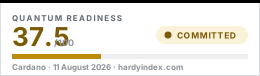
Tier 3: Committed. A funded roadmap with public dates and active research exists, but no post-quantum signature is live on mainnet.
| No. | Dimension | Score | Weight | Contribution |
|---|---|---|---|---|
| 1 | Signature scheme | 0 | 30% | 0.0 |
| 2 | Deployment stage | 5 | 25% | 12.5 |
| 3 | NIST alignment | 5 | 15% | 7.5 |
| 4 | Migration path | 6 | 15% | 9.0 |
| 5 | Exposure | 4 | 10% | 4.0 |
| 6 | Verification | 9 | 5% | 4.5 |
| Hardy Score | 37.5 | |||
Band 0: Classical signatures only on mainnet, with nothing post-quantum protecting live funds. Short-lived devnets and one-off benchmarks sit here: they demonstrate research rather than something a user can hold keys on.
Cardano mainnet signs with Ed25519 and its slot-leader election uses an elliptic-curve VRF, both broken by Shor's algorithm. No post-quantum signature is available on mainnet in any form, opt-in or otherwise. source
Band 5: Tier 3: Committed.
Tier 3: Committed. Post-quantum security is one of three named pillars of a funded research programme with named deliverables and an identified research lead, and nothing is live on mainnet. source
Band 3 to 5: NIST schemes are referenced as candidates without a committed selection, or the work is bespoke research.
The programme's first deliverable is assessing state-of-the-art post-quantum building blocks rather than committing to a NIST scheme, and the post-quantum VRF it plans to design is novel research with no standardised counterpart. Cardano has not yet named the signature scheme it intends to adopt. source
Placement in the band The top of the band rather than a 3: the programme is funded, names its research lead and enumerates deliverables, which is stronger than a passing reference to candidates. It cannot reach 6 because no signature scheme has been selected and the planned post-quantum VRF has no standardised counterpart at all.
Band 6 to 8: A credible published plan exists with a mechanism identified, but key parts are unbuilt or undated.
A published migration strategy is deliverable D3.1, so the plan for the plan exists rather than the plan itself. Cardano's on-chain governance gives it a credible route to enact a change once designed, and its formal-methods culture means a migration SIP would arrive with proofs attached. source
Placement in the band The floor of the band: what exists is deliverable D3.1, a commitment to produce a migration strategy, rather than the strategy itself. A 7 or an 8 would need the mechanism named, and on-chain governance is the route to enact a plan rather than the plan.
Band 3 to 5: Most active accounts have revealed a public key, or the chain has no live supply to assess.
CIP-19 defines a Shelley address as a payment credential plus a delegation credential, each of them a blake2b-224 hash of an Ed25519 verification key rather than the key itself. A payment key is therefore revealed when an output is spent, not when an address is created, so never-spent holdings are not yet harvestable. The stake key is revealed separately when an address delegates. Scored on the address model: we found no published measurement of Cardano's exposed share. source
Placement in the band A 4 rather than a 3, because the payment key is revealed only when an output is spent, so never-spent holdings remain unharvestable, which is better than the account-model chains sharing this band. Not a 5, because no published measurement of Cardano's exposed share was found and the stake key is revealed separately on delegation.
Band 9 to 10: Open source, independently audited, with the claim checkable on-chain or in public research.
Cardano's research is peer-reviewed and published, the programme names its research lead and enumerates deliverables, the protocol is open source, and the roadmap was put through Cardano's on-chain governance process rather than announced unilaterally. source
Placement in the band Not a 10: the peer review and the governance process are real, but they cover research and a roadmap. There is no deployed post-quantum component on Cardano for anyone to audit or check on-chain.
The deployment dimension is not a separate judgement. It is Tier 3 expressed as a number. See the tier mapping.
The 9 chains Cardano sits among, out of 31 rated. The last column is the gap in Hardy points from Cardano.
| Rank | Chain | Tier | Hardy | vs ADA |
|---|---|---|---|---|
| 13 | Zcash | 3: Committed | 41.0 | +3.5 |
| 14 | Aptos | 3: Committed | 40.5 | +3.0 |
| 15 | Polkadot | 3: Committed | 40.5 | +3.0 |
| 16 | Ethereum | 3: Committed | 40.0 | +2.5 |
| 17 | Cardano this chain | 3: Committed | 37.5 | |
| 18 | Tron | 4: Debating | 34.5 | -3.0 |
| 19 | BNB Chain | 4: Debating | 22.5 | -15.0 |
| 20 | Monero | 4: Debating | 21.0 | -16.5 |
| 21 | IOTA | 5: Exposed | 18.5 | -19.0 |
Assess state-of-the-art post-quantum cryptography building blocks for use in Cardano's core primitives. source
Design a novel post-quantum verifiable random function to replace the one currently used to elect slot leaders. source
Produce an end-to-end security proof for an improved, post-quantum-secure Ouroboros protocol. source
Build a prototype implementing the post-quantum Ouroboros design. source
Publish a post-quantum migration strategy as a SIP. source
Exposure measures how much of the chain's value already sits behind a public key that an attacker can record today and break later. This is the part of the threat that a future upgrade cannot undo.
Cardano's extended UTXO model gives it a structural advantage over account-model chains. CIP-19 defines a Shelley address as a payment credential plus a delegation credential, each a blake2b-224 hash of an Ed25519 verification key, so the payment public key is not on-chain until an output is spent. ADA that has been received and never moved is therefore not harvestable today. Two qualifiers cut against that. Spending reveals the payment key permanently, and delegating reveals the stake key separately, so the unexposed share is smaller than the address model alone would suggest. We found no published measurement of how much smaller.
What this rating means for you
Cardano has a funded roadmap but no post-quantum signature protecting funds on mainnet yet. Until it ships, your exposure is the ordinary one, and the steps that reduce it cost nothing.
Editorial guidance from the Hardy Index. Nothing on this profile is sponsored and nothing on it is an affiliate link. The guides carry disclosed affiliate links, which never affect a rating. How we make money.
From the newsroom
We will email you the day this rating moves, with the changelog note that explains why. Nothing else, and nothing in between.
No. Cardano uses Ed25519 signatures and an elliptic-curve verifiable random function for slot-leader election, and a sufficiently large quantum computer breaks both. Cardano has a funded research programme aimed at replacing those primitives but nothing post-quantum is live on mainnet.
It makes post-quantum security one of three strategic pillars alongside user-centric design and scalable architecture. The work is described as bottom-up: build quantum-secure replacements for Cardano's core primitives, including the signatures and key-evolving signatures that protect proof-of-stake security, then prove the resulting protocol secure end to end and publish a migration strategy.
Because Cardano's proof-of-stake security depends on the verifiable random function that elects slot leaders, not only on transaction signatures. If that VRF is built on elliptic curves, a quantum adversary could predict or manipulate leader election even if transaction signatures were already post-quantum. Deliverable D1.2 is designing a novel post-quantum VRF for exactly this reason.
Not yet. The programme's first deliverable is an assessment of state-of-the-art post-quantum building blocks, which means the selection is still open. That is the main reason Cardano scores 5 rather than higher on NIST alignment in this index: it has not committed to a standardised scheme.
A rating is only true as of the day it was reviewed, so both forms below carry the review date and the methodology version. If you are quoting the score, quote those too.
The Hardy Index (2026). Cardano: quantum readiness assessment. Hardy Score 37.5 of 100, Tier 3: Committed. Methodology v1.4. Reviewed 2 October 2026. https://hardyindex.com/chains/cardano
@misc{hardyindex_cardano_2026,
  author       = {{The Hardy Index}},
  title        = {Cardano: quantum readiness assessment},
  year         = {2026},
  howpublished = {\url{https://hardyindex.com/chains/cardano}},
  note         = {Hardy Score 37.5 of 100, Tier 3: Committed. Methodology v1.4},
  urldate      = {2026-10-02}
}
The whole dataset is reusable under the terms on the about page. A machine-readable version of this page is at /chains/cardano.md.
This is a security-readiness assessment, not investment advice.