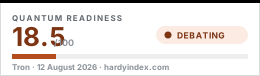
The Hardy Index Quantum readiness benchmark

Chain profile

Tron

TRX Debating

Signs with ECDSA on secp256k1 and has announced an intention to deploy NIST post-quantum signatures on mainnet, but we could not confirm dated milestones from a primary source.

Is Tron quantum-safe?

No. Tron accounts are secured by ECDSA on the secp256k1 curve, the same scheme Bitcoin and Ethereum use, and a sufficiently large quantum computer would break it. Tron has publicly signalled an intention to deploy NIST-standardised post-quantum signatures on mainnet, and has framed that as an ambition to be among the first major public chains to do so. We are recording that intention rather than scoring it, because at the time of writing we could not confirm dated milestones, a named parameter set, or a published technical specification from a primary Tron source. Under this index's rules an announced intention without a verifiable schedule sits in Tier 4, not Tier 3. If Tron publishes a dated roadmap, this profile moves and the change will appear in the changelog.

Where we are making a judgement call We have deliberately not credited Tron's announced post-quantum intention beyond a low score. Public statements of intent are easy to make and hard to verify, and this index rates what can be checked. If Tron publishes a specification, a named parameter set or a testnet implementation, the score will move on evidence rather than on announcement.

At a glance

On mainnet today

ECDSA on secp256k1

Post-quantum scheme

NIST-standardised post-quantum signatures signalled as an intention. No specific scheme or parameter set confirmed.

NIST standard

None confirmed at the time of writing

Readiness tier

Tier 4: Debating. The threat is acknowledged and proposals exist, but there is no consensus and no published timeline.

Score breakdown

Each dimension scored 0 to 10. The weight beside it is its share of the total score.
Show the weighted arithmetic and the sourced note for each dimension
Tron Hardy Score by dimension, with weights and weighted contributions
No. Dimension Score Weight Contribution
1 Signature scheme 0 30% 0.0
2 Deployment stage 2 25% 5.0
3 NIST alignment 4 15% 6.0
4 Migration path 2 15% 3.0
5 Exposure 2 10% 2.0
6 Verification 5 5% 2.5
Hardy Score 18.5

1 Signature scheme 0/10, weighted 30%

Tron signs transactions with ECDSA on secp256k1. Nothing post-quantum protects TRX or TRC-20 balances on mainnet today. source

2 Deployment stage 2/10, weighted 25%

Tier 4: Debating. An intention to adopt NIST post-quantum signatures has been signalled publicly, but we could not confirm a funded roadmap with public dates, which is the test for Tier 3. source

3 NIST alignment 4/10, weighted 15%

Tron has referred to NIST-standardised post-quantum signatures in general terms. We could not confirm which standard or parameter set has been selected, so this scores as a stated direction rather than a committed choice. source

4 Migration path 2/10, weighted 15%

No published migration plan for existing holders was found. Tron's comparatively concentrated validator set would make a protocol change easier to coordinate than on a diffuse network, but that does not address moving holders off already-exposed keys. source

5 Exposure 2/10, weighted 10%

Tron addresses are derived from a hash of the public key, so a funded account that has never sent a transaction keeps its key private. Given Tron's transaction volumes, effectively all economically meaningful accounts have transacted and published their keys. source

6 Verification 5/10, weighted 5%

The protocol client is open source and the signature scheme is verifiable from the code. The post-quantum intention, by contrast, rests on announcements rather than a published specification or testnet implementation we could inspect. source

The deployment dimension is not a separate judgement. It is Tier 4 expressed as a number. See the tier mapping.

How it compares

All 23 rated chains on the 0 to 100 scale. Tron is marked. Select any point to open that profile.

Roadmap

  1. 2026 proposed

    Tron signals an intention to deploy NIST-standardised post-quantum signatures on mainnet. source

  2. No date published proposed

    A dated technical roadmap for post-quantum deployment. None was found at the time of writing. source

Exposure

Exposure measures how much of the chain's value already sits behind a public key that an attacker can record today and break later. This is the part of the threat that a future upgrade cannot undo.

Tron derives addresses from a hash of the public key, in the same manner as Ethereum, so an account that has been funded but has never signed a transaction has not published its key. That protection is theoretical for most of the network. Tron carries very high transaction volumes, particularly in stablecoin transfers, so the accounts holding meaningful value have almost all signed repeatedly and published their keys. Those keys can be recorded today against a future quantum computer.

What this rating means for you

If you hold Tron

Tron has acknowledged the threat without agreeing a plan, so nothing is going to change for holders in the near term. That makes address hygiene the part worth attending to.

Editorial guidance from the Hardy Index. Nothing on this profile is sponsored and nothing on it is an affiliate link. The guides carry disclosed affiliate links, which never affect a rating. How we make money.

Questions

Is Tron quantum-safe?

No. Tron signs with ECDSA on the secp256k1 curve, which a sufficiently large quantum computer would break. Tron has signalled an intention to adopt NIST post-quantum signatures, but nothing post-quantum protects TRX or TRC-20 balances on mainnet today.

Has Tron committed to a post-quantum roadmap?

It has signalled an intention, and we could not confirm more than that. At the time of writing we found no dated milestones, no named parameter set and no published technical specification from a primary Tron source. That is why Tron sits in Tier 4 rather than with the chains that have published schedules.

Does Tron's stablecoin volume change its quantum exposure?

It worsens it in practice. Address derivation on Tron hashes the public key, so an account that has never signed keeps its key private. High transfer volumes mean the accounts holding value have signed many times and published their keys, so the theoretical protection of a hashed address does not apply to most of the network's value.

What would move Tron up this index?

Evidence rather than announcement: a published specification naming a scheme and parameter set, a testnet implementation that can be inspected, or a dated roadmap. Any of those would support a Tier 3 placement and a materially higher score on the NIST and migration dimensions.

Sources

  1. java-tron, the Tron protocol implementation Tron Protocol (GitHub) · primary · checked 12 August 2026
  2. FIPS 204: Module-Lattice-Based Digital Signature Standard (ML-DSA) NIST · primary · checked 12 August 2026
  3. Safeguarding cryptocurrency by disclosing quantum vulnerabilities responsibly Google Research · primary · checked 12 August 2026

This is a security-readiness assessment, not investment advice.