27 December 2020 shipped
Tidecoin's genesis block is mined, with Falcon-512 in place of ECDSA as the signature for every spend. source
Chain profile
Tidecoin has required a Falcon-512 lattice signature for every spend since its mainnet launched on 27 December 2020, and its node verifies transaction signatures with Falcon-512 alone.
Yes, on the signature question this rating measures. Tidecoin is a proof-of-work chain built from the Bitcoin Core codebase with its own genesis block, mined on 27 December 2020, and it replaced ECDSA with Falcon-512, a lattice-based scheme selected by NIST for standardisation as FN-DSA. We checked this in the released node rather than taking it from project material: in Tidecoin Core v0.18.3, the function that verifies every transaction signature calls the PQClean Falcon-512 verifier and nothing else, so there is no classical path a spend can take. We also read it off the chain: a mainnet transaction in block 2,784,867 on 23 October 2026 carries 53 inputs, each with an 898-byte public key (the 897-byte Falcon-512 key plus a one-byte prefix) and a signature of 655 to 663 bytes. The qualifications are about standards and review rather than security. The Falcon that Tidecoin runs is the round 3 specification, verified since genesis under what its own whitepaper calls a relaxed legacy acceptance bound, not the final FN-DSA standard, which NIST had not published at the time of writing. We found no outside audit of the implementation.
Where we are making a judgement call Tidecoin ranks outside the seventy-five largest layer 1s and is covered on the deployment test, because a post-quantum signature runs on its mainnet. We confirmed the chain was live on 23 October 2026, when its explorer reported block 2,784,870 at 05:30 UTC. Two judgement calls shape the row. First, NIST alignment is a 7 rather than the 8 a deployed NIST selection would otherwise get, because Tidecoin's whitepaper says mainnet verifies Falcon under a relaxed legacy acceptance bound rather than the specified one; reading the scheme as plain Falcon-512 would give 8 and a Hardy Score of 90.5 rather than 89.0. Second, verification is a 5 on the view that a NIST mailing-list discussion is not review of the implementation; counting it as public review would give 6 and a Hardy Score of 89.5. The released node is v0.18.3 from 2022, and the 1.0 line is still at release candidate. We did not compile or run the node: the signature finding rests on the released source and on transactions read through the public explorer. The upcoming AuxPoW activation moves mining to merged mining with Litecoin, which would not take Tidecoin outside its own consensus.
Falcon-512 (round 3 Falcon through PQClean), mandatory for every spend since genesis and verified under a legacy acceptance bound
Falcon-512 itself. Falcon-1024 and ML-DSA-44, 65 and 87 are coded in the 1.0 release candidates and gated on an upgrade with no mainnet activation height.
Falcon, selected by NIST for standardisation as FN-DSA (FIPS 206), standard not final at the time of writing; ML-DSA (FIPS 204, final) is specified for a future upgrade only
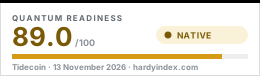
Tier 1: Native. Post-quantum secure at mainnet today, with quantum-resistant signatures built in from genesis.
A role not listed is not evidenced either way. Every scheme, and which other chains share it, is in the cryptography registry.
| No. | Dimension | Score | Weight | Contribution |
|---|---|---|---|---|
| 1 | Signature scheme | 10 | 30% | 30.0 |
| 2 | Deployment stage | 10 | 25% | 25.0 |
| 3 | NIST alignment | 7 | 15% | 10.5 |
| 4 | Migration path | 8 | 15% | 12.0 |
| 5 | Exposure | 9 | 10% | 9.0 |
| 6 | Verification | 5 | 5% | 2.5 |
| Hardy Score | 89.0 | |||
Band 10: A post-quantum signature is the mandatory scheme for all accounts on mainnet.
Falcon-512 is the mandatory signature for every spend on Tidecoin mainnet. In the v0.18.3 release, CPubKey::Verify calls PQCLEAN_FALCON512_CLEAN_crypto_sign_verify and no other verifier, and pubkey.h fixes the public key at 897 bytes plus a prefix byte. The secp256k1 library is still vendored in the tree, but the signature check every script runs goes to Falcon-512. A mainnet transaction in block 2,784,867 confirms it: each of its 53 inputs carries an 898-byte key and a 655 to 663-byte signature. source
Band 10: Tier 1: Native.
Tier 1: Native. Falcon-512 has protected every unit of supply since the genesis block of 27 December 2020, so there is no classical cohort to migrate and nothing a holder has to opt into. source
Band 6 to 8: The scheme is NIST-selected but the standard is not yet final, or a NIST-approved scheme is named but not yet deployed.
Falcon was selected by NIST for standardisation as FN-DSA in FIPS 206, which was not final at the time of writing. Tidecoin's whitepaper says it runs vendored PQClean Falcon implementing the original round 3 specification, and that since genesis it has verified signatures in a legacy mode with a relaxed norm bound derived from the pre-2019 acceptance threshold. A strict mode using the standard bound, plus Falcon-1024 and FIPS 204 ML-DSA, is written into the 1.0 release candidates but gated on an upgrade with no mainnet height set. source
Placement in the band A 7 rather than the 8 a deployed NIST selection would otherwise earn: what verifies on mainnet today is Falcon under a relaxed acceptance bound that Tidecoin itself describes as a legacy mode, rather than the scheme as specified. It is above a 6 because the scheme is the NIST selection, deployed and mandatory, not merely named.
Band 6 to 8: A credible published plan exists with a mechanism identified, but key parts are unbuilt or undated.
There is no classical legacy to migrate. What remains ahead is a scheme upgrade within post-quantum cryptography: the whitepaper bundles strict Falcon verification, Falcon-1024 and ML-DSA into the AuxPoW activation, keeps public keys unchanged between legacy and strict modes so wallets need no key migration, and in the mainnet chain parameters that activation is still set to disabled. source
Placement in the band The top of the band rather than a 7, because no holder has a classical key to move. Not a 9: the move from the legacy Falcon mode to the strict one and to the further schemes is designed and coded but has no activation height on mainnet, and the releases carrying it are candidates rather than final releases.
Band 9 to 10: No quantum-vulnerable public keys are exposed on-chain, or the exposed keys protect nothing.
No Tidecoin public key is a quantum liability in the sense this dimension measures, because every spend has been signed with Falcon-512, whose security rests on lattice problems that Shor's algorithm does not address. Public keys are revealed when outputs are spent, as on Bitcoin, but a revealed Falcon-512 key gives a quantum adversary nothing to harvest. source
Placement in the band Not a 10: the claim that a revealed key is no liability rests on a scheme that is not yet a final standard and that mainnet verifies under a relaxed legacy bound, so it is believed rather than settled. It is above an 8 because no classical key protects any Tidecoin output.
Band 3 to 5: A post-quantum component exists, on mainnet, on a persistent testnet or as a merged implementation, but is unreviewed.
The Falcon-512 component is open source under the MIT licence and its use is checkable on-chain, where every input carries a Falcon-sized key and signature. We found no review of Tidecoin's integration by anyone outside its developers and no audit. The README says Tidecoin was discussed on NIST's pqc-forum mailing list, which we do not count as review of the implementation, and review of the upstream PQClean library does not count here either. source
Placement in the band The top of the band rather than a 4: the component is live, mandatory, openly licensed and visible in every mainnet spend, so an outsider has everything needed to check it. It cannot reach 6 without public review or a named audit of Tidecoin's own code, which we did not find as of 23 October 2026.
The deployment dimension is not a separate judgement. It is Tier 1 expressed as a number. See the tier mapping.
The 9 chains Tidecoin sits among, out of 80 rated. The last column is the gap in Hardy points from Tidecoin.
| Rank | Chain | Tier | Hardy | vs TDC |
|---|---|---|---|---|
| 1 | Quantus Network | 1: Native | 94.0 | +5.0 |
| 2 | Dilithion | 1: Native | 93.5 | +4.5 |
| 3 | Quantum Resistant Ledger | 1: Native | 92.5 | +3.5 |
| 4 | Mochimo | 1: Native | 89.0 | level |
| 5 | Tidecoin this chain | 1: Native | 89.0 | |
| 6 | QoreChain | 2: Shipping | 84.5 | -4.5 |
| 7 | Abelian | 1: Native | 84.0 | -5.0 |
| 8 | NEAR Protocol | 2: Shipping | 80.0 | -9.0 |
| 9 | Algorand | 2: Shipping | 77.0 | -12.0 |
Tidecoin's genesis block is mined, with Falcon-512 in place of ECDSA as the signature for every spend. source
Tidecoin Core v0.18.3 is released, with binaries for Linux, macOS and Windows. It is the current final release, and its verifier calls Falcon-512 alone. source
Tidecoin v1.0.0rc2 is published as a release candidate, built on a codebase initially based on Bitcoin Core v30 and carrying Falcon-1024, ML-DSA-44, 65 and 87, strict Falcon verification and ML-KEM-512 peer transport, all gated on the AuxPoW activation. source
AuxPoW activation, the single height-gated upgrade that switches mining to scrypt merged mining with Litecoin and turns on the further signature schemes. The mainnet parameters set it to disabled, and no activation height has been published. source
Not applicable
Every Tidecoin output since the genesis block has been protected by Falcon-512, so there are no classical-key coins to migrate.
As of 23 October 2026. Published beside the score, not in it. Every chain's stance is compared on the commitments page.
Exposure measures how much of the chain's value already sits behind a public key that an attacker can record today and break later. This is the part of the threat that a future upgrade cannot undo.
Tidecoin keeps Bitcoin's output model, so a public key appears on-chain when the output it protects is spent, and addresses before that are hashes. The difference is what that key is. Every Tidecoin key since genesis has been a Falcon-512 key, and recording one today gives a future quantum computer nothing Shor's algorithm can use, so the harvest-now-decrypt-later exposure this dimension exists to measure does not arise. Tidecoin is not a fork of another chain's history: it has its own genesis block, so it inherits no classical outputs. What a holder is relying on instead is that Falcon-512 holds up, in the round 3 form and the relaxed legacy verification mode mainnet uses today.
What this rating means for you
Tidecoin already runs post-quantum signatures for every account on mainnet, so there is no migration for you to make here. The habits that still matter are address hygiene and keeping your own keys.
Editorial guidance from the Hardy Index.
We will email you the day this rating moves, with the changelog note that explains why. Nothing else, and nothing in between.
On the signature question, yes. Every Tidecoin spend since the genesis block in December 2020 has been signed with Falcon-512, a lattice-based scheme that Shor's algorithm does not break, and the released node verifies signatures with Falcon-512 alone. The open questions are about standards and review rather than about a classical weakness.
Two ways. In the v0.18.3 release the signature verification function calls the PQClean Falcon-512 verifier and nothing else. And on the chain itself, a transaction from 23 October 2026 carries 53 inputs, each with an 898-byte public key and a signature of around 660 bytes. Those are Falcon-512 sizes: an ECDSA key is 33 bytes and its signature about 71.
Falcon was selected by NIST as FN-DSA, but the FIPS 206 standard was not final at the time of writing, which keeps any Falcon chain below 9. Tidecoin sits a point lower than that because its own whitepaper says mainnet has verified Falcon since genesis under a relaxed legacy acceptance bound, with the standard bound due only at a future upgrade that has no date.
It has coded it. The 1.0 release candidates add ML-DSA-44, 65 and 87 and Falcon-1024 alongside Falcon-512, activated together at the AuxPoW upgrade. In the mainnet parameters that upgrade is set to disabled and no activation height has been published, so for now Falcon-512 is what protects funds.
A rating is only true as of the day an editor last reviewed it, so both forms below carry that date and the methodology version, with the date its cited sources were last checked. If you are quoting the score, quote those too.
The Hardy Index (2026). Tidecoin: quantum readiness assessment. Hardy Score 89.0 of 100, Tier 1: Native. Methodology v1.8. Last reviewed 23 October 2026; sources checked 13 November 2026. https://hardyindex.com/chains/tidecoin
@misc{hardyindex_tidecoin_2026,
  author       = {{The Hardy Index}},
  title        = {Tidecoin: quantum readiness assessment},
  year         = {2026},
  howpublished = {\url{https://hardyindex.com/chains/tidecoin}},
  note         = {Hardy Score 89.0 of 100, Tier 1: Native. Methodology v1.8},
  urldate      = {2026-11-13}
}
The whole dataset is reusable under the terms on the about page. A machine-readable version of this page is at /chains/tidecoin.md.
This is a security-readiness assessment, not investment advice.