1 Signature scheme 0/10, weighted 30%
Band 0: Classical signatures only on mainnet, with nothing post-quantum protecting live funds. Short-lived devnets and one-off benchmarks sit here: they demonstrate research rather than something a user can hold keys on.
Stellar accounts sign with Ed25519 and no post-quantum signature protects live XLM on mainnet. The planned ML-DSA support is verification inside Soroban rather than a deployed account signature scheme.
source
2 Deployment stage 5/10, weighted 25%
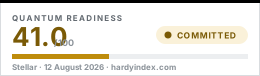
Band 5: Tier 3: Committed.
Tier 3: Committed. A published, staged preparedness plan with named schemes and a 2026 first stage, and nothing post-quantum live on mainnet at the time of writing.
source
3 NIST alignment 8/10, weighted 15%
Band 6 to 8: The scheme is NIST-selected but the standard is not yet final, or a NIST-approved scheme is named but not yet deployed.
The plan names ML-DSA-44 and ML-DSA-65, both parameter sets of the finalised FIPS 204 standard, rather than referring to post-quantum cryptography in the abstract. Committing to specific parameter sets of a final standard is a strong signal.
source
Placement in the band The top of the band rather than a 6 or a 7: ML-DSA-44 and ML-DSA-65 are specific parameter sets of a final standard, not post-quantum cryptography in the abstract. It cannot reach 9 because nothing is deployed, so the standard is committed to rather than in use.
4 Migration path 7/10, weighted 15%
Band 6 to 8: A credible published plan exists with a mechanism identified, but key parts are unbuilt or undated.
Soroban's account abstraction gives Stellar a credible route: contract accounts can adopt quantum-safe authentication without a protocol-wide signature replacement or a contentious fork. The deduction is that this makes protection opt-in, so classic Ed25519 accounts are not carried across by the upgrade itself.
source
Placement in the band A 7 rather than an 8: Soroban's account abstraction is a credible mechanism that avoids a contentious fork, but it makes protection opt-in, so classic Ed25519 accounts are not carried across by the upgrade itself.
5 Exposure 2/10, weighted 10%
Band 0 to 2: Public keys are exposed for effectively all accounts, or a large, measured share of total supply sits in exposed addresses.
A Stellar account ID is a direct encoding of the Ed25519 public key, so the key is readable from the address whether or not the account has ever transacted. Effectively all classical XLM is harvestable today.
source
Placement in the band At the top of the band rather than a 0 or a 1: Stellar meets this band on its structural limb, the account ID being a direct encoding of the key, but no measured share of at-risk supply has been published.
6 Verification 8/10, weighted 5%
Band 6 to 8: Open source with public review or a named third-party audit of the relevant component.
The plan is published by the Stellar Development Foundation under its own name with named algorithms and staged scope, and the protocol and Soroban are open source, so the first stage can be checked against the code as it lands.
source
Placement in the band The top of the band: the plan is published under the foundation's own name with named algorithms and staged scope, against open source, so the first stage is checkable as it lands. It stops short of 9 because nothing post-quantum has landed yet.