1 Signature scheme 7/10, weighted 30%
Band 7 to 9: A post-quantum signature is available on mainnet at the protocol level as a first-class account type.
Falcon-512 is a protocol-level key type for Nexus signature chains: Transaction::Verify in Tritium Core 5.1.6 checks a FALCON or BRAINPOOL signature by the transaction's key type, with no activation gate, and FLKey generates keys at Falcon degree 512. It is opt-in. ExtractScheme returns BRAINPOOL when no scheme parameter is given, and no holder transaction in our mainnet sample used Falcon.
source
Placement in the band The bottom of the band rather than an 8: Falcon is a consensus-level account key type, which is what this band describes, but it is reachable only through a per-call API parameter, the code reverts to Brainpool when the parameter is left out, and we found no Falcon-signed transaction on mainnet. Read as an experimental option on those grounds, it would be a 5.
2 Deployment stage 8/10, weighted 25%
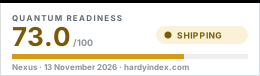
Band 8: Tier 2: Shipping.
Tier 2: Shipping. A Falcon-512 signature is accepted on mainnet for signature-chain transactions, and a holder can select it with released software, without anyone's permission: the stable Nexus wallet, v3.1.5 with installers for Windows, macOS and Linux, bundles Core 5.1.4 and an API console that accepts scheme=falcon. Brainpool ECDSA remains the default.
source
3 NIST alignment 8/10, weighted 15%
Band 6 to 8: The scheme is NIST-selected but the standard is not yet final, or a NIST-approved scheme is named but not yet deployed.
Falcon was selected by NIST for standardisation as FN-DSA in FIPS 206, which was not final at the time of writing. Nexus vendors the Falcon project's 2017 to 2019 reference implementation at degree 512, whose sampler table matches the version fixed in September 2019, and the consensus code accepts it on mainnet today. It is not the FN-DSA standard, which had not been published.
source
Placement in the band The top of the band rather than a 7: the scheme is the NIST selection and is accepted by mainnet consensus now, not merely named for later. It cannot reach 9 because FN-DSA was not final at the time of writing.
4 Migration path 8/10, weighted 15%
Band 6 to 8: A credible published plan exists with a mechanism identified, but key parts are unbuilt or undated.
The mechanism exists: every Nexus transaction names the key type of the next one, so a holder can move a signature chain to Falcon in place, keeping the account, with the documented scheme parameter. Keeping it there is the gap. In our reading of create.cpp, a transaction built without the parameter sets the next key type back to Brainpool, mining and stake blocks are built that way, and the wallet exposes the parameter only through its API console.
source
Placement in the band An 8 rather than the 9 that holders being able to move today would otherwise earn: a holder can switch, but the released software switches them back on any call that omits the parameter, including staking, so a migrated account does not stay migrated without care at every step. It is above a 7 because the rotation mechanism is built into every transaction rather than proposed.
5 Exposure 7/10, weighted 10%
Band 6 to 8: Addresses are key hashes and exposure is limited to spent outputs, keeping a meaningful share of supply unexposed.
Each signature-chain transaction reveals the public key whose SK256 hash the previous transaction committed to as its next hash, and commits in turn to the hash of a fresh key derived from the holder's credentials. Consensus rejects a transaction whose key does not match that commitment, so a Brainpool key read off the chain has already been retired and the key that controls the funds stays hidden. The pre-2019 legacy UTXO layer, whose transactions blocks still carry, uses Bitcoin-style key-hash addresses with ECDSA over sect571r1.
source
Placement in the band A 7 rather than an 8 or a 9: on signature chains a revealed key protects nothing, which would read as the band above, but the legacy UTXO cohort keeps Bitcoin's address model and no measurement of its size or exposure has been published. It is above a 6 because the signature chains, where Tritium-era balances sit, never leave a controlling key exposed.
6 Verification 2/10, weighted 5%
Band 0 to 2: No post-quantum component exists, or the claims rest on marketing.
A post-quantum component exists and is open source under the MIT licence: the vendored Falcon-512 code and the consensus path that verifies it. We found no outside review or audit of it, and no holder transaction using it in our mainnet sample. The project's headline claim, "571-bit" listed under "Quantum Resistant" on its homepage, matches the default curve of the node's elliptic-curve key, sect571r1, which Shor's algorithm breaks.
source
Placement in the band The top of the band rather than a 0 or 1: a real post-quantum component is open source and accepted by consensus, where a chain flagged with no such component sits at 0. Not a 3, because nothing outside the project has verified the component and the headline quantum-resistance claim rests on marketing about a classical curve.