20 October 2022 shipped
The WEMIX3.0 mainnet produces block 1 under Stake-based Proof of Authority, with accounts signing in ECDSA on secp256k1. source
Chain profile
Accounts on WEMIX3.0 sign with ECDSA on secp256k1, its 40 governance-approved block producers sign blocks with secp256k1 node keys, and no post-quantum plan, proposal or research programme was found.
No. WEMIX3.0, the EVM chain whose mainnet produced its first block on 20 October 2022, runs go-wemix, a fork of go-ethereum. Accounts are Ethereum-style externally owned accounts that sign transactions with ECDSA on the secp256k1 curve, and the block producer signs each block header with its node's secp256k1 key, which every other node checks against the producer set recorded in WEMIX's governance contract. A sufficiently large quantum computer running Shor's algorithm would break both. WEMIX describes its consensus as Stake-based Proof of Authority: blocks are produced only by authority members, 40 Node Council Partners also called WONDERS, who are admitted or removed by a majority vote in an on-chain governance contract after staking WEMIX and signing an agreement with the WEMIX Foundation. No post-quantum roadmap, improvement proposal, research programme or code was found in WEMIX's documentation, the go-wemix repository or the WEMIX Foundation's published material, which is why WEMIX sits in Tier 5.
Where we are making a judgement call Two judgement calls carry this profile, and one matter of control belongs beside them. The first judgement is migration. The record of coordinated hard forks is credited at the top of the lowest band, as for other EVM chains without key rotation; a reader who credits nothing short of a mechanism would score 1 and take 1.5 points off. The second is scope. WEMIX's block producers are a permissioned set of 40 members admitted by vote of the existing members after an offline agreement with the WEMIX Foundation, which some readers would not count as a public chain with its own consensus. It is rated, as Hedera is, because it runs its own consensus on a public mainnet that anyone can transact on; a reader who excludes permissioned producer sets would leave it out of the index rather than score it differently. The matter of control: the producer set is not only in the members' hands. go-wemix finds the governance contract through a Registry contract, and the Registry's setContractDomain function, which can point the network at a different governance contract, staking contract or reward address, is restricted to the Registry's owner. Read from the chain through WEMIX's public RPC endpoint on 22 October 2026, that owner, and the owner of the governance contract, is a single externally owned account, the coinbase of the genesis block, and the staking contract is owned by another single account that can upgrade it. A key with that reach over validators and staked funds is a single point of control, and it is quantum-vulnerable like every other key on the chain. Phase 3 of WEMIX's roadmap describes a move to open proof of stake as WEMIX4.0 with no schedule; this profile rates the consensus that runs today.
ECDSA on secp256k1 for account transactions and fee-payer signatures, and for block producers' header signatures
None selected or proposed.
None adopted.
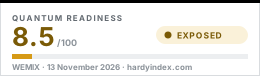
Tier 5: Exposed. The signatures securing funds on mainnet today are quantum-vulnerable, and no public post-quantum plan, proposal or research programme addressing them could be found.
A role not listed is not evidenced either way. Every scheme, and which other chains share it, is in the cryptography registry.
| No. | Dimension | Score | Weight | Contribution |
|---|---|---|---|---|
| 1 | Signature scheme | 0 | 30% | 0.0 |
| 2 | Deployment stage | 1 | 25% | 2.5 |
| 3 | NIST alignment | 0 | 15% | 0.0 |
| 4 | Migration path | 2 | 15% | 3.0 |
| 5 | Exposure | 2 | 10% | 2.0 |
| 6 | Verification | 2 | 5% | 1.0 |
| Hardy Score | 8.5 | |||
Band 0: Classical signatures only on mainnet, with nothing post-quantum protecting live funds. Short-lived devnets and one-off benchmarks sit here: they demonstrate research rather than something a user can hold keys on.
WEMIX transactions are validated through go-ethereum's signer, which recovers an ECDSA secp256k1 sender, and fee-delegated transactions add a second secp256k1 signature from the fee payer. Block producers sign headers with secp256k1 node keys. Nothing post-quantum protects WEMIX or any asset on the chain today. source
Band 1: Tier 5: Exposed.
Tier 5: Exposed. The signatures that authorise spends and seal blocks are quantum-vulnerable, and no post-quantum roadmap, improvement proposal or research programme was found from the WEMIX Foundation, in WEMIX's documentation or in the go-wemix repository. source
Band 0 to 2: No post-quantum scheme named for the chain’s fund-protecting signatures, or a proprietary scheme with no public cryptanalysis.
No post-quantum scheme has been named for WEMIX's account or block producer signatures. Neither the WEMIX3.0 documentation nor the go-wemix code mentions one. source
Placement in the band The floor of the band rather than a 1 or a 2: no one with authority over WEMIX has named a post-quantum scheme for its signatures, so there is nothing to place against a standard.
Band 0 to 2: No agreed migration path, or the proposals on the table would strand or freeze holder funds.
WEMIX has coordinated network upgrades through hard forks, Applepie at block 20,476,911 on 14 June 2023 and Brioche at block 53,525,500 on 1 July 2024 Korean time, so a change of signature scheme could be delivered the same way. There is no mechanism for replacing an account's key in place: an address is a hash of its key, and moving to a new key means moving the funds. Nothing on post-quantum migration has been proposed. source
Placement in the band The top of the band rather than a 0 or a 1: the record of coordinated hard forks under a 40-member governance shows a change could be delivered. Not a 3, because no key rotation or account abstraction mechanism exists and the problem has not been acknowledged.
Band 0 to 2: Public keys are exposed for effectively all accounts, or a large, measured share of total supply sits in exposed addresses.
WEMIX uses Ethereum's account model, in which an address is a hash of the public key, so a funded account that has never sent a transaction keeps its key private. Any account that has signed has published its key, and because WEMIX accounts use the same keys and addresses as Ethereum, a key that has signed on any EVM chain is exposed on WEMIX too. source
Placement in the band The top of the band rather than a 1: the hashed-address model protects never-signed accounts. Not a 3, because almost all economically active WEMIX sits behind a key that has signed, and no measurement of the unexposed share has been published.
Band 0 to 2: No post-quantum component exists, or the claims rest on marketing.
No post-quantum component exists for WEMIX's signatures: no code, specification or testnet implementation was found. go-wemix is open source, but under v1.8 the openness of classical code earns nothing here. source
Placement in the band The top of the band rather than a 0 or a 1: there is no post-quantum component to verify, but nothing about WEMIX is marketed as quantum-safe, so its position does not rest on marketing.
The deployment dimension is not a separate judgement. It is Tier 5 expressed as a number. See the tier mapping.
The 9 chains WEMIX sits among, out of 80 rated. The last column is the gap in Hardy points from WEMIX.
| Rank | Chain | Tier | Hardy | vs WEMIX |
|---|---|---|---|---|
| 70 | Provenance Blockchain | 5: Exposed | 8.5 | level |
| 71 | Theta Network | 5: Exposed | 8.5 | level |
| 72 | THORChain | 5: Exposed | 8.5 | level |
| 73 | VeChain | 5: Exposed | 8.5 | level |
| 74 | WEMIX this chain | 5: Exposed | 8.5 | |
| 75 | Whitechain | 5: Exposed | 8.5 | level |
| 76 | Beldex | 5: Exposed | 7.5 | -1.0 |
| 77 | Ozone Chain | 5: Exposed | 7.5 | -1.0 |
| 78 | Cronos | 5: Exposed | 7.0 | -1.5 |
The WEMIX3.0 mainnet produces block 1 under Stake-based Proof of Authority, with accounts signing in ECDSA on secp256k1. source
The Brioche hard fork activates at block 53,525,500, changing block rewards to a halving schedule. Signatures are unchanged. source
No post-quantum proposal, research programme, implementation or testnet for WEMIX's account or block producer signatures was found at the time of writing. source
No stated policy
Nothing in WEMIX's documentation or the WEMIX Foundation's published material addresses accounts that never move to post-quantum keys, because no post-quantum migration has been proposed.
As of 22 October 2026. Published beside the score, not in it. Every chain's stance is compared on the commitments page.
Exposure measures how much of the chain's value already sits behind a public key that an attacker can record today and break later. This is the part of the threat that a future upgrade cannot undo.
WEMIX follows Ethereum's address model: an address is derived from a hash of the public key, so an account that has received funds but never sent a transaction has not revealed its key. The first signature reveals it permanently, and active accounts sign constantly, so almost all economically meaningful WEMIX sits behind a key that can be collected today against a future quantum computer. Because WEMIX keys and addresses are the same as Ethereum's, a key published by a signature on any EVM chain is equally visible here. Block producers' node keys are public by design, since their node IDs are the public keys and are recorded in the governance contract. WEMIX3.0 started from its own genesis in October 2022 and is not a fork of another chain's history, so the exposure inheritance rule does not apply. No measurement of exposed supply has been published.
What this rating means for you
WEMIX runs quantum-vulnerable signatures with no published post-quantum plan that we could find. Nothing here is urgent today, and there is also nothing scheduled to change it.
Editorial guidance from the Hardy Index.
We will email you the day this rating moves, with the changelog note that explains why. Nothing else, and nothing in between.
No. WEMIX accounts sign with ECDSA on secp256k1, and block producers sign block headers with secp256k1 node keys. A sufficiently large quantum computer would break both. Nothing post-quantum protects WEMIX on mainnet today, and no plan to change that has been published.
Forty authority members, called Node Council Partners or WONDERS, each of whom stakes WEMIX, signs a legal agreement with the WEMIX Foundation and is admitted by a majority vote of the existing members in an on-chain governance contract. Each block's producer signs the header with its node key, and every node checks that key against the governance contract's member list.
No. WEMIX follows Ethereum's account model, where the address is derived from the key, so a new key means a new address and the funds have to be sent across. A post-quantum migration would need a new account type or signature scheme delivered by hard fork, and none has been proposed.
A formal proposal or a public research programme on post-quantum signatures for WEMIX's accounts or block producers, from the WEMIX Foundation or the go-wemix developers, would meet the Tier 4 floor. A published plan naming the scheme WEMIX will adopt would meet Tier 3.
A rating is only true as of the day an editor last reviewed it, so both forms below carry that date and the methodology version, with the date its cited sources were last checked. If you are quoting the score, quote those too.
The Hardy Index (2026). WEMIX: quantum readiness assessment. Hardy Score 8.5 of 100, Tier 5: Exposed. Methodology v1.8. Last reviewed 22 October 2026; sources checked 13 November 2026. https://hardyindex.com/chains/wemix
@misc{hardyindex_wemix_2026,
  author       = {{The Hardy Index}},
  title        = {WEMIX: quantum readiness assessment},
  year         = {2026},
  howpublished = {\url{https://hardyindex.com/chains/wemix}},
  note         = {Hardy Score 8.5 of 100, Tier 5: Exposed. Methodology v1.8},
  urldate      = {2026-11-13}
}
The whole dataset is reusable under the terms on the about page. A machine-readable version of this page is at /chains/wemix.md.
This is a security-readiness assessment, not investment advice.