2025 shipped
The Web3 Foundation publishes a post-quantum cryptography roadmap covering both Polkadot and JAM. source
Chain profile
The Web3 Foundation published a post-quantum roadmap covering Polkadot and JAM, naming Dilithium for consensus signatures and Falcon for accounts.
No, not today. Polkadot signs with sr25519, a Schnorr construction over the Ristretto compression of Curve25519, and with Ed25519 in places, and Shor's algorithm breaks both. Polkadot's answer is unusually broad in scope because a proof-of-stake network with a shared security model has many different signatures to replace, not just account keys. The Web3 Foundation's published roadmap for Polkadot and JAM sets out replacements across the board: the signatures used in GRANDPA finality, BABE block production and other protocol messages move to CRYSTALS-Dilithium, while user account signatures move to Falcon. As of 2026 none of that is live at protocol level, which places Polkadot alongside Ethereum, Cardano and the other chains with a credible published plan and a classical present.
sr25519 (Schnorr over Ristretto-compressed Curve25519), with Ed25519 in some roles
CRYSTALS-Dilithium for consensus signatures; Falcon for account signatures
FIPS 204 (ML-DSA, standardised Dilithium); Falcon pending final publication
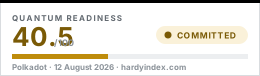
Tier 3: Committed. A funded roadmap with public dates and active research exists, but no post-quantum signature is live on mainnet.
| No. | Dimension | Score | Weight | Contribution |
|---|---|---|---|---|
| 1 | Signature scheme | 0 | 30% | 0.0 |
| 2 | Deployment stage | 5 | 25% | 12.5 |
| 3 | NIST alignment | 8 | 15% | 12.0 |
| 4 | Migration path | 6 | 15% | 9.0 |
| 5 | Exposure | 3 | 10% | 3.0 |
| 6 | Verification | 8 | 5% | 4.0 |
| Hardy Score | 40.5 | |||
Band 0: Classical signatures only on mainnet, with nothing post-quantum protecting live funds. Short-lived devnets and one-off benchmarks sit here: they demonstrate research rather than something a user can hold keys on.
Polkadot uses sr25519 for most signing and Ed25519 in places, both elliptic-curve schemes broken by Shor's algorithm. No post-quantum signature is live at protocol level for accounts or consensus. source
Band 5: Tier 3: Committed.
Tier 3: Committed. A published Web3 Foundation roadmap covers both Polkadot and JAM, names specific replacement schemes for each signature role, and is backed by a research organisation, with nothing live on mainnet. source
Band 6 to 8: The scheme is NIST-selected but the standard is not yet final, or a NIST-approved scheme is named but not yet deployed.
The roadmap names CRYSTALS-Dilithium, standardised as ML-DSA in FIPS 204, for consensus signatures and Falcon for account signatures. One is a final standard and the other is NIST-selected but not yet published. source
Placement in the band Not a 9: only one of the two named schemes, ML-DSA, is a final standard. Falcon is NIST-selected but unpublished, and neither is deployed.
Band 6 to 8: A credible published plan exists with a mechanism identified, but key parts are unbuilt or undated.
Polkadot has a genuine advantage in that its runtime is upgradeable on-chain through forkless upgrades and on-chain governance, so enacting a cryptographic change does not require a contentious hard fork. The deduction is for the breadth of the problem: consensus, parachain and account signatures all have to move, and no dated schedule was found. source
Placement in the band The floor of the band: forkless on-chain upgrades are a genuine mechanism for enacting a cryptographic change without a contentious fork. It cannot reach 7 because consensus, parachain and account signatures all have to move and no dated schedule was found.
Band 3 to 5: Most active accounts have revealed a public key, or the chain has no live supply to assess.
Polkadot addresses are SS58 encodings of the public key itself rather than a hash of it, so an account's key is readable from its address without the account ever having signed. Balances are therefore harvestable today. source
Placement in the band The floor of the band: an SS58 address is the public key itself, so keys are readable without an account ever signing, which is the worst structural position this band covers. It is not a 2 because no measured share of at-risk supply has been published.
Band 6 to 8: Open source with public review or a named third-party audit of the relevant component.
The roadmap was published openly on the Polkadot forum by the Web3 Foundation, the cryptography is documented in public research and wiki material, and the implementation is open source and independently audited. source
Placement in the band The top of the band: the implementation is open source and independently audited, and the roadmap was published openly by the Web3 Foundation. It stops short of 9 because the audited component is the existing cryptography, not a post-quantum one.
The deployment dimension is not a separate judgement. It is Tier 3 expressed as a number. See the tier mapping.
The 9 chains Polkadot sits among, out of 31 rated. The last column is the gap in Hardy points from Polkadot.
| Rank | Chain | Tier | Hardy | vs DOT |
|---|---|---|---|---|
| 11 | Hedera | 3: Committed | 42.0 | +1.5 |
| 12 | Stellar | 3: Committed | 41.0 | +0.5 |
| 13 | Zcash | 3: Committed | 41.0 | +0.5 |
| 14 | Aptos | 3: Committed | 40.5 | level |
| 15 | Polkadot this chain | 3: Committed | 40.5 | |
| 16 | Ethereum | 3: Committed | 40.0 | -0.5 |
| 17 | Cardano | 3: Committed | 37.5 | -3.0 |
| 18 | Tron | 4: Debating | 34.5 | -6.0 |
| 19 | BNB Chain | 4: Debating | 22.5 | -18.0 |
The Web3 Foundation publishes a post-quantum cryptography roadmap covering both Polkadot and JAM. source
Research and implementation work toward replacing GRANDPA, BABE and protocol-message signatures with CRYSTALS-Dilithium. source
Falcon account signatures for Polkadot and its app chains. No dated schedule for mainnet deployment was found at the time of writing. source
Exposure measures how much of the chain's value already sits behind a public key that an attacker can record today and break later. This is the part of the threat that a future upgrade cannot undo.
A Polkadot address in SS58 format encodes the account's public key directly, with a network prefix and a checksum, rather than encoding a hash of the key. That means the key can be read straight off the address, and an account does not need to have signed anything for its key to be known. This is the same structural position as Algorand and Solana, and it means every classical DOT balance is available for harvest-now-decrypt-later collection today rather than only after first spend.
What this rating means for you
Polkadot has a funded roadmap but no post-quantum signature protecting funds on mainnet yet. Until it ships, your exposure is the ordinary one, and the steps that reduce it cost nothing.
Editorial guidance from the Hardy Index. Nothing on this profile is sponsored and nothing on it is an affiliate link. The guides carry disclosed affiliate links, which never affect a rating. How we make money.
We will email you the day this rating moves, with the changelog note that explains why. Nothing else, and nothing in between.
No. Polkadot signs with sr25519 and Ed25519, both of which are broken by Shor's algorithm on a sufficiently large quantum computer. The Web3 Foundation has published a post-quantum roadmap naming replacement schemes, but nothing post-quantum is live at protocol level.
Two different schemes for two different jobs. Consensus signatures, meaning those used in GRANDPA finality, BABE block production and other protocol messages, move to CRYSTALS-Dilithium. User account signatures, including those of app chains built on Polkadot, move to Falcon.
Probably not, and that is one of its advantages. Polkadot's runtime can be upgraded on-chain through its governance process without requiring node operators to coordinate a hard fork. The difficulty is scope rather than mechanism: consensus, parachain and account signatures all have to change.
Because a Polkadot address is an encoding of the public key itself rather than a hash of it. On Bitcoin or Cardano, a funded address that has never spent keeps its key private. On Polkadot the key is readable from the address, so every classical balance is exposed to collection today.
A rating is only true as of the day it was reviewed, so both forms below carry the review date and the methodology version. If you are quoting the score, quote those too.
The Hardy Index (2026). Polkadot: quantum readiness assessment. Hardy Score 40.5 of 100, Tier 3: Committed. Methodology v1.4. Reviewed 2 October 2026. https://hardyindex.com/chains/polkadot
@misc{hardyindex_polkadot_2026,
  author       = {{The Hardy Index}},
  title        = {Polkadot: quantum readiness assessment},
  year         = {2026},
  howpublished = {\url{https://hardyindex.com/chains/polkadot}},
  note         = {Hardy Score 40.5 of 100, Tier 3: Committed. Methodology v1.4},
  urldate      = {2026-10-02}
}
The whole dataset is reusable under the terms on the about page. A machine-readable version of this page is at /chains/polkadot.md.
This is a security-readiness assessment, not investment advice.