April 2026 shipped
Hedera publishes a phased post-quantum migration roadmap moving from Ed25519 and ECDSA to NIST-standardised algorithms. source
Chain profile
Published a phased post-quantum migration roadmap in April 2026, targeting a new post-quantum key type for users in 2027 with existing keys continuing to work.
No, not today. Hedera accounts are secured by Ed25519 or ECDSA on secp256k1, and a sufficiently large quantum computer breaks both. Hedera has said so itself, in its own words: Ed25519 and ECDSA remain secure today but are vulnerable in the face of future quantum advances. In April 2026 Hedera published a phased migration roadmap moving to NIST-standardised algorithms, with a new post-quantum key type for users targeted for a 2027 release and testnet trials before that. The plan is explicitly backward compatible, so existing Ed25519 and ECDSA keys keep working through the transition rather than being invalidated. That combination, a named standard and a dated release window with no break for existing holders, is why Hedera scores well on migration despite having nothing post-quantum live on mainnet.
Ed25519 or ECDSA on secp256k1, selectable per account
A new post-quantum key type targeted for 2027, using Falcon or ML-DSA if the Falcon standard is delayed
FIPS 204 (ML-DSA); Falcon pending final publication
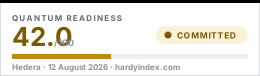
Tier 3: Committed. A funded roadmap with public dates and active research exists, but no post-quantum signature is live on mainnet.
| No. | Dimension | Score | Weight | Contribution |
|---|---|---|---|---|
| 1 | Signature scheme | 0 | 30% | 0.0 |
| 2 | Deployment stage | 5 | 25% | 12.5 |
| 3 | NIST alignment | 8 | 15% | 12.0 |
| 4 | Migration path | 8 | 15% | 12.0 |
| 5 | Exposure | 2 | 10% | 2.0 |
| 6 | Verification | 7 | 5% | 3.5 |
| Hardy Score | 42.0 | |||
Band 0: Classical signatures only on mainnet, with nothing post-quantum protecting live funds. Short-lived devnets and one-off benchmarks sit here: they demonstrate research rather than something a user can hold keys on.
Hedera accounts and transactions are signed with Ed25519 or ECDSA on secp256k1 today. Both are broken by Shor's algorithm, and no post-quantum signature protects live HBAR. source
Band 5: Tier 3: Committed.
Tier 3: Committed. A phased migration roadmap was published in April 2026 with a named scheme and a target release window, and testnet trials are scheduled ahead of it, but nothing post-quantum is live on mainnet. source
Band 6 to 8: The scheme is NIST-selected but the standard is not yet final, or a NIST-approved scheme is named but not yet deployed.
The roadmap commits to NIST-standardised algorithms and names ML-DSA, finalised as FIPS 204, as the fallback if the Falcon standard slips. That is a committed selection of a published standard rather than a survey of candidates. source
Placement in the band The top of the band rather than a 6 or a 7: ML-DSA is a final standard named as a concrete fallback, not a survey of candidates. It cannot reach 9 because nothing is deployed, so the standard is committed to rather than in use.
Band 6 to 8: A credible published plan exists with a mechanism identified, but key parts are unbuilt or undated.
The transition is designed to be backward compatible: existing Ed25519 and ECDSA keys keep working while a new post-quantum key type is added alongside them. A migration that does not invalidate existing holders is the hard part, and Hedera has designed for it explicitly. source
Placement in the band The top of the band: backward compatibility is designed in explicitly, which is the hard part of this problem. It is not a 9 because holders cannot migrate today and the new key type is not yet live.
Band 0 to 2: Public keys are exposed for effectively all accounts, or a large, measured share of total supply sits in exposed addresses.
Hedera is an account-model network where an account's public key is recorded in state and readable from the mirror nodes, so keys are effectively public rather than revealed only on spend. Classical balances are harvestable today. source
Placement in the band At the top of the band rather than a 0 or a 1: Hedera meets this band on its structural limb, with keys readable from state, but no measured share of at-risk supply has been published.
Band 6 to 8: Open source with public review or a named third-party audit of the relevant component.
Hedera published its own analysis of the vulnerability of its current keys and a dated migration roadmap under its own name, which is checkable against the dates as they pass. The network is governed by a named council rather than being anonymous. source
Placement in the band A 7 rather than an 8: publishing its own vulnerability analysis under its own name, with a named governing council, is strong public review, but no third-party audit of the post-quantum design was found.
The deployment dimension is not a separate judgement. It is Tier 3 expressed as a number. See the tier mapping.
The 9 chains Hedera sits among, out of 31 rated. The last column is the gap in Hardy points from Hedera.
| Rank | Chain | Tier | Hardy | vs HBAR |
|---|---|---|---|---|
| 7 | Bitcoin Cash | 2: Shipping | 66.0 | +24.0 |
| 8 | Solana | 2: Shipping | 54.5 | +12.5 |
| 9 | XRP Ledger | 3: Committed | 46.5 | +4.5 |
| 10 | Sui | 3: Committed | 45.5 | +3.5 |
| 11 | Hedera this chain | 3: Committed | 42.0 | |
| 12 | Stellar | 3: Committed | 41.0 | -1.0 |
| 13 | Zcash | 3: Committed | 41.0 | -1.0 |
| 14 | Aptos | 3: Committed | 40.5 | -1.5 |
| 15 | Polkadot | 3: Committed | 40.5 | -1.5 |
Hedera publishes a phased post-quantum migration roadmap moving from Ed25519 and ECDSA to NIST-standardised algorithms. source
Testnet trials of the post-quantum key type. source
A new post-quantum key type for users, with existing Ed25519 and ECDSA keys continuing to work alongside it. source
Exposure measures how much of the chain's value already sits behind a public key that an attacker can record today and break later. This is the part of the threat that a future upgrade cannot undo.
Hedera records account keys in network state, and mirror nodes expose that state publicly. That means an account's public key is generally readable without the account ever having spent, which removes the protection that hash-based addressing gives chains like Bitcoin and Cardano. Any balance held under a classical Ed25519 or ECDSA key is therefore harvestable today against a future quantum computer, which is the gap the 2027 key type is meant to close.
What this rating means for you
Hedera has a funded roadmap but no post-quantum signature protecting funds on mainnet yet. Until it ships, your exposure is the ordinary one, and the steps that reduce it cost nothing.
Editorial guidance from the Hardy Index. Nothing on this profile is sponsored and nothing on it is an affiliate link. The guides carry disclosed affiliate links, which never affect a rating. How we make money.
We will email you the day this rating moves, with the changelog note that explains why. Nothing else, and nothing in between.
Not today. Hedera accounts use Ed25519 or ECDSA on secp256k1, both of which a sufficiently large quantum computer would break. Hedera published a migration roadmap in April 2026 targeting a post-quantum key type for users in 2027, but nothing post-quantum protects HBAR on mainnet at present.
No. Claims that Hedera uses Dilithium today are premature. Hedera's published roadmap places a post-quantum key type in a 2027 release window and names ML-DSA, which is the standardised form of Dilithium, as the algorithm it would use if the Falcon standard is delayed. That is a plan, not a deployment.
No, according to the published roadmap. Hedera's transition is designed to be backward compatible, with existing Ed25519 and ECDSA keys continuing to work while the new post-quantum key type is introduced alongside them. That is a materially easier position than chains proposing to sunset legacy signatures.
Because account public keys are held in network state and are readable through public mirror nodes. On chains where an address is a hash of a key, an account that has never spent keeps its key private. Hedera does not get that protection, so classical balances are exposed to harvest-now-decrypt-later collection today.
A rating is only true as of the day it was reviewed, so both forms below carry the review date and the methodology version. If you are quoting the score, quote those too.
The Hardy Index (2026). Hedera: quantum readiness assessment. Hardy Score 42.0 of 100, Tier 3: Committed. Methodology v1.4. Reviewed 2 October 2026. https://hardyindex.com/chains/hedera
@misc{hardyindex_hedera_2026,
  author       = {{The Hardy Index}},
  title        = {Hedera: quantum readiness assessment},
  year         = {2026},
  howpublished = {\url{https://hardyindex.com/chains/hedera}},
  note         = {Hardy Score 42.0 of 100, Tier 3: Committed. Methodology v1.4},
  urldate      = {2026-10-02}
}
The whole dataset is reusable under the terms on the about page. A machine-readable version of this page is at /chains/hedera.md.
This is a security-readiness assessment, not investment advice.