1 Signature scheme 0/10, weighted 30%
Band 0: Classical signatures only on mainnet, with nothing post-quantum protecting live funds. Short-lived devnets and one-off benchmarks sit here: they demonstrate research rather than something a user can hold keys on.
Celestia accounts sign with ECDSA on secp256k1 and validators sign consensus votes with Ed25519, the single validator key type mainnet's consensus parameters allow. Both are broken by Shor's algorithm, and nothing post-quantum protects TIA on mainnet.
source
2 Deployment stage 1/10, weighted 25%
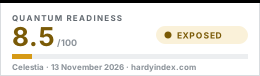
Band 1: Tier 5: Exposed.
Tier 5: Exposed. The signatures securing TIA are quantum-vulnerable, no CIP addresses post-quantum signatures, and the one post-quantum pull request in Celestia's repositories concerned verifying other chains' validator keys, not Celestia's own, and was closed unmerged. See the caveat below on why this is a judgement call.
source
3 NIST alignment 0/10, weighted 15%
Band 0 to 2: No post-quantum scheme named for the chain’s fund-protecting signatures, or a proprietary scheme with no public cryptanalysis.
No post-quantum scheme has been named for Celestia's account or validator signatures. ML-DSA-65 appears in Celestia's repositories in a single closed pull request for verifying counterparty chains' validator keys over IBC, which states that Celestia validators are Ed25519 only.
source
Placement in the band The floor of the band rather than a 1 or a 2: no scheme has been named for Celestia's own fund-protecting signatures at all. The ML-DSA-65 pull request named a final NIST standard for other chains' keys, which v1.8 does not count, and it was closed without merging.
4 Migration path 2/10, weighted 15%
Band 0 to 2: No agreed migration path, or the proposals on the table would strand or freeze holder funds.
No migration plan exists. A mechanism exists upstream: Cosmos SDK v0.55 adds ML-DSA-65 account and validator keys, and Celestia ships protocol changes through coordinated network upgrades under CIP-10. Celestia's own SDK fork does not carry the ML-DSA code, and nobody with authority over Celestia has proposed adopting it.
source
Placement in the band The top of the band rather than a 0 or a 1: working ML-DSA account and validator keys exist in the framework Celestia forks, and Celestia has a defined process for coordinated major upgrades under CIP-10. Not a 3, because no one with authority over Celestia has acknowledged migration as its problem to solve.
5 Exposure 2/10, weighted 10%
Band 0 to 2: Public keys are exposed for effectively all accounts, or a large, measured share of total supply sits in exposed addresses.
Celestia uses the Cosmos SDK account model, in which an address is a hash of the secp256k1 public key, so an address that has never signed keeps its key hidden. The key is revealed with the account's first transaction, and staking TIA needs a signed delegation, so nearly all TIA in active use sits behind a revealed key. Validator consensus keys are public by design.
source
Placement in the band The top of the band rather than a 3: this is the key-hash model in which staking or any send reveals the key, so effectively all TIA in use is exposed. It is not a 0 or a 1 because never-used addresses keep their keys hidden and no measured share of exposed TIA has been published.
6 Verification 2/10, weighted 5%
Band 0 to 2: No post-quantum component exists, or the claims rest on marketing.
No post-quantum component exists for Celestia's signatures: no code, specification or testnet implementation was found, and the one ML-DSA pull request was closed unmerged and concerned other chains' keys. celestia-app is open source, but under v1.8 the openness of the classical code earns nothing here.
source
Placement in the band The top of the band rather than a 0 or a 1: there is no post-quantum component to verify, but Celestia does not market itself as quantum-safe, so its position does not rest on marketing.