1 Signature scheme 0/10, weighted 30%
Band 0: Classical signatures only on mainnet, with nothing post-quantum protecting live funds. Short-lived devnets and one-off benchmarks sit here: they demonstrate research rather than something a user can hold keys on.
Theta's ledger recovers transaction signers with ECDSA on secp256k1, validator votes are signed with the same keys, and guardian votes are aggregated BLS signatures on BLS12-381. Nothing post-quantum protects THETA, TFUEL or any asset on Theta today.
source
2 Deployment stage 1/10, weighted 25%
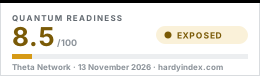
Band 1: Tier 5: Exposed.
Tier 5: Exposed. The signatures securing Theta are quantum-vulnerable, and Theta Labs' published quantum work is research on the cost of attacking secp256k1, not post-quantum work on Theta's own signatures: it proposes no scheme, plan or change for Theta. See the caveat on why this is a judgement call.
source
3 NIST alignment 0/10, weighted 15%
Band 0 to 2: No post-quantum scheme named for the chain’s fund-protecting signatures, or a proprietary scheme with no public cryptanalysis.
No post-quantum scheme has been named for Theta's account, validator or guardian signatures. Theta Labs' Q&A cites NIST's draft transition timeline and says organisations need to choose standardised post-quantum replacements, but it names none and does not apply the point to Theta.
source
Placement in the band The floor of the band rather than a 1 or a 2: no scheme has been named for Theta, even as an example. A reference to NIST's transition timeline in general terms is not a scheme, so there is no choice to align with a standard.
4 Migration path 2/10, weighted 15%
Band 0 to 2: No agreed migration path, or the proposals on the table would strand or freeze holder funds.
No migration plan for Theta exists. Theta does have a record of coordinated protocol upgrades: the node software activates changes at fixed block heights, and its thirteen activation constants, set at twelve distinct heights from January 2020 to November 2022 (two share block 8,411,427), brought in Theta 2.0, smart contracts, Theta 3.0, Ethereum-compatible RPC and Metachain support. Nothing has been proposed to carry a post-quantum scheme through that route.
source
Placement in the band The top of the band rather than a 0 or a 1: Theta has repeatedly changed its protocol through height-activated hard forks, including new transaction types. Not a 3, because the migration problem has been acknowledged by Theta Labs for blockchains in general, never for Theta's own holders.
5 Exposure 2/10, weighted 10%
Band 0 to 2: Public keys are exposed for effectively all accounts, or a large, measured share of total supply sits in exposed addresses.
A Theta address is the last twenty bytes of the Keccak-256 hash of the secp256k1 public key, as on Ethereum, so an account that has never signed keeps its key hidden. Any send, stake or contract call reveals it, which covers almost all THETA in use. Validator and guardian keys are public by design.
source
Placement in the band The top of the band rather than a 1: never-signed addresses keep their keys hidden. Not a 3, because almost all economically active THETA sits behind a revealed key, staking to a guardian or validator needs a signed transaction, and no measurement of the unexposed share has been published.
6 Verification 2/10, weighted 5%
Band 0 to 2: No post-quantum component exists, or the claims rest on marketing.
No post-quantum component exists for Theta: no code, specification or testnet implementation was found in the Theta ledger repository or elsewhere in the Theta Labs GitHub organisation. The ledger is open source, but under v1.8 the openness of classical code earns nothing here, and the attack-cost research is not a component of Theta.
source
Placement in the band The top of the band rather than a 0 or a 1: there is nothing post-quantum to verify, but Theta Labs does not market Theta as quantum-safe, and its quantum posts describe research rather than claims about the chain.