20 April 2026 shipped
Ripple publishes a four-phase post-quantum roadmap for the XRP Ledger, targeting full readiness by 2028. source
Chain profile
A dated four-phase roadmap targets full post-quantum transition by 2028, with ML-DSA already deployed on AlphaNet and a Q-Day contingency plan defined.
No, not today. The XRP Ledger signs transactions with secp256k1 or Ed25519, both of which a sufficiently large quantum computer would break. What the XRP Ledger does have is one of the most concrete published transition plans in this index. In April 2026 Ripple set out a four-phase roadmap targeting full post-quantum readiness by 2028: a Q-Day contingency plan that would stop the network accepting classical signatures and let holders prove ownership through post-quantum zero-knowledge proofs; experimentation with NIST-standardised algorithms through the first half of 2026, with ML-DSA already deployed on AlphaNet by a core engineer; hybrid post-quantum and elliptic-curve signatures on Devnet in the second half of 2026; and a native post-quantum amendment for network-wide deployment targeting 2028. None of that is on mainnet yet, which is why the XRP Ledger sits in Tier 3 rather than Tier 2.
secp256k1 or Ed25519, selectable per account
ML-DSA under evaluation, deployed on AlphaNet; hybrid post-quantum and elliptic-curve signatures planned for Devnet
FIPS 204 (ML-DSA), finalised August 2024
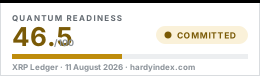
Tier 3: Committed. A funded roadmap with public dates and active research exists, but no post-quantum signature is live on mainnet.
| No. | Dimension | Score | Weight | Contribution |
|---|---|---|---|---|
| 1 | Signature scheme | 0 | 30% | 0.0 |
| 2 | Deployment stage | 5 | 25% | 12.5 |
| 3 | NIST alignment | 9 | 15% | 13.5 |
| 4 | Migration path | 9 | 15% | 13.5 |
| 5 | Exposure | 3 | 10% | 3.0 |
| 6 | Verification | 8 | 5% | 4.0 |
| Hardy Score | 46.5 | |||
Band 0: Classical signatures only on mainnet, with nothing post-quantum protecting live funds. Short-lived devnets and one-off benchmarks sit here: they demonstrate research rather than something a user can hold keys on.
Mainnet transactions are signed with secp256k1 or Ed25519 and nothing post-quantum protects live XRP. ML-DSA has been deployed on AlphaNet, which is a pre-Devnet test network, so no post-quantum signature guards funds on the public ledger. source
Band 5: Tier 3: Committed.
Tier 3: Committed. The roadmap is funded, staffed, phased and dated to 2028, and post-quantum work is running on test networks, but no post-quantum signature is live on mainnet. source
Band 9 to 10: The scheme in use is covered by a final NIST standard (FIPS 204, FIPS 205, or SP 800-208).
The roadmap explicitly commits to NIST-standardised quantum-resistant algorithms and names ML-DSA, which is finalised as FIPS 204, as the scheme already running on AlphaNet. This is a committed selection of a final standard rather than a survey of candidates. source
Placement in the band Not a 10: ML-DSA is a final standard and a committed selection, but it runs on AlphaNet, a pre-Devnet network. A 10 would need the standardised scheme in use somewhere it protects something.
Band 9 to 10: Holders can migrate today, or the published plan is dated, specific, and executable under the chain’s existing governance.
The strongest migration thinking in the index. Phase 1 defines a Q-Day response in which classical signatures stop being accepted and holders migrate using post-quantum zero-knowledge proofs of key ownership, so funds can be rescued without revealing a compromised key. Native key rotation already exists on the ledger, and the amendment process is a proven governance route for consensus changes. source
Placement in the band Not a 10: holders cannot migrate today. The Q-Day mechanism is specific and executable under the existing amendment process, but it is a response awaiting an event rather than a route that is open now.
Band 3 to 5: Most active accounts have revealed a public key, or the chain has no live supply to assess.
XRP Ledger accounts are derived from a hash of the public key, but the key is published in the transaction that first sends from the account, so any account that has transacted is exposed. Native key rotation gives holders a mitigation that most account-model chains lack. source
Placement in the band The floor of the band: the key is published on an account's first send, so any account that has ever transacted is exposed, which is close to all of them. It is not a 2 because native key rotation is a real mitigation and never-sent accounts do keep a hashed address.
Band 6 to 8: Open source with public review or a named third-party audit of the relevant component.
rippled is open source, the roadmap is published with named phases, and the post-quantum work is being run with an external partner, Project Eleven, on validator-level testing, Devnet benchmarking and a post-quantum custody wallet prototype rather than in-house only. source
Placement in the band The top of the band: Project Eleven is a named external partner running validator-level testing and Devnet benchmarking, which is closer to a third-party audit than open code alone. It stops short of 9 because the reviewed component sits on a test network rather than on the ledger.
The deployment dimension is not a separate judgement. It is Tier 3 expressed as a number. See the tier mapping.
The 9 chains XRP Ledger sits among, out of 31 rated. The last column is the gap in Hardy points from XRP Ledger.
| Rank | Chain | Tier | Hardy | vs XRP |
|---|---|---|---|---|
| 5 | Algorand | 2: Shipping | 77.5 | +31.0 |
| 6 | Nervos CKB | 2: Shipping | 75.5 | +29.0 |
| 7 | Bitcoin Cash | 2: Shipping | 66.0 | +19.5 |
| 8 | Solana | 2: Shipping | 54.5 | +8.0 |
| 9 | XRP Ledger this chain | 3: Committed | 46.5 | |
| 10 | Sui | 3: Committed | 45.5 | -1.0 |
| 11 | Hedera | 3: Committed | 42.0 | -4.5 |
| 12 | Stellar | 3: Committed | 41.0 | -5.5 |
| 13 | Zcash | 3: Committed | 41.0 | -5.5 |
Ripple publishes a four-phase post-quantum roadmap for the XRP Ledger, targeting full readiness by 2028. source
Post-quantum recovery and Q-Day readiness: a contingency under which classical public-key signatures would no longer be accepted, with post-quantum zero-knowledge proofs letting holders prove ownership and migrate without exposing keys. source
Formal experimentation with NIST-standardised algorithms, benchmarking signature size, verification cost and throughput under real XRPL workloads. ML-DSA deployed on AlphaNet; validator testing and custody prototypes with Project Eleven. source
Hybrid deployment of post-quantum and elliptic-curve signatures on Devnet, plus exploration of post-quantum primitives for zero-knowledge proofs and homomorphic encryption. source
A new amendment proposing native post-quantum cryptography for the XRPL, with network-wide deployment. source
Exposure measures how much of the chain's value already sits behind a public key that an attacker can record today and break later. This is the part of the threat that a future upgrade cannot undo.
An XRP Ledger account address is derived from a hash of the account's public key, so a funded account that has never sent a transaction does not have its key on-chain. The key is published the first time the account signs, which means the large majority of economically active XRP is exposed. The ledger's native key rotation feature is a meaningful mitigation that most account-model chains do not offer: an account can be reassigned to a new signing key without moving funds, which becomes the migration primitive if the roadmap's post-quantum amendment lands.
What this rating means for you
XRP Ledger has a funded roadmap but no post-quantum signature protecting funds on mainnet yet. Until it ships, your exposure is the ordinary one, and the steps that reduce it cost nothing.
Editorial guidance from the Hardy Index. Nothing on this profile is sponsored and nothing on it is an affiliate link. The guides carry disclosed affiliate links, which never affect a rating. How we make money.
We will email you the day this rating moves, with the changelog note that explains why. Nothing else, and nothing in between.
No. XRP Ledger transactions are signed with secp256k1 or Ed25519, both of which are broken by Shor's algorithm on a sufficiently large quantum computer. Ripple has published a four-phase roadmap targeting full post-quantum readiness by 2028, but no post-quantum signature protects XRP on mainnet today.
Four phases, targeting 2028. Phase 1 is a Q-Day contingency plan. Phase 2, covering the first half of 2026, is experimentation with NIST-standardised algorithms and validator testing. Phase 3, in the second half of 2026, puts hybrid post-quantum and elliptic-curve signatures on Devnet. Phase 4, targeting 2028, proposes a native post-quantum amendment for network-wide deployment.
Phase 1 of the roadmap is designed for exactly that. Under the Q-Day response plan, the network would stop accepting classical public-key signatures, and post-quantum zero-knowledge proofs would let existing account holders prove ownership and migrate their funds to quantum-safe accounts without exposing their keys, even in a compromised environment.
Project Eleven is an external partner Ripple named in the roadmap for validator-level testing, Devnet benchmarking and a post-quantum custody wallet prototype. Their involvement means the work is not being done inside Ripple alone, which is why the XRP Ledger scores 8 rather than lower on the verification dimension.
A rating is only true as of the day it was reviewed, so both forms below carry the review date and the methodology version. If you are quoting the score, quote those too.
The Hardy Index (2026). XRP Ledger: quantum readiness assessment. Hardy Score 46.5 of 100, Tier 3: Committed. Methodology v1.4. Reviewed 2 October 2026. https://hardyindex.com/chains/xrp-ledger
@misc{hardyindex_xrp_ledger_2026,
  author       = {{The Hardy Index}},
  title        = {XRP Ledger: quantum readiness assessment},
  year         = {2026},
  howpublished = {\url{https://hardyindex.com/chains/xrp-ledger}},
  note         = {Hardy Score 46.5 of 100, Tier 3: Committed. Methodology v1.4},
  urldate      = {2026-10-02}
}
The whole dataset is reusable under the terms on the about page. A machine-readable version of this page is at /chains/xrp-ledger.md.
This is a security-readiness assessment, not investment advice.