No published position proposed
No post-quantum roadmap, improvement proposal, research programme or testnet implementation from the Opentensor Foundation or the core developers was found at the time of writing. source
Chain profile
A Substrate chain signing with sr25519, carrying no published post-quantum position of its own, while the Polkadot ecosystem it inherits its runtime from has an active RFC on exactly that question.
No. Bittensor runs on Substrate, and its coldkeys and hotkeys are sr25519 key pairs, a Schnorr signature over the Ristretto group on Curve25519. Shor's algorithm breaks it in the same way it breaks the ECDSA and Ed25519 used elsewhere, so every TAO balance and every validator and miner registration on the network is protected by cryptography with no defence against a sufficiently large quantum computer. We found no post-quantum roadmap, improvement proposal, research programme or testnet implementation published by the Opentensor Foundation or the core developers. There is one point in Bittensor's favour that this rubric cannot score, and it is worth stating: because the chain is Substrate-based, changing a signature scheme is a runtime upgrade rather than a multi-year fork negotiation, which is a materially easier position than Bitcoin's. Capacity to act is not action, and the readiness spine measures what has been done.
Where we are making a judgement call Our finding is that we could not locate a published post-quantum position, not that we have confirmed none exists. Tier 5 records quantum-vulnerable signatures alongside the absence of a plan we could find. The rung is a statement about disclosed readiness and nothing else, and it is not a judgement on Bittensor's engineering or on the subnet economy it runs. If the Opentensor Foundation has published a position, the primary source is the fastest way to correct this profile.
sr25519 (Schnorr over Curve25519) for coldkeys and hotkeys, the Substrate default
None. No scheme has been named or proposed for Bittensor.
None adopted and none named as a candidate by this chain.
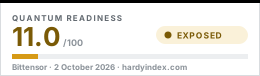
Tier 5: Exposed. The signatures securing funds on mainnet today are quantum-vulnerable, and no public post-quantum plan, proposal or research programme addressing them could be found.
| No. | Dimension | Score | Weight | Contribution |
|---|---|---|---|---|
| 1 | Signature scheme | 0 | 30% | 0.0 |
| 2 | Deployment stage | 1 | 25% | 2.5 |
| 3 | NIST alignment | 0 | 15% | 0.0 |
| 4 | Migration path | 2 | 15% | 3.0 |
| 5 | Exposure | 3 | 10% | 3.0 |
| 6 | Verification | 5 | 5% | 2.5 |
| Hardy Score | 11.0 | |||
Band 0: Classical signatures only on mainnet, with nothing post-quantum protecting live funds. Short-lived devnets and one-off benchmarks sit here: they demonstrate research rather than something a user can hold keys on.
Bittensor wallets are built from sr25519 key pairs, the Substrate default, used for both the coldkey that holds TAO and the hotkey that mines and validates. sr25519 is a Schnorr signature over Curve25519 and is broken by Shor's algorithm. Nothing post-quantum protects funds or registrations on the network. source
Band 1: Tier 5: Exposed.
Tier 5: Exposed. Signatures securing mainnet balances are quantum-vulnerable and we found no roadmap, improvement proposal, research programme or testnet implementation from the foundation or the core developers. See the caveat below on what that finding does and does not establish. source
Band 0 to 2: No named post-quantum scheme, or a proprietary scheme with no public cryptanalysis.
No post-quantum scheme has been named or selected for Bittensor, so there is nothing to assess against a NIST standard. The Polkadot RFC that the wider Substrate ecosystem is discussing names Dilithium and Falcon, but that is Polkadot's document and not Bittensor's. source
Placement in the band The floor of the band rather than a 1 or a 2, because Bittensor itself has named no candidate. Work happening elsewhere in the same technology stack is not this chain having chosen anything, and crediting it here would score a chain for someone else's document.
Band 0 to 2: No agreed migration path, or the proposals on the table would strand or freeze holder funds.
No migration plan, mechanism or published position was found. The one genuine mitigating fact is architectural rather than planned: a Substrate runtime upgrade can change a signature scheme without a contentious hard fork, so the governance obstacle that dominates Bitcoin's migration problem is largely absent here. source
Placement in the band A 2 rather than a 0, because the upgrade path a Substrate runtime provides is a real and unusual advantage that a chain with no such mechanism does not have. It goes no higher because nothing has been proposed to run through it, and this band's upper values require an acknowledged problem rather than only the means to fix one.
Band 3 to 5: Most active accounts have revealed a public key, or the chain has no live supply to assess.
A Substrate account address is an SS58 encoding of the public key itself rather than a hash of it, so the key protecting a Bittensor account is readable by anyone who knows the address, before that account has ever signed. Validator and miner hotkeys are registered on-chain by construction and are therefore public for the entire active set. source
Placement in the band At the floor of the band rather than a 4 or a 5, because the exposure is not limited to accounts that have transacted: the address format publishes the key, so every account of any kind is exposed from creation. It stays out of the band below only because no measured share of at-risk supply has been published for this chain.
Band 3 to 5: Some independent verification exists, but the headline quantum-safety claim itself is not verified.
The node implementation is open source and the wallet key model is documented, so the current cryptographic position is checkable by a reader. There is no post-quantum claim to verify, and no published position to hold against future statements. source
Placement in the band At the top of the band rather than a 4 or a 3, because the scheme and the key model are documented and the implementation is public. It cannot reach the band above, which credits independent verification of a post-quantum claim, and Bittensor has made none.
The deployment dimension is not a separate judgement. It is Tier 5 expressed as a number. See the tier mapping.
The 9 chains Bittensor sits among, out of 31 rated. The last column is the gap in Hardy points from Bittensor.
| Rank | Chain | Tier | Hardy | vs TAO |
|---|---|---|---|---|
| 22 | Bitcoin | 4: Debating | 17.0 | +6.0 |
| 23 | Internet Computer | 5: Exposed | 14.5 | +3.5 |
| 24 | TON | 5: Exposed | 13.0 | +2.0 |
| 25 | Litecoin | 5: Exposed | 12.5 | +1.5 |
| 26 | Bittensor this chain | 5: Exposed | 11.0 | |
| 27 | Dogecoin | 5: Exposed | 11.0 | level |
| 28 | Avalanche | 5: Exposed | 10.5 | -0.5 |
| 29 | Cronos | 5: Exposed | 8.5 | -2.5 |
| 30 | MemeCore | 5: Exposed | 8.5 | -2.5 |
No post-quantum roadmap, improvement proposal, research programme or testnet implementation from the Opentensor Foundation or the core developers was found at the time of writing. source
Exposure measures how much of the chain's value already sits behind a public key that an attacker can record today and break later. This is the part of the threat that a future upgrade cannot undo.
Bittensor's exposure is total and structural, and it is worse than the Ethereum-style chains it sits near in this index. A Substrate address is an SS58 encoding of the public key, not a hash of it, so knowing an address means knowing the key. There is no equivalent of the never-spent Bitcoin address whose key stays hidden until first use: on this chain every account publishes its key at creation, and an adversary harvesting keys today needs only the address book. The active set is more exposed still, because validator and miner hotkeys must be registered on-chain to participate at all. Nobody has published a measurement of at-risk supply for Bittensor, and given the address format the honest answer is that the share is effectively all of it.
What this rating means for you
Bittensor runs quantum-vulnerable signatures with no published post-quantum plan that we could find. Nothing here is urgent today, and there is also nothing scheduled to change it.
Editorial guidance from the Hardy Index. Nothing on this profile is sponsored and nothing on it is an affiliate link. The guides carry disclosed affiliate links, which never affect a rating. How we make money.
From the newsroom
We will email you the day this rating moves, with the changelog note that explains why. Nothing else, and nothing in between.
No. Bittensor coldkeys and hotkeys are sr25519 key pairs, a Schnorr signature over Curve25519, which Shor's algorithm breaks. No post-quantum scheme has been named or proposed for the chain, and we found no roadmap, improvement proposal or research programme from the foundation or the core developers.
Not automatically. Bittensor is built on Substrate, the same framework Polkadot uses, and Polkadot has an active RFC discussing post-quantum primitives and a migration mechanism. That is Polkadot's document, governing Polkadot. Bittensor would have to adopt something equivalent through its own process, and nothing published indicates it has started. This index scores each chain on what it has done, not on what its technology stack makes possible.
Because of the address format. An Ethereum address is a hash of the public key, so a funded address that has never signed keeps its key private. A Substrate address is an SS58 encoding of the public key itself, so the key is readable from the address alone, whether or not the account has ever transacted. On Bittensor there is no such thing as an unexposed funded account.
More easily than most, yes. Changing a signature scheme on a Substrate chain is a runtime upgrade rather than a contentious hard fork, so the governance obstacle that dominates Bitcoin's migration problem is largely absent. That is why the migration dimension scores above zero here. It does not score higher because capacity to act is not the same as a plan, and no plan has been published.
A rating is only true as of the day it was reviewed, so both forms below carry the review date and the methodology version. If you are quoting the score, quote those too.
The Hardy Index (2026). Bittensor: quantum readiness assessment. Hardy Score 11.0 of 100, Tier 5: Exposed. Methodology v1.4. Reviewed 2 October 2026. https://hardyindex.com/chains/bittensor
@misc{hardyindex_bittensor_2026,
  author       = {{The Hardy Index}},
  title        = {Bittensor: quantum readiness assessment},
  year         = {2026},
  howpublished = {\url{https://hardyindex.com/chains/bittensor}},
  note         = {Hardy Score 11.0 of 100, Tier 5: Exposed. Methodology v1.4},
  urldate      = {2026-10-02}
}
The whole dataset is reusable under the terms on the about page. A machine-readable version of this page is at /chains/bittensor.md.
This is a security-readiness assessment, not investment advice.