30 April 2025 shipped
Pectra activates on Gnosis Chain mainnet, bringing EIP-7702 unmodified: an account can delegate to contract code while its ECDSA key keeps authority over it. source
Chain profile
Accounts sign with ECDSA on secp256k1 and validators with BLS12-381 under Ethereum's consensus specification, and no GnosisDAO proposal or Gnosis publication on post-quantum signatures for the chain could be found.
No. Gnosis Chain runs Ethereum's execution and consensus specifications with its own presets, its own beacon chain and its own validator set, which stakes GNO through a deposit contract. Accounts sign transactions with ECDSA on the secp256k1 curve, as on Ethereum, and validators sign with BLS12-381 keys, and a sufficiently large quantum computer running Shor's algorithm would break both. Gnosis follows Ethereum's hard forks closely: its specifications say each upgrade activates all EIPs also activated on Ethereum mainnet, and Dencun, Pectra and Fusaka are live on Gnosis mainnet. None of those forks carries anything post-quantum, and we found no GnosisDAO improvement proposal, Gnosis documentation or Gnosis team publication addressing post-quantum signatures for the chain. Ethereum's own post-quantum research is real, but it is Ethereum's, and nothing on Gnosis's side adopts it. In August 2026 GnosisDAO approved GIP-153, a strategic direction to turn Gnosis Chain from a standalone layer 1 into a rollup settling on Ethereum and to sunset its validator set, with genesis targeted around the turn of 2026 into 2027. Until that happens Gnosis Chain is a layer 1 with its own consensus, and it is rated as one.
Where we are making a judgement call Three judgement calls carry this profile. The first is the tier. Gnosis Chain runs Ethereum's specifications and its upgrade specifications activate all EIPs also activated on Ethereum mainnet, so a reader could treat Ethereum's funded post-quantum programme as Gnosis's too. We do not, because the commitments rule takes plans only from the chain's own authority, and no GnosisDAO proposal, Gnosis document or Gnosis team publication adopts Ethereum's post-quantum work; Ethereum's programme has also not yet put a post-quantum change into any fork Gnosis could inherit. A reader who counts it would place Gnosis in Tier 3, raising the deployment score from 1 to 5 and the Hardy Score by 10 points before any change to NIST alignment or migration. The second is migration. EIP-7702 is live on Gnosis as on Ethereum, but a delegated account still obeys its ECDSA key, so it is not credited as a route to post-quantum keys; a reader who credits it as a step towards account abstraction would score migration 3, adding 1.5 points. The third concerns scope. GnosisDAO approved GIP-153 on 19 August 2026, directing Gnosis Chain to become a rollup settling on Ethereum and to sunset its validator set, with genesis targeted around the turn of 2026 into 2027. Gnosis Chain is rated today because it still runs its own consensus on a live mainnet. When the rollup launches it will inherit settlement security from Ethereum and leave the index's scope, and we will review the profile then; a reader who judges by the adopted direction rather than the current chain would leave it out now. Separately, a community draft on the Gnosis forum, "GIP-XX: Sovereign-Reth Multi-Chain Composability PoC" (topic 12412), lists NIST post-quantum standards among the curves it would support. It is a draft, not from the chain's authority, and we discounted it.
ECDSA on secp256k1 for accounts; BLS12-381 for beacon chain validators; P-256 verification available to contracts since Fusaka
None. No post-quantum scheme has been proposed, selected or tested for Gnosis Chain.
None adopted.
Tier 5: Exposed. The signatures securing funds on mainnet today are quantum-vulnerable, and no public post-quantum plan, proposal or research programme addressing them could be found.
A role not listed is not evidenced either way. Every scheme, and which other chains share it, is in the cryptography registry.
| No. | Dimension | Score | Weight | Contribution |
|---|---|---|---|---|
| 1 | Signature scheme | 0 | 30% | 0.0 |
| 2 | Deployment stage | 1 | 25% | 2.5 |
| 3 | NIST alignment | 0 | 15% | 0.0 |
| 4 | Migration path | 2 | 15% | 3.0 |
| 5 | Exposure | 2 | 10% | 2.0 |
| 6 | Verification | 2 | 5% | 1.0 |
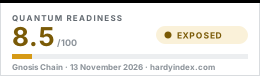
| Hardy Score | 8.5 | |||
Band 0: Classical signatures only on mainnet, with nothing post-quantum protecting live funds. Short-lived devnets and one-off benchmarks sit here: they demonstrate research rather than something a user can hold keys on.
Gnosis Chain specifies only its differences from Ethereum, and it changes neither the account signature, ECDSA on secp256k1, nor the BLS12-381 validator signatures of Ethereum's consensus specification. Nothing post-quantum protects xDAI, GNO or any asset on Gnosis Chain. source
Band 1: Tier 5: Exposed.
Tier 5: Exposed. The signatures protecting funds and finalising blocks are quantum-vulnerable, and no GnosisDAO improvement proposal, Gnosis documentation or research programme on post-quantum signatures for Gnosis Chain was found. Ethereum's post-quantum programme is not counted as Gnosis's own: see the caveat below. source
Band 0 to 2: No post-quantum scheme named for the chain’s fund-protecting signatures, or a proprietary scheme with no public cryptanalysis.
No post-quantum scheme has been named for Gnosis Chain's account or validator signatures by GnosisDAO or the Gnosis team, so there is nothing to assess against a NIST standard. source
Placement in the band The floor of the band rather than a 1 or a 2: nobody with authority over Gnosis Chain has named a scheme, even as an example. Schemes named in Ethereum's research are not counted, because no Gnosis proposal or document adopts them.
Band 0 to 2: No agreed migration path, or the proposals on the table would strand or freeze holder funds.
No migration plan or published position exists. Gnosis does have a working record of coordinated protocol change: Dencun, Pectra on 30 April 2025 and Fusaka on 14 April 2026 all activated on mainnet, each adopting Ethereum's EIPs. Pectra brought EIP-7702 unmodified, so an account can delegate to contract code, but the original ECDSA key keeps full authority over a delegated account, so it is not a route off a vulnerable key. source
Placement in the band The top of the band rather than a 0 or a 1: Gnosis reliably carries Ethereum's protocol changes to its own mainnet, which is the route a post-quantum change made on Ethereum would also take. Not a 3, because no one with authority over Gnosis has acknowledged the quantum problem, and EIP-7702 leaves the ECDSA key in control.
Band 0 to 2: Public keys are exposed for effectively all accounts, or a large, measured share of total supply sits in exposed addresses.
Gnosis Chain keeps Ethereum's account model: an address is a hash of the public key, so an account that has never signed keeps its key private. Accounts in use have signed and published their keys, and because Gnosis accepts the same keys and addresses as Ethereum, a key published on any EVM chain exposes the same address on Gnosis. Validator BLS public keys are public in the beacon state by design. source
Placement in the band The top of the band rather than a 1: never-signed addresses keep their keys hidden. Not a 3, because almost all economically active supply sits behind a key that has signed, here or on another EVM chain, and no measurement of the unexposed share has been published.
Band 0 to 2: No post-quantum component exists, or the claims rest on marketing.
No post-quantum component exists for Gnosis Chain: no code, specification or testnet implementation was found in its specifications repository or its governance forum. Its clients are open-source Ethereum clients, but under v1.8 the openness of classical code earns nothing on this dimension. source
Placement in the band The top of the band rather than a 0 or a 1: there is nothing post-quantum to verify, but nothing about Gnosis Chain is marketed as quantum-safe, so its position does not rest on marketing.
The deployment dimension is not a separate judgement. It is Tier 5 expressed as a number. See the tier mapping.
The 9 chains Gnosis sits among, out of 80 rated. The last column is the gap in Hardy points from Gnosis.
| Rank | Chain | Tier | Hardy | vs GNO |
|---|---|---|---|---|
| 59 | dYdX Chain | 5: Exposed | 8.5 | level |
| 60 | eCash | 5: Exposed | 8.5 | level |
| 61 | Filecoin | 5: Exposed | 8.5 | level |
| 62 | GateChain | 5: Exposed | 8.5 | level |
| 63 | Gnosis Chain this chain | 5: Exposed | 8.5 | |
| 64 | Injective | 5: Exposed | 8.5 | level |
| 65 | KCC (KuCoin Community Chain) | 5: Exposed | 8.5 | level |
| 66 | Kite | 5: Exposed | 8.5 | level |
| 67 | Mina Protocol | 5: Exposed | 8.5 | level |
Pectra activates on Gnosis Chain mainnet, bringing EIP-7702 unmodified: an account can delegate to contract code while its ECDSA key keeps authority over it. source
Fusaka activates on Gnosis Chain mainnet, including the EIP-7951 P-256 precompile. P-256 is an elliptic curve and offers no post-quantum protection. source
GnosisDAO approves GIP-153 on Snapshot, the vote closing on 19 August 2026 with 99.8 per cent of votes cast in favour. It sets a strategic direction to turn Gnosis Chain into a rollup settling on Ethereum and to sunset its validator set. It says nothing about post-quantum signatures. source
Genesis of the Gnosis rollup under GIP-153: the validator set is sunset and the first block is produced on the new design, conditional, as GIP-153 states, on the broader Ethereum Economic Zone dependencies landing. It does not address post-quantum signatures. source
Target December 2026/ Jan 2027. Open
No post-quantum improvement proposal, roadmap, research programme or testnet implementation for Gnosis Chain's signatures was found from GnosisDAO or the Gnosis team at the time of writing. source
No stated policy
Neither GnosisDAO nor the Gnosis team has said anything about post-quantum migration, so nothing has been said about accounts that never move to post-quantum keys.
As of 22 October 2026. Published beside the score, not in it. Every chain's stance is compared on the commitments page.
Exposure measures how much of the chain's value already sits behind a public key that an attacker can record today and break later. This is the part of the threat that a future upgrade cannot undo.
Gnosis Chain uses Ethereum's address model: an address is the last twenty bytes of the Keccak hash of the public key, so an account that has received funds but never sent a transaction has not published its key. The key is published permanently when the account signs, and almost every account of consequence has signed. Because Gnosis accepts the same keys and addresses as Ethereum, a holder who has signed with the same key on Ethereum or any other EVM chain has a published key on Gnosis too, even if the Gnosis account has never sent a transaction. Validator BLS public keys sit in the beacon state by design. GNO also exists as an ERC-20 token on Ethereum, where it is protected by Ethereum's signatures rather than Gnosis's, and that exposure belongs to Ethereum's profile. Gnosis Chain has its own genesis and its own transaction history, with network upgrades recorded from January 2019, and shares no transaction history with Ethereum, so the exposure inheritance rule does not apply.
What this rating means for you
Gnosis runs quantum-vulnerable signatures with no published post-quantum plan that we could find. Nothing here is urgent today, and there is also nothing scheduled to change it.
Editorial guidance from the Hardy Index.
We will email you the day this rating moves, with the changelog note that explains why. Nothing else, and nothing in between.
No. Gnosis Chain accounts sign with ECDSA on secp256k1 and its validators sign with BLS12-381, the same schemes Ethereum uses, and a sufficiently large quantum computer would break both. No post-quantum plan for Gnosis Chain has been published by GnosisDAO or the Gnosis team.
Not as things stand. Gnosis adopts Ethereum's hard forks, so a post-quantum change that Ethereum ships could reach Gnosis by the same route. But Ethereum's post-quantum work has not yet reached any fork, and no Gnosis governance proposal or document commits Gnosis to following it, so the index does not count it as Gnosis's plan.
Not on its own. EIP-7702, live on Gnosis since Pectra on 30 April 2025, lets an account delegate to contract code, but the original ECDSA key keeps full authority over the account, so a quantum attacker who recovered that key would still control it. Smart contract wallets can change their verification logic, but no post-quantum verification has been proposed for Gnosis.
GIP-153, approved by GnosisDAO in August 2026, sets a direction to turn Gnosis Chain into a rollup settling on Ethereum and to sunset its validator set, with genesis targeted around the turn of 2026 into 2027. Until that happens Gnosis Chain is a layer 1 with its own consensus and is rated as one. Once it inherits settlement security from Ethereum, it falls outside the index's scope.
A GnosisDAO improvement proposal or a public research programme on post-quantum signatures for Gnosis Chain's accounts or validators would meet the Tier 4 floor. An adopted proposal committing Gnosis to a named post-quantum scheme, including by adopting Ethereum's, would meet Tier 3.
A rating is only true as of the day an editor last reviewed it, so both forms below carry that date and the methodology version, with the date its cited sources were last checked. If you are quoting the score, quote those too.
The Hardy Index (2026). Gnosis Chain: quantum readiness assessment. Hardy Score 8.5 of 100, Tier 5: Exposed. Methodology v1.8. Last reviewed 22 October 2026; sources checked 13 November 2026. https://hardyindex.com/chains/gnosis
@misc{hardyindex_gnosis_2026,
  author       = {{The Hardy Index}},
  title        = {Gnosis Chain: quantum readiness assessment},
  year         = {2026},
  howpublished = {\url{https://hardyindex.com/chains/gnosis}},
  note         = {Hardy Score 8.5 of 100, Tier 5: Exposed. Methodology v1.8},
  urldate      = {2026-11-13}
}
The whole dataset is reusable under the terms on the about page. A machine-readable version of this page is at /chains/gnosis.md.
This is a security-readiness assessment, not investment advice.