6 September 2017 shipped
Qtum's genesis block is mined, starting a ledger of its own. Qtum took Bitcoin Core's code, not Bitcoin's transaction history, so no Bitcoin output exists on Qtum. source
Chain profile
A proof-of-stake UTXO chain built from Bitcoin Core's code whose coins and staked blocks are signed with ECDSA on secp256k1, with Schnorr for Taproot outputs, and no post-quantum proposal for either.
No. Qtum protects QTUM with ECDSA on the secp256k1 curve, inherited from the Bitcoin Core code it is built on, and since its 2022 hard fork also accepts Taproot outputs spent with Schnorr signatures on the same curve. A sufficiently large quantum computer running Shor's algorithm would break both. Qtum is proof of stake, and each block is signed by the staker's own key with an ECDSA signature, so the signatures that produce and finalise blocks are quantum-vulnerable too. We found no Qtum Improvement Proposal, roadmap item or research programme on post-quantum signatures. Despite the name, nothing we found in Qtum's own material markets it as quantum-safe. What Qtum does have is a record of shipping coordinated hard forks, most recently the January 2026 upgrade at block 5,483,000, which is the capability a migration would one day need. Qtum began its own ledger in September 2017, so it took Bitcoin's code but none of Bitcoin's coins.
Where we are making a judgement call Two judgement calls, and one fact a reader should have. First, exposure scores 4 on the key-hash address model, as Litecoin and Dogecoin do, although staking reveals keys on a scale those chains do not have: every block signature exposes the staker's key, and qtum.info reports a stake weight of about 20.5 million QTUM against a supply of about 106.1 million. Not all of that has produced a block, and nobody has measured how much has. A reader who takes staking to mean that most active coins have revealed a key would score 3, lowering the Hardy Score from 10.5 to 9.5. Second, migration scores 2 on Qtum's record of hard forks, one of which added a new signature type. A reader who weighs that record at nothing without a quantum plan would score 1, taking 1.5 points off. Qtum's Account Abstraction Layer earns nothing here: it connects UTXOs to the EVM's account model and does not let a holder rotate to a new kind of key. Third, the fact: Qtum's Decentralised Governance Protocol lets admin and governor keys, voting in an on-chain contract, change the minimum gas price, block gas limit, block size and gas schedule without a fork. The DGP contract template sets its first admin key to whoever calls it first, and we found no published list of who holds those keys. They govern fees and block parameters, not minting or signatures, and change no score here. Whatever its name suggests, nothing we found in Qtum's own material markets the chain as quantum-safe, so the claims-unverified flag does not apply.
ECDSA on secp256k1 for spends and for proof-of-stake block signatures; Schnorr on secp256k1 for Taproot outputs since the 2022 hard fork
None deployed or proposed.
None adopted
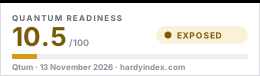
Tier 5: Exposed. The signatures securing funds on mainnet today are quantum-vulnerable, and no public post-quantum plan, proposal or research programme addressing them could be found.
A role not listed is not evidenced either way. Every scheme, and which other chains share it, is in the cryptography registry.
| No. | Dimension | Score | Weight | Contribution |
|---|---|---|---|---|
| 1 | Signature scheme | 0 | 30% | 0.0 |
| 2 | Deployment stage | 1 | 25% | 2.5 |
| 3 | NIST alignment | 0 | 15% | 0.0 |
| 4 | Migration path | 2 | 15% | 3.0 |
| 5 | Exposure | 4 | 10% | 4.0 |
| 6 | Verification | 2 | 5% | 1.0 |
| Hardy Score | 10.5 | |||
Band 0: Classical signatures only on mainnet, with nothing post-quantum protecting live funds. Short-lived devnets and one-off benchmarks sit here: they demonstrate research rather than something a user can hold keys on.
Qtum spends are authorised by ECDSA on secp256k1, and since the v22.0 hard fork Taproot outputs by Schnorr signatures on the same curve. Proof-of-stake blocks carry an ECDSA signature by the staker's key, which the node checks against the block key published in the coinstake output. Nothing post-quantum protects QTUM on mainnet. source
Band 1: Tier 5: Exposed.
Tier 5: Exposed. The signatures securing QTUM and signing its blocks are quantum-vulnerable, and the Qtum Improvement Proposals, which are filed as issues in the qips repository, include none on post-quantum signatures. No roadmap or research programme addressing them was found on qtum.org or in the node repository. source
Band 0 to 2: No post-quantum scheme named for the chain’s fund-protecting signatures, or a proprietary scheme with no public cryptanalysis.
No post-quantum scheme has been named for Qtum's spend signatures or its block signatures, so there is nothing to assess against a NIST standard. source
Placement in the band The floor of the band rather than a 1 or a 2: no scheme of any kind has been named for Qtum's fund-protecting signatures, standardised or otherwise, so there is nothing for the band's upper values to credit.
Band 0 to 2: No agreed migration path, or the proposals on the table would strand or freeze holder funds.
No migration plan exists. Qtum has shipped a run of mandatory hard forks: v22.0 activated Taproot and Schnorr signatures at block 2,080,512, v27.1 forked at block 4,590,000 in February 2025, and v29.1 at block 5,483,000 in January 2026. None changed the signature scheme away from secp256k1. Its Decentralised Governance Protocol adjusts fee and block parameters, not keys. source
Placement in the band The top of the band rather than a 0 or a 1: repeated coordinated hard forks, including one that added a signature type, are direct evidence that Qtum can ship the kind of change a migration needs. Not a 3, because nobody with authority over the chain has acknowledged quantum migration as a problem to solve.
Band 3 to 5: Most active accounts have revealed a public key, or the chain has no live supply to assess.
Qtum has its own ledger, begun with a genesis block of 6 September 2017, and follows Bitcoin's UTXO model, where a standard address is a key hash and the key is revealed when an output is spent. Staking adds exposure: every block's signature reveals the staker's public key, and a coinstake output that changes form must be a pay-to-public-key output. source
Placement in the band A 4 rather than a 5, on the same address-model reasoning as Litecoin and Dogecoin: never-spent coins at key-hash addresses have published no key, but reuse, spending and staking reveal keys. Not a 3, because no measurement of the share of supply behind revealed keys exists, and staking coins that have not yet produced a block have revealed nothing.
Band 0 to 2: No post-quantum component exists, or the claims rest on marketing.
No post-quantum component protects Qtum, so there is nothing post-quantum to review or audit. Under v1.8 the openness of the Qtum node, which tracks Bitcoin Core, earns nothing here, because it is classical code that a quantum computer would break. source
Placement in the band The top of the band rather than a 0 or a 1: there is no post-quantum component to verify, but nothing about Qtum is marketed as quantum-safe, so its position does not rest on marketing.
The deployment dimension is not a separate judgement. It is Tier 5 expressed as a number. See the tier mapping.
The 9 chains Qtum sits among, out of 80 rated. The last column is the gap in Hardy points from Qtum.
| Rank | Chain | Tier | Hardy | vs QTUM |
|---|---|---|---|---|
| 42 | Decred | 5: Exposed | 10.5 | level |
| 43 | IOTA | 5: Exposed | 10.5 | level |
| 44 | Litecoin | 5: Exposed | 10.5 | level |
| 45 | Midnight | 5: Exposed | 10.5 | level |
| 46 | Qtum this chain | 5: Exposed | 10.5 | |
| 47 | Kaia | 5: Exposed | 10.0 | -0.5 |
| 48 | Vaulta | 5: Exposed | 10.0 | -0.5 |
| 49 | Dogecoin | 5: Exposed | 9.0 | -1.5 |
| 50 | 0G | 5: Exposed | 8.5 | -2.0 |
Qtum's genesis block is mined, starting a ledger of its own. Qtum took Bitcoin Core's code, not Bitcoin's transaction history, so no Bitcoin output exists on Qtum. source
The v22.0 hard fork activates at block 2,080,512, adding Taproot, Schnorr signatures and Tapscript. A new signature type on secp256k1, not post-quantum work, but evidence that Qtum can change how coins are signed. source
The v27.1 hard fork activates at block 4,590,000, moving Qtum to Bitcoin Core 27.1 and the Cancun EVM. source
The v29.1 hard fork activates at block 5,483,000, moving Qtum to Bitcoin Core 29.1 and the Pectra EVM. It does not change the signature scheme. source
No Qtum Improvement Proposal, roadmap item or research programme on post-quantum signatures was found in the qips repository, the node repository or on qtum.org at the time of writing. source
No stated policy
Qtum has published no policy on coins that stay behind ECDSA or Schnorr keys, including staking coins whose keys block signatures have already revealed.
As of 22 October 2026. Published beside the score, not in it. Every chain's stance is compared on the commitments page.
Exposure measures how much of the chain's value already sits behind a public key that an attacker can record today and break later. This is the part of the threat that a future upgrade cannot undo.
Qtum began its own ledger with a genesis block dated 6 September 2017, so it shares no transaction history with Bitcoin and the exposure inheritance rule does not apply. Within that ledger it follows Bitcoin's UTXO model: a standard address is a key hash, and the key is revealed when an output is spent, so address reuse and ordinary spending erode the protection. Proof of stake adds a Qtum-specific exposure. Every block carries an ECDSA signature by the staker's key, and the key itself is published in the coinstake transaction's second output. A coinstake transaction must either return the stake to the same script or pay it to a pay-to-public-key output, so a coin that has staked a block has its key on-chain while it goes on staking. Under offline staking, the delegator's signed proof of delegation is checked against the delegator's address in the same way. The explorer qtum.info reports a network stake weight of about 20.5 million QTUM against a supply of about 106.1 million, but how much of that has produced a block, and so revealed its key, has not been measured. The score therefore reflects the address model rather than a measured figure.
What this rating means for you
Qtum runs quantum-vulnerable signatures with no published post-quantum plan that we could find. Nothing here is urgent today, and there is also nothing scheduled to change it.
Editorial guidance from the Hardy Index.
We will email you the day this rating moves, with the changelog note that explains why. Nothing else, and nothing in between.
No. Qtum signs spends with ECDSA on the secp256k1 curve, and Taproot spends with Schnorr on the same curve. Its proof-of-stake blocks are signed with ECDSA too. A sufficiently large quantum computer would break all of them, and no post-quantum proposal, plan or research programme for Qtum was found.
No. Nothing we found in Qtum's code or published material claims quantum resistance, and its signatures are the same elliptic-curve schemes Bitcoin uses. The index rates the cryptography the chain runs, which here is entirely quantum-vulnerable.
Once your coins stake a block, yes. Each Qtum block carries the staker's ECDSA signature, the block key is published in the coinstake transaction, and the staked coins return either to the same script or to a pay-to-public-key output. A key revealed this way stays on-chain for good, which is what a harvest-now attacker needs.
No. Qtum is built from Bitcoin Core's code, but its ledger began with its own genesis block in September 2017, so no Bitcoin output exists on Qtum. Its exposure comes from its own history: address reuse, ordinary spending and staking.
A rating is only true as of the day an editor last reviewed it, so both forms below carry that date and the methodology version, with the date its cited sources were last checked. If you are quoting the score, quote those too.
The Hardy Index (2026). Qtum: quantum readiness assessment. Hardy Score 10.5 of 100, Tier 5: Exposed. Methodology v1.8. Last reviewed 22 October 2026; sources checked 13 November 2026. https://hardyindex.com/chains/qtum
@misc{hardyindex_qtum_2026,
  author       = {{The Hardy Index}},
  title        = {Qtum: quantum readiness assessment},
  year         = {2026},
  howpublished = {\url{https://hardyindex.com/chains/qtum}},
  note         = {Hardy Score 10.5 of 100, Tier 5: Exposed. Methodology v1.8},
  urldate      = {2026-11-13}
}
The whole dataset is reusable under the terms on the about page. A machine-readable version of this page is at /chains/qtum.md.
This is a security-readiness assessment, not investment advice.