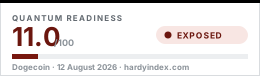
No published position proposed
No post-quantum roadmap, improvement proposal or research programme specific to Dogecoin was found at the time of writing. source
Chain profile
A Bitcoin-derived chain using ECDSA on secp256k1, with no published post-quantum roadmap and the same governance difficulty Bitcoin faces without the same research effort.
No. Dogecoin is derived from Bitcoin's codebase and signs with ECDSA on the secp256k1 curve, which a sufficiently large quantum computer would break. We found no published post-quantum roadmap, named replacement scheme or research programme for Dogecoin at the time of writing. Dogecoin's position is harder than Bitcoin's in one specific respect and easier in another. Harder, because the substantial research effort now going into Bitcoin's post-quantum proposals has no Dogecoin equivalent, so Dogecoin has neither a specification nor an activation debate. Easier, because Dogecoin shares Bitcoin's architecture closely enough that work done for Bitcoin, such as the output types proposed in BIP-360, could in principle be adapted rather than designed from scratch.
Where we are making a judgement call Tier 5 records that Dogecoin's mainnet signatures are quantum-vulnerable and that no post-quantum position has been published, and nothing beyond that. Dogecoin also inherits Bitcoin's governance difficulty without Bitcoin's research effort, which is why its migration score sits near the floor. A published proposal would move this row.
ECDSA on secp256k1, inherited from Bitcoin
None proposed. No Dogecoin-specific post-quantum work was found.
None adopted
Tier 5: Exposed. The signatures securing funds on mainnet today are quantum-vulnerable, and no public post-quantum plan, proposal or research programme addressing them could be found.
| No. | Dimension | Score | Weight | Contribution |
|---|---|---|---|---|
| 1 | Signature scheme | 0 | 30% | 0.0 |
| 2 | Deployment stage | 1 | 25% | 2.5 |
| 3 | NIST alignment | 0 | 15% | 0.0 |
| 4 | Migration path | 1 | 15% | 1.5 |
| 5 | Exposure | 4 | 10% | 4.0 |
| 6 | Verification | 6 | 5% | 3.0 |
| Hardy Score | 11.0 | |||
Band 0: Classical signatures only on mainnet, with nothing post-quantum protecting live funds. Short-lived devnets and one-off benchmarks sit here: they demonstrate research rather than something a user can hold keys on.
Dogecoin uses ECDSA on secp256k1, inherited from the Bitcoin codebase. Nothing post-quantum protects DOGE on mainnet. source
Band 1: Tier 5: Exposed.
Tier 5: Exposed. Dogecoin signs with ECDSA on secp256k1 and no proposal, roadmap or research programme specific to Dogecoin was found: quantum-vulnerable signatures with no public post-quantum plan. source
Band 0 to 2: No named post-quantum scheme, or a proprietary scheme with no public cryptanalysis.
No post-quantum scheme has been named or proposed for Dogecoin, so there is nothing to assess against a NIST standard. source
Placement in the band The floor of the band rather than a 1 or a 2: no scheme has been named or proposed for Dogecoin at all, so there is nothing to assess, as distinct from something assessed and found wanting.
Band 0 to 2: No agreed migration path, or the proposals on the table would strand or freeze holder funds.
Dogecoin faces Bitcoin's migration problem, which is that coins behind exposed keys cannot be moved without their owners acting, and it faces that problem without Bitcoin's active specification work. Its close architectural similarity to Bitcoin means future Bitcoin solutions could be adapted. source
Placement in the band Not a zero: Dogecoin's architectural similarity to Bitcoin means a future Bitcoin solution could be adapted. It does not reach 2 because, unlike Bitcoin, there is no specification work of its own to adapt from.
Band 3 to 5: Most active accounts have revealed a public key, or the chain has no live supply to assess.
Dogecoin uses the UTXO model with addresses derived from public key hashes, so coins received and never spent have not published a key. Address reuse is common on Dogecoin, and every spend publishes the key, so a substantial share of supply is exposed. source
Placement in the band A 4 rather than a 5: the UTXO model means never-spent coins have published no key, which is genuinely better than the account-model chains here. It is held down because address reuse is common on Dogecoin and every spend publishes the key.
Band 6 to 8: Open source with public review or a named third-party audit of the relevant component.
The Dogecoin client is open source and derived from a heavily reviewed codebase, so the signature scheme is directly verifiable. There is no post-quantum claim to verify. source
Placement in the band The floor of the band: the client is open source and derived from a heavily reviewed codebase, but there is no post-quantum claim to verify and no audit of one, which is what a 7 or an 8 would need.
The deployment dimension is not a separate judgement. It is Tier 5 expressed as a number. See the tier mapping.
The 9 chains Dogecoin sits among, out of 31 rated. The last column is the gap in Hardy points from Dogecoin.
| Rank | Chain | Tier | Hardy | vs DOGE |
|---|---|---|---|---|
| 23 | Internet Computer | 5: Exposed | 14.5 | +3.5 |
| 24 | TON | 5: Exposed | 13.0 | +2.0 |
| 25 | Litecoin | 5: Exposed | 12.5 | +1.5 |
| 26 | Bittensor | 5: Exposed | 11.0 | level |
| 27 | Dogecoin this chain | 5: Exposed | 11.0 | |
| 28 | Avalanche | 5: Exposed | 10.5 | -0.5 |
| 29 | Cronos | 5: Exposed | 8.5 | -2.5 |
| 30 | MemeCore | 5: Exposed | 8.5 | -2.5 |
| 31 | Hyperliquid | 5: Exposed | 7.0 | -4.0 |
No post-quantum roadmap, improvement proposal or research programme specific to Dogecoin was found at the time of writing. source
Exposure measures how much of the chain's value already sits behind a public key that an attacker can record today and break later. This is the part of the threat that a future upgrade cannot undo.
Dogecoin inherits Bitcoin's UTXO model, where an address is a hash of the public key and the key is revealed only when an output is spent. Coins that have been received and never moved are therefore not harvestable. Two things erode that protection on Dogecoin specifically: address reuse is common, particularly for tipping, exchange deposits and mining payouts, and reuse publishes the key while the address continues to hold and receive value. Dogecoin also has no equivalent of the analytical work that has produced measured exposure figures for Bitcoin, so the share of supply behind revealed keys is not independently quantified.
What this rating means for you
Dogecoin runs quantum-vulnerable signatures with no published post-quantum plan that we could find. Nothing here is urgent today, and there is also nothing scheduled to change it.
Editorial guidance from the Hardy Index. Nothing on this profile is sponsored and nothing on it is an affiliate link. The guides carry disclosed affiliate links, which never affect a rating. How we make money.
From the newsroom
We will email you the day this rating moves, with the changelog note that explains why. Nothing else, and nothing in between.
No. Dogecoin uses ECDSA on the secp256k1 curve, inherited from Bitcoin, and a sufficiently large quantum computer would break it. We found no published post-quantum roadmap or proposal specific to Dogecoin.
Plausibly, and that is its main advantage. Dogecoin's codebase is closely derived from Bitcoin's, so an output type such as the one proposed in BIP-360 could in principle be adapted rather than designed from scratch. That depends on Bitcoin producing an activated solution first, which has not happened.
It is not independently quantified. Dogecoin uses Bitcoin's model, where a key is revealed when an output is spent, so coins received and never moved are not exposed. Address reuse is common on Dogecoin, which publishes keys for addresses that keep receiving value. Unlike Bitcoin, no third-party analysis of exposed supply was found.
No. The Hardy Score measures readiness for a future quantum computer, not present-day security. Dogecoin's cryptography is not broken now. The score says that if a cryptographically relevant quantum computer arrives, Dogecoin has no published plan and no proposal in progress, which is a statement about preparedness.
A rating is only true as of the day it was reviewed, so both forms below carry the review date and the methodology version. If you are quoting the score, quote those too.
The Hardy Index (2026). Dogecoin: quantum readiness assessment. Hardy Score 11.0 of 100, Tier 5: Exposed. Methodology v1.4. Reviewed 2 October 2026. https://hardyindex.com/chains/dogecoin
@misc{hardyindex_dogecoin_2026,
  author       = {{The Hardy Index}},
  title        = {Dogecoin: quantum readiness assessment},
  year         = {2026},
  howpublished = {\url{https://hardyindex.com/chains/dogecoin}},
  note         = {Hardy Score 11.0 of 100, Tier 5: Exposed. Methodology v1.4},
  urldate      = {2026-10-02}
}
The whole dataset is reusable under the terms on the about page. A machine-readable version of this page is at /chains/dogecoin.md.
This is a security-readiness assessment, not investment advice.