1 Signature scheme 0/10, weighted 30%
Band 0: Classical signatures only on mainnet, with nothing post-quantum protecting live funds. Short-lived devnets and one-off benchmarks sit here: they demonstrate research rather than something a user can hold keys on.
conflux-rust signs and recovers transaction signatures with ECDSA on secp256k1 through the secp256k1 crate, for Core Space and for eSpace's Ethereum-type transactions alike. The proof-of-stake finality layer signs votes with BLS12-381. The secp256r1 precompile added in v3.1 verifies another elliptic curve. Nothing post-quantum protects CFX or any asset on Conflux today.
source
2 Deployment stage 1/10, weighted 25%
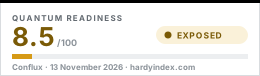
Band 1: Tier 5: Exposed.
Tier 5: Exposed. The signatures that authorise spends and finalise blocks are quantum-vulnerable, and no CIP, Conflux Foundation publication, forum proposal or research programme on post-quantum signatures for Conflux was found. The 2020 forum post argues that no work is needed yet, which is a position, not a plan or a programme.
source
3 NIST alignment 0/10, weighted 15%
Band 0 to 2: No post-quantum scheme named for the chain’s fund-protecting signatures, or a proprietary scheme with no public cryptanalysis.
No post-quantum scheme has been named for Conflux's account or finality signatures. The 2020 forum post says only that many quantum-resistant algorithms already exist, and CIP-166 mentions post-quantum signature schemes as a use for a counting opcode without naming one.
source
Placement in the band The floor of the band rather than a 1 or a 2: no scheme has been named at all, even as an example, by anyone with authority over Conflux, so there is no choice to align with a standard.
4 Migration path 2/10, weighted 15%
Band 0 to 2: No agreed migration path, or the proposals on the table would strand or freeze holder funds.
No migration plan exists. Conflux has a long record of coordinated hard forks through the CIP process, from Tethys and Hydra, which added proof-of-stake finality and eSpace, to v3.0, which brought EIP-7702 delegation to eSpace, and v3.1, which added a secp256r1 verification precompile. CIP-45, a Draft from 2021, would let accounts be controlled by rules other than ECDSA on secp256k1, but its specification has never been written.
source
Placement in the band The top of the band rather than a 0 or a 1: the CIP and hard-fork process has repeatedly changed the transaction format and added signature-verification primitives on mainnet, which is the route a post-quantum scheme would need. Not a 3, because no one with authority has acknowledged migration as a problem to solve: the 2020 forum post treats it as easy and not yet needed.
5 Exposure 2/10, weighted 10%
Band 0 to 2: Public keys are exposed for effectively all accounts, or a large, measured share of total supply sits in exposed addresses.
A Core Space address is a four-bit type marker plus 156 bits of the Keccak hash of the public key, and an eSpace address is an Ethereum address, so an account that has never signed keeps its key private in either space. Every account that has sent a transaction has published its key, staking for proof of stake included, and a key reused on eSpace or any EVM chain is published there too.
source
Placement in the band The top of the band rather than a 1: never-signed addresses keep their keys hidden in both spaces. Not a 3, because almost all economically active CFX sits behind a key that has signed, and no measurement of the unexposed share has been published.
6 Verification 2/10, weighted 5%
Band 0 to 2: No post-quantum component exists, or the claims rest on marketing.
No post-quantum component exists for Conflux: no code, specification or testnet implementation was found in conflux-rust or the CIPs repository. conflux-rust is open source, but under v1.8 the openness of classical code earns nothing on this dimension.
source
Placement in the band The top of the band rather than a 0 or a 1: there is nothing post-quantum to verify, but Conflux does not market itself as quantum-safe. The 2020 forum post plays the threat down rather than claiming protection against it.