1 Signature scheme 0/10, weighted 30%
Band 0: Classical signatures only on mainnet, with nothing post-quantum protecting live funds. Short-lived devnets and one-off benchmarks sit here: they demonstrate research rather than something a user can hold keys on.
Dash's developer documentation states that Dash uses ECDSA with the secp256k1 curve, and a standard pay-to-public-key-hash output is spent with an secp256k1 signature. The spend signatures in Dash Platform's shielded pool are RedPallas, also elliptic-curve. Nothing post-quantum protects DASH on mainnet.
source
2 Deployment stage 1/10, weighted 25%
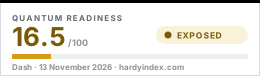
Band 1: Tier 5: Exposed.
Tier 5: Exposed. The signatures securing DASH are quantum-vulnerable, and the Dash Improvement Proposal index lists no post-quantum proposal. The one quantum mention in a DIP is in open pull request 161, a draft DIP-0032 for Confidential Transactions by an author outside Dash's organisation, whose Quantum Computer Risk section concerns inflation through forged Pedersen commitments rather than signatures. The GroveDB threat analysis covers Platform's shielded pool, not Dash Core, and defers signature replacement rather than planning it.
source
3 NIST alignment 3/10, weighted 15%
Band 3 to 5: NIST schemes are referenced as candidates without a committed selection, or the work is bespoke research.
A threat analysis merged into GroveDB's documentation, in the dashpay GitHub organisation, names ML-DSA and SLH-DSA as the replacements for spend authorisation signatures in Dash Platform's shielded pool, which holds Dash-backed credits. It commits to neither and dates the change at 2035 or later, if needed. Nothing has been named for Dash Core's ECDSA.
source
Placement in the band The floor of the band rather than a 4 or a 5: NIST schemes are named as candidates, but only for Platform's shielded pool, with no selection between them, no plan and nothing named for Dash Core's ECDSA keys.
4 Migration path 3/10, weighted 15%
Band 3 to 5: Migration is acknowledged as a problem with no agreed mechanism, or the mechanism is contested.
No migration path exists. The GroveDB threat analysis, merged in the dashpay organisation, acknowledges migration for Platform's shielded pool: it says to design for upgradability now, versioning stored formats, and to migrate signatures and the proof system from 2035 if needed. Dash has also shown it can ship consensus changes: deterministic masternode lists, long-living masternode quorums, ChainLocks and an enhanced hard fork mechanism are all Dash Improvement Proposals with Final status. Nothing addresses moving coins on Dash Core.
source
Placement in the band The floor of the band rather than a 4 or a 5, on the standard applied to Sonic: the GroveDB chapter acknowledges migration and says to design for upgradability, but it agrees no mechanism, defers signature migration to 2035 or later, and covers Platform's shielded pool rather than Dash Core. Above a 2, because the acknowledgement comes from within Dash's own organisation, the same chapter the NIST score credits.
5 Exposure 4/10, weighted 10%
Band 3 to 5: Most active accounts have revealed a public key, or the chain has no live supply to assess.
Dash follows Bitcoin's UTXO model: a standard address is the hash of a public key, and the key is published when the output is spent. Address reuse and every spend reveal keys, and early coinbase outputs from January 2014 paid straight to public keys, such as the 500 DASH output of block 1000, which is still unspent.
source
Placement in the band A 4 rather than a 5, on the same address-model reasoning as Litecoin and Dogecoin: never-spent coins at key-hash addresses have published no key, but reuse and spending reveal keys, pay-to-public-key coinbase outputs from 2014 have keys on-chain now, and a masternode registration with external collateral carries a signature by the collateral key while the 1,000 DASH stays unspent. Neither Dash-specific exposure has been measured, and a measurement could take exposure lower.
6 Verification 2/10, weighted 5%
Band 0 to 2: No post-quantum component exists, or the claims rest on marketing.
No post-quantum component protects Dash. The hybrid ML-KEM note encryption proposed for Platform's shielded pool is an open, unmerged pull request, and it encrypts notes rather than signing spends. Under v1.8 the openness of the classical code earns nothing here.
source
Placement in the band The top of the band rather than a 0 or a 1: there is no post-quantum component to verify, but nothing about Dash is marketed as quantum-safe, so its position does not rest on marketing.