15 April 2026 shipped
Governance passes proposal 12218, upgrading the chain to node v4.0.0 on Cosmos SDK v0.53.6 at height 28,214,400. The upgrade adds no key type. source
Chain profile
Terra Classic accounts sign with secp256k1 and validators with Ed25519 on a Cosmos SDK v0.53 chain; a core contributor's pre-formal post-quantum roadmap names ML-DSA, but it has not reached governance.
No. Terra Classic is the original Terra chain, columbus-5, kept running by its community since the May 2022 collapse. LUNC accounts sign with ECDSA on secp256k1, and validators sign consensus votes with Ed25519, which the chain's consensus parameters make the one accepted validator key type. A sufficiently large quantum computer breaks both. The node, classic-terra/core, runs Cosmos SDK v0.53.6, which has no post-quantum key type, and the v4.1.1 upgrade, which took effect at height 31,010,600 on 26 October 2026, kept the same SDK. In May 2026 a contributor to the node software published a Post-Quantum Roadmap RFC on the community forum that selects ML-DSA for validator consensus and a hybrid ML-DSA path for wallets, but the author described it as a non-binding, pre-formal discussion, not a governance proposal, and the governance step the author said would follow has not been submitted. LUNC also circulates as bridged tokens on Ethereum, BNB Smart Chain and Solana, where those chains' signatures protect it.
Where we are making a judgement call Three judgement calls. The first is the tier. The Post-Quantum Roadmap RFC was written by fragwuerdig, a contributor to classic-terra/core who published its v4.0.1-patch.3 release, so it comes from someone working on the chain's node rather than an outsider, and it names a scheme and a phased route. A reader who counts it as documented post-quantum work by people with authority over the chain would place Terra Classic in Tier 4, with a deployment score of 2, raising the Hardy Score from 14.5 to 17.0. We do not, because the Tier 4 floor asks for a formal improvement proposal or a public research programme, and the author said the post is not a governance proposal and not the formal RFC window; the governance proposal the author said would follow the discussion round, which closed on 5 June 2026, had not been submitted by 23 October 2026. Terra Classic's authority is its on-chain governance, and the RFC has not reached it. The second is the NIST score, which credits that same draft for naming ML-DSA for the chain's own signatures. A reader who credits only work with formal standing would score NIST alignment 0, and the Hardy Score would be 10.0. The third is migration and the upstream framework. The score of 3 credits the same draft as an acknowledgement of the problem, on top of the chain's record of governance-approved software upgrades; a reader who credits the upgrade record alone would score 2, a Hardy Score of 13.0. The ML-DSA keys in Cosmos SDK v0.55 are not credited, because Terra Classic runs SDK v0.53.6 and no one with authority over it has proposed moving to v0.55; a reader who credits them as the Cosmos Hub profile does might score NIST alignment 5, migration 5 and verification 3 and place the chain in Tier 4, a Hardy Score of 23.5. On dating: the Terra ledger dates from the Columbus mainnet of 2019, and this profile dates the chain now running, columbus-5, whose genesis file records a genesis time of 30 September 2021. Separately, Terra Classic is rated as it runs today; if it stops producing blocks of its own, it leaves the index.
ECDSA on secp256k1 for accounts; Ed25519 for validator consensus keys
None deployed. A pre-formal RFC by a node contributor selects ML-DSA for consensus and a hybrid ML-DSA path for wallets; it has not been put to governance.
FIPS 204 (ML-DSA) named in a pre-formal draft; none adopted
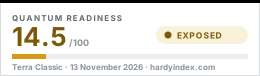
Tier 5: Exposed. The signatures securing funds on mainnet today are quantum-vulnerable, and no public post-quantum plan, proposal or research programme addressing them could be found.
A role not listed is not evidenced either way. Every scheme, and which other chains share it, is in the cryptography registry.
| No. | Dimension | Score | Weight | Contribution |
|---|---|---|---|---|
| 1 | Signature scheme | 0 | 30% | 0.0 |
| 2 | Deployment stage | 1 | 25% | 2.5 |
| 3 | NIST alignment | 3 | 15% | 4.5 |
| 4 | Migration path | 3 | 15% | 4.5 |
| 5 | Exposure | 2 | 10% | 2.0 |
| 6 | Verification | 2 | 5% | 1.0 |
| Hardy Score | 14.5 | |||
Band 0: Classical signatures only on mainnet, with nothing post-quantum protecting live funds. Short-lived devnets and one-off benchmarks sit here: they demonstrate research rather than something a user can hold keys on.
LUNC accounts sign with ECDSA on secp256k1: every signer in the first 100 of 13,071 mainnet transactions between heights 30,962,000 and 30,962,700, read from a public node on 23 October 2026, carried a secp256k1 key. Validators sign with Ed25519, the one key type the consensus parameters accept. Nothing post-quantum protects LUNC on mainnet. source
Band 1: Tier 5: Exposed.
Tier 5: Exposed. The signatures securing LUNC are quantum-vulnerable, and the post-quantum document with standing is a roadmap RFC by a classic-terra/core contributor that its author posted as an informal, non-binding discussion, stating it is not a governance proposal. The governance proposal the author said would open the formal RFC has not been submitted. See the caveat below on why this is a judgement call. A community post of 23 July 2026, "LUNC Must Become Quantum Resistant", carries no authority over the chain. source
Band 3 to 5: NIST schemes are referenced as candidates without a committed selection, or the work is bespoke research.
The pre-formal RFC selects ML-DSA, from the final FIPS 204, as the target for the consensus path and as the post-quantum half of a hybrid path for wallet and transaction signatures. It names no parameter set, and the decision log calls it a target profile in a document that is not yet in the formal RFC process. source
Placement in the band The bottom of the band rather than a 4 or a 5: the document is a pre-formal draft with no governance standing, and it names the scheme without a parameter set. Above a 2, because a final NIST standard is named for the chain's own fund-protecting signatures by a contributor to its node software.
Band 3 to 5: Migration is acknowledged as a problem with no agreed mechanism, or the mechanism is contested.
No migration plan is adopted. Terra Classic has a working route for protocol change: governance has passed a run of software upgrades, including v4.0.0, which moved the chain to Cosmos SDK v0.53, in April 2026, and v4.1.1, which took effect at height 31,010,600 on 26 October 2026. The RFC sketches a hybrid ML-DSA path for wallets and a validator key binding before a consensus cutover, and it comes from a contributor to the chain's node, but it is a draft, and no mechanism for holders exists in the node. source
Placement in the band The floor of the band rather than a 2: the RFC from a classic-terra/core contributor acknowledges the problem and sketches a route, as the Sonic and Kaspa profiles credit, and governance ships coordinated upgrades routinely. Not a 4, because the route is a pre-formal draft that has not been put to governance, and no mechanism exists in the code.
Band 0 to 2: Public keys are exposed for effectively all accounts, or a large, measured share of total supply sits in exposed addresses.
A Terra Classic address is a Bech32 hash of the secp256k1 public key, so an account that has never signed keeps its key off the chain. The key is recorded with the account's opening transaction, and staking LUNC needs a signed delegation, so actively held LUNC sits behind a revealed key. Validator consensus keys are published by design. No measurement of the exposed share has been published. source
Placement in the band The top of the band rather than a 3: the address structure is the same as on other Cosmos SDK key-hash chains, where any send or delegation reveals the key. It is not a 0 or a 1 because never-used addresses do keep their keys hidden.
Band 0 to 2: No post-quantum component exists, or the claims rest on marketing.
No post-quantum component protects Terra Classic, so there is nothing to verify: the RFC is a design document with no code, and neither v4.0.1-patch.3 nor v4.1.1 adds a key type. Under v1.8 the openness of the classical code earns nothing here. source
Placement in the band The top of the band rather than a 0 or a 1: there is no post-quantum component to verify, but nothing about the chain is marketed as quantum-safe, so its position does not rest on marketing.
The deployment dimension is not a separate judgement. It is Tier 5 expressed as a number. See the tier mapping.
The 9 chains Terra Classic sits among, out of 80 rated. The last column is the gap in Hardy points from Terra Classic.
| Rank | Chain | Tier | Hardy | vs LUNC |
|---|---|---|---|---|
| 33 | Neo | 4: Debating | 17.0 | +2.5 |
| 34 | Dash | 5: Exposed | 16.5 | +2.0 |
| 35 | Bitcoin | 4: Debating | 14.5 | level |
| 36 | Sonic | 5: Exposed | 14.5 | level |
| 37 | Terra Classic this chain | 5: Exposed | 14.5 | |
| 38 | Ethereum Classic | 5: Exposed | 13.0 | -1.5 |
| 39 | Flare | 5: Exposed | 13.0 | -1.5 |
| 40 | Internet Computer | 5: Exposed | 13.0 | -1.5 |
| 41 | TON | 5: Exposed | 11.0 | -3.5 |
Governance passes proposal 12218, upgrading the chain to node v4.0.0 on Cosmos SDK v0.53.6 at height 28,214,400. The upgrade adds no key type. source
A Post-Quantum Roadmap RFC for Terra Classic is posted to the community forum for informal, non-binding discussion until 5 June 2026. It selects ML-DSA for consensus and a hybrid path for wallets, and it says a governance proposal would open the formal comment window. source
Node v4.1.1 takes effect at height 31,010,600 under proposal 12233, which passed on 19 October 2026. It fixes bugs, keeps Cosmos SDK v0.53.6 and changes no signature scheme. source
A governance proposal to open the formal RFC comment window, the first step the RFC itself sets out. None was found among the proposals submitted up to 23 October 2026. source
No stated policy
Nothing adopted or put to governance says what happens to LUNC in accounts that never move to post-quantum keys. The pre-formal RFC proposes a hybrid wallet path in which classical signatures stay valid during a transition and does not address dormant accounts.
As of 23 October 2026. Published beside the score, not in it. Every chain's stance is compared on the commitments page.
Exposure measures how much of the chain's value already sits behind a public key that an attacker can record today and break later. This is the part of the threat that a future upgrade cannot undo.
Terra Classic uses the Cosmos SDK account model. An address is a Bech32 hash of the account's secp256k1 public key, so a never-used address has not published its key, but the key goes on-chain with the account's opening transaction and stays there. Staking LUNC needs a signed delegation, so actively held LUNC sits behind revealed keys. Validator consensus keys are Ed25519 keys published by design, and a public node listed 90 bonded validators on 23 October 2026. The columbus-5 ledger carries balances forward from the Columbus mainnets that began in 2019, so keys revealed by signatures in that earlier history are public too; no measurement of the exposed share has been published, so the score rests on the address model. LUNC bridged to Ethereum, BNB Smart Chain and Solana through governance-owned Hyperlane contracts, and LUNC sent over IBC, is represented on those chains and protected by their signatures, not Terra Classic's.
What this rating means for you
Terra Classic runs quantum-vulnerable signatures with no published post-quantum plan that we could find. Nothing here is urgent today, and there is also nothing scheduled to change it.
Editorial guidance from the Hardy Index.
We will email you the day this rating moves, with the changelog note that explains why. Nothing else, and nothing in between.
No. LUNC accounts sign with ECDSA on secp256k1 and validators sign with Ed25519, both of which a large enough quantum computer would break. No post-quantum key type is available on mainnet, and the v4.1.1 upgrade of 26 October 2026 did not add one.
Not an adopted one. A contributor to the node software posted a Post-Quantum Roadmap RFC in May 2026 that selects ML-DSA for validators and a hybrid ML-DSA path for wallets, and it drew supportive replies. The author described it as an informal, non-binding discussion, and the governance proposal meant to open the formal RFC process has not been submitted.
No. ML-DSA-65 keys arrived in Cosmos SDK v0.55. Terra Classic runs SDK v0.53.6, and its v4.1.1 upgrade of 26 October 2026 kept that version, so no LUNC holder or validator can use an ML-DSA key on mainnet.
For actively held LUNC, yes. An address is a hash of the key and hides it until the account signs, but sending or delegating reveals it, and the chain's history back to the 2019 Columbus mainnet is public. Those keys could be recorded now and attacked later by a quantum computer.
A rating is only true as of the day an editor last reviewed it, so both forms below carry that date and the methodology version, with the date its cited sources were last checked. If you are quoting the score, quote those too.
The Hardy Index (2026). Terra Classic: quantum readiness assessment. Hardy Score 14.5 of 100, Tier 5: Exposed. Methodology v1.8. Last reviewed 4 November 2026; sources checked 13 November 2026. https://hardyindex.com/chains/terra-classic
@misc{hardyindex_terra_classic_2026,
  author       = {{The Hardy Index}},
  title        = {Terra Classic: quantum readiness assessment},
  year         = {2026},
  howpublished = {\url{https://hardyindex.com/chains/terra-classic}},
  note         = {Hardy Score 14.5 of 100, Tier 5: Exposed. Methodology v1.8},
  urldate      = {2026-11-13}
}
The whole dataset is reusable under the terms on the about page. A machine-readable version of this page is at /chains/terra-classic.md.
This is a security-readiness assessment, not investment advice.