2026 shipped
BNB Chain tests post-quantum signatures with full EVM compatibility using ML-DSA-44, and publishes the cost: throughput down roughly 40 per cent and blocks nearly eighteen times larger. source
Chain profile
Tested ML-DSA-44 signatures on its own network and published the cost honestly: throughput fell around 40 per cent and blocks grew nearly eighteenfold.
No. BNB Chain accounts are secured by ECDSA on the secp256k1 curve, the same scheme Ethereum uses, and a sufficiently large quantum computer would break it. BNB Chain has done more experimental work than most chains in this group. It tested post-quantum signatures while preserving full EVM compatibility, using ML-DSA-44 from the finalised FIPS 204 standard for transaction signatures paired with a proof-aggregation approach for consensus. The result was published rather than buried, and it is the most useful contribution BNB Chain has made to this question: throughput fell by roughly 40 per cent and blocks grew close to eighteen times larger. That is the real cost of a naive migration on a high-throughput EVM chain, and it is why aggregation matters. We could not find a funded roadmap with public dates for deploying any of this to mainnet, which is why BNB Chain sits in Tier 4 rather than Tier 3.
Where we are making a judgement call BNB Chain is placed in Tier 4 despite doing more hands-on post-quantum engineering than several Tier 3 chains. The tier measures published commitment, not effort: without a funded roadmap carrying public dates, the spine puts a chain in Debating however good its research is. A reader who weights demonstrated engineering above published schedules would reasonably rank BNB Chain higher.
ECDSA on secp256k1, for EVM compatibility
ML-DSA-44 tested for transaction signatures, with proof aggregation explored for consensus. Not deployed.
FIPS 204 (ML-DSA), finalised August 2024
Tier 4: Debating. Post-quantum work on the chain’s own signatures is documented by people with authority over it, in a formal improvement proposal or a public research programme, but no scheme is agreed and no timeline is published.
| No. | Dimension | Score | Weight | Contribution |
|---|---|---|---|---|
| 1 | Signature scheme | 0 | 30% | 0.0 |
| 2 | Deployment stage | 2 | 25% | 5.0 |
| 3 | NIST alignment | 5 | 15% | 7.5 |
| 4 | Migration path | 3 | 15% | 4.5 |
| 5 | Exposure | 2 | 10% | 2.0 |
| 6 | Verification | 7 | 5% | 3.5 |
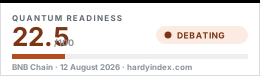
| Hardy Score | 22.5 | |||
Band 0: Classical signatures only on mainnet, with nothing post-quantum protecting live funds. Short-lived devnets and one-off benchmarks sit here: they demonstrate research rather than something a user can hold keys on.
BNB Chain signs with ECDSA on secp256k1 for EVM compatibility, and nothing post-quantum protects live funds. The ML-DSA work was a test on a non-production network. source
Band 2: Tier 4: Debating.
Tier 4: Debating. BNB Chain clears the floor on the research limb rather than the proposal limb: there is no post-quantum BEP, but the core team ran and published ML-DSA-44 testing against BNB Chain's own throughput and block size, which is a public research programme by people with authority over the protocol. It is not Tier 3 because we found no funded roadmap with public dates for mainnet deployment. source
Band 3 to 5: NIST schemes are referenced as candidates without a committed selection, or the work is bespoke research.
The testing used ML-DSA-44, a parameter set of the final FIPS 204 standard, which is a specific and sound selection. source
Placement in the band The top of the band rather than a 3 or a 4: ML-DSA-44 is a specific parameter set of a final standard, which is a concrete and sound selection. It cannot reach 6 because a scheme used in a test is not a scheme the chain has committed to adopt.
Band 3 to 5: Migration is acknowledged as a problem with no agreed mechanism, or the mechanism is contested.
BNB Chain's validator set is comparatively concentrated, which in principle makes coordinating a protocol change faster than on a more diffuse network. Against that, no migration plan for existing holders was found, and the published performance results suggest a naive migration is not viable without aggregation work. source
Placement in the band The floor of the band rather than a 4 or a 5: validator concentration would make coordination easier, but no migration plan for existing holders was found and BNB Chain's own benchmarks suggest a naive migration is not viable without aggregation work.
Band 0 to 2: Public keys are exposed for effectively all accounts, or a large, measured share of total supply sits in exposed addresses.
As an EVM chain, a BNB Chain address is a hash of the public key, so a funded account that has never sent a transaction keeps its key private. In practice nearly every account holding meaningful value has transacted and published its key. source
Placement in the band At the top of the band rather than a 0 or a 1: the hashed-address model does protect never-signed accounts, unlike the account-model chains at the floor of this band, though high transaction volumes leave little of value covered.
Band 6 to 8: Open source with public review or a named third-party audit of the relevant component.
BNB Chain published performance results that make its own preferred approach look expensive, including a 40 per cent throughput drop and an eighteenfold block size increase. Publishing an inconvenient measurement is a stronger signal of good faith than publishing a roadmap. source
Placement in the band A 7 rather than an 8: publishing measurements that make its own preferred approach look expensive is strong public review, but no named third-party audit of the post-quantum work was found.
The deployment dimension is not a separate judgement. It is Tier 4 expressed as a number. See the tier mapping.
The 9 chains BNB Chain sits among, out of 31 rated. The last column is the gap in Hardy points from BNB Chain.
| Rank | Chain | Tier | Hardy | vs BNB |
|---|---|---|---|---|
| 15 | Polkadot | 3: Committed | 40.5 | +18.0 |
| 16 | Ethereum | 3: Committed | 40.0 | +17.5 |
| 17 | Cardano | 3: Committed | 37.5 | +15.0 |
| 18 | Tron | 4: Debating | 34.5 | +12.0 |
| 19 | BNB Chain this chain | 4: Debating | 22.5 | |
| 20 | Monero | 4: Debating | 21.0 | -1.5 |
| 21 | IOTA | 5: Exposed | 18.5 | -4.0 |
| 22 | Bitcoin | 4: Debating | 17.0 | -5.5 |
| 23 | Internet Computer | 5: Exposed | 14.5 | -8.0 |
BNB Chain tests post-quantum signatures with full EVM compatibility using ML-DSA-44, and publishes the cost: throughput down roughly 40 per cent and blocks nearly eighteen times larger. source
Mainnet deployment of post-quantum signatures. No funded roadmap with public dates was found at the time of writing. source
Exposure measures how much of the chain's value already sits behind a public key that an attacker can record today and break later. This is the part of the threat that a future upgrade cannot undo.
BNB Chain inherits Ethereum's address model, where an address is derived from a hash of the public key. A funded account that has never sent a transaction has not published its key and is not harvestable. That protection disappears on first use, and on a chain built for high-frequency activity almost every account of consequence has transacted many times. The practical position is therefore close to full exposure for economically active supply, even though the address model is better than the account-model chains where the address is the key.
What this rating means for you
BNB Chain has acknowledged the threat without agreeing a plan, so nothing is going to change for holders in the near term. That makes address hygiene the part worth attending to.
Editorial guidance from the Hardy Index. Nothing on this profile is sponsored and nothing on it is an affiliate link. The guides carry disclosed affiliate links, which never affect a rating. How we make money.
We will email you the day this rating moves, with the changelog note that explains why. Nothing else, and nothing in between.
No. BNB Chain uses ECDSA on the secp256k1 curve, which a sufficiently large quantum computer would break. It has tested post-quantum signatures on a non-production network, but nothing post-quantum protects funds on mainnet.
That a straightforward swap is expensive. Using ML-DSA-44 for transaction signatures while keeping full EVM compatibility cut throughput by roughly 40 per cent and made blocks nearly eighteen times larger. That result is the strongest available evidence that high-throughput EVM chains cannot migrate without signature aggregation.
Because Tier 3 requires a funded roadmap with public dates, and we could not find one. The five-tier spine measures published commitment rather than research effort. We flag this as a judgement call on the profile, because BNB Chain has done more practical work than several chains ranked above it.
In principle, yes. A more concentrated validator set makes coordinating a protocol upgrade faster than on a widely distributed network, which is a genuine advantage for a change of this size. It does nothing about the harder problem, which is moving existing holders off exposed keys.
A rating is only true as of the day it was reviewed, so both forms below carry the review date and the methodology version. If you are quoting the score, quote those too.
The Hardy Index (2026). BNB Chain: quantum readiness assessment. Hardy Score 22.5 of 100, Tier 4: Debating. Methodology v1.4. Reviewed 2 October 2026. https://hardyindex.com/chains/bnb-chain
@misc{hardyindex_bnb_chain_2026,
  author       = {{The Hardy Index}},
  title        = {BNB Chain: quantum readiness assessment},
  year         = {2026},
  howpublished = {\url{https://hardyindex.com/chains/bnb-chain}},
  note         = {Hardy Score 22.5 of 100, Tier 4: Debating. Methodology v1.4},
  urldate      = {2026-10-02}
}
The whole dataset is reusable under the terms on the about page. A machine-readable version of this page is at /chains/bnb-chain.md.
This is a security-readiness assessment, not investment advice.