29 August 2024 shipped
The Kaia transition hard fork activates at block 162,900,480, described by Kaia as the transition from Klaytn to the Kaia blockchain. Accounts continue to sign with secp256k1 keys. source
Chain profile
Accounts and validator seals sign with ECDSA on secp256k1, and the Kaia DLT Foundation's agreement with BTQ to deploy a post-quantum stablecoin product names no scheme and publishes no mechanism for the chain's own signatures.
No. Kaia, the chain formed when Klaytn transitioned to Kaia in August 2024 and Finschia's holders moved across, signs transactions with ECDSA on the secp256k1 curve, and its validators seal blocks in an Istanbul BFT variant with secp256k1 signatures. Block proposers also sign a BLS12-381 random value that feeds on-chain randomness. A sufficiently large quantum computer running Shor's algorithm would break all of these. Kaia does have a key-replacement mechanism: an account's key can be replaced in place with an account update transaction, keeping the address, and an account can carry weighted multisig or separate keys for separate roles. Every key type it accepts today is a secp256k1 key, so the mechanism cannot yet carry a post-quantum key. On 30 September 2026 BTQ Technologies announced a three-year commercial agreement with the Kaia DLT Foundation to deploy its Quantum Secure Stablecoin Network across Kaia, and the foundation's chairman, Sam Seo, is quoted calling it a chain-level integration. The announcement names no signature scheme, no date and no technical design, and no Kaia Improvement Proposal, governance forum post or developer forum post on post-quantum signatures could be found, which is why Kaia sits in Tier 5.
Where we are making a judgement call Four judgement calls carry this profile. The first and largest is the tier. The Kaia DLT Foundation, the chain's own authority, is a party to a three-year commercial agreement under which BTQ and the foundation say they will introduce quantum-safe security across Kaia's transaction and settlement infrastructure. We do not read that as Tier 4 or Tier 3. It is a commercial agreement announced by the vendor, not an improvement proposal or a research programme; it names no scheme and describes no mechanism; and BTQ's own published account of the product, from June 2025, dual-signs a stablecoin issuer's privileged operations such as minting and burning while leaving holders' transfers and keys unchanged, which is not a change to the signatures that authorise holders' spends. A reader who counts the agreement as documented post-quantum work by the chain's authority would place Kaia in Tier 4 and add 2.5 points; a reader who counts it as a funded plan would place it in Tier 3 and add 10 points before any change to NIST alignment. The second is NIST alignment: ML-DSA appears in BTQ's description of its product, not in the Kaia agreement, so it is not counted; a reader who counts it would score 3 and add 4.5 points. The third is migration. The account update mechanism is credited above the floor because it exists on mainnet and keeps the address, even though it can only install secp256k1 keys today; a reader who credits nothing short of a post-quantum key type would score 2 and take 1.5 points off. The fourth is verification: BTQ markets post-quantum security for Kaia, but for a product not yet deployed and outside the fund-protecting signatures, so it is not read as Kaia marketing itself as quantum-safe; a reader who does would score 1 and take 0.5 points off.
ECDSA on secp256k1 for every account key type and for validator committed seals; BLS12-381 signatures by block proposers for on-chain randomness
None selected. A commercial agreement with BTQ Technologies to deploy its Quantum Secure Stablecoin Network on Kaia names no scheme.
None adopted.
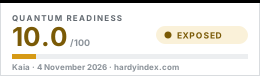
Tier 5: Exposed. The signatures securing funds on mainnet today are quantum-vulnerable, and no public post-quantum plan, proposal or research programme addressing them could be found.
A role not listed is not evidenced either way. Every scheme, and which other chains share it, is in the cryptography registry.
| No. | Dimension | Score | Weight | Contribution |
|---|---|---|---|---|
| 1 | Signature scheme | 0 | 30% | 0.0 |
| 2 | Deployment stage | 1 | 25% | 2.5 |
| 3 | NIST alignment | 0 | 15% | 0.0 |
| 4 | Migration path | 3 | 15% | 4.5 |
| 5 | Exposure | 2 | 10% | 2.0 |
| 6 | Verification | 2 | 5% | 1.0 |
| Hardy Score | 10.0 | |||
Band 0: Classical signatures only on mainnet, with nothing post-quantum protecting live funds. Short-lived devnets and one-off benchmarks sit here: they demonstrate research rather than something a user can hold keys on.
Kaia's account keys support the S256 curve and nothing else, so every account type, from legacy to role-based, verifies ECDSA on secp256k1. Validators sign committed seals with secp256k1 keys. Nothing post-quantum protects KAIA or any asset on Kaia today. source
Band 1: Tier 5: Exposed.
Tier 5: Exposed. The signatures protecting funds and finalising blocks are quantum-vulnerable. The Kaia DLT Foundation has signed a commercial agreement for a vendor's post-quantum stablecoin product, but it is neither a formal improvement proposal nor a public research programme, and it publishes no plan for the chain's own signatures. See the caveat below on why this is a judgement call. source
Band 0 to 2: No post-quantum scheme named for the chain’s fund-protecting signatures, or a proprietary scheme with no public cryptanalysis.
No post-quantum scheme has been named for Kaia's account or validator signatures. The September 2026 announcement of the BTQ agreement names no scheme, and no Kaia Improvement Proposal mentions one. source
Placement in the band The floor of the band rather than a 1 or a 2: no one with authority over Kaia has named a scheme for its signatures. BTQ describes its stablecoin product elsewhere as dual-signing issuer operations with ML-DSA, but that secures issuer controls, which v1.8 does not count, and the Kaia agreement does not name it.
Band 3 to 5: Migration is acknowledged as a problem with no agreed mechanism, or the mechanism is contested.
Kaia has a live mechanism for replacing an account's key in place: an account update transaction swaps the key behind an address for a new public key, a weighted multisig or a role-based set, without moving funds. The Kaia DLT Foundation's chairman has acknowledged that infrastructure must be ready for threats years away. But every key type the chain accepts is secp256k1, so a post-quantum key would need a new account key type through a hard fork, and nothing has been proposed. source
Placement in the band The floor of the band rather than a 4 or a 5: the rotation mechanism is real and keeps the address, which is the hard part of migration, but it reaches only classical keys and no post-quantum key type has been proposed. Above a 2, because the mechanism exists on mainnet and the foundation has acknowledged the threat.
Band 0 to 2: Public keys are exposed for effectively all accounts, or a large, measured share of total supply sits in exposed addresses.
A legacy Kaia account derives its address from the hash of its public key, as on Ethereum, so it keeps its key private until it signs. Accounts in use have signed, a key published on any EVM chain exposes the same address on Kaia, and an account that has updated its key stores the new public key in account state, where it is visible before it ever signs. source
Placement in the band The top of the band rather than a 1: never-signed legacy accounts keep their keys hidden. Not a 3, because almost all economically active KAIA sits behind a key that has signed or is stored in account state, and no measurement of the unexposed share has been published.
Band 0 to 2: No post-quantum component exists, or the claims rest on marketing.
No post-quantum component exists for Kaia's signatures: no code, specification or testnet implementation was found in the node, the KIPs or Kaia's forums. BTQ's product for Kaia is announced, not deployed, and no code for it is public. Kaia's node is open source, but under v1.8 the openness of classical code earns nothing here. source
Placement in the band The top of the band rather than a 0 or a 1: there is no post-quantum component to verify, and the post-quantum claim in view is a vendor's announcement of a future product rather than a claim that Kaia is quantum-safe today.
The deployment dimension is not a separate judgement. It is Tier 5 expressed as a number. See the tier mapping.
The 9 chains Kaia sits among, out of 80 rated. The last column is the gap in Hardy points from Kaia.
| Rank | Chain | Tier | Hardy | vs KAIA |
|---|---|---|---|---|
| 43 | IOTA | 5: Exposed | 10.5 | +0.5 |
| 44 | Litecoin | 5: Exposed | 10.5 | +0.5 |
| 45 | Midnight | 5: Exposed | 10.5 | +0.5 |
| 46 | Qtum | 5: Exposed | 10.5 | +0.5 |
| 47 | Kaia this chain | 5: Exposed | 10.0 | |
| 48 | Vaulta | 5: Exposed | 10.0 | level |
| 49 | Dogecoin | 5: Exposed | 9.0 | -1.0 |
| 50 | 0G | 5: Exposed | 8.5 | -1.5 |
| 51 | AIOZ Network | 5: Exposed | 8.5 | -1.5 |
The Kaia transition hard fork activates at block 162,900,480, described by Kaia as the transition from Klaytn to the Kaia blockchain. Accounts continue to sign with secp256k1 keys. source
The Prague hard fork activates on mainnet, adding EIP-7702 SetCode transactions under KIP-228. A delegated account still obeys its original ECDSA key, so delegation offers no route off a secp256k1 key. source
BTQ Technologies announces a three-year commercial agreement with the Kaia DLT Foundation to deploy its Quantum Secure Stablecoin Network across Kaia, protecting stablecoins at the account level. No scheme, date or technical design is published. source
No Kaia Improvement Proposal, research programme, implementation or testnet for post-quantum account or validator signatures was found at the time of writing. source
No stated policy
Neither the Kaia DLT Foundation nor the KIP process has said anything about accounts that never move to post-quantum keys. The BTQ announcement describes protection applied at the account level without saying how, or what happens to accounts it does not reach.
As of 22 October 2026. source Published beside the score, not in it. Every chain's stance is compared on the commitments page.
Exposure measures how much of the chain's value already sits behind a public key that an attacker can record today and break later. This is the part of the threat that a future upgrade cannot undo.
A legacy Kaia account follows Ethereum's address model: the address is derived from a hash of the public key, so an account that has received funds but never signed has not published its key. Kaia adds two cases of its own. An account that has replaced its key through an account update transaction stores the new public key in its account state, so that key is public from the moment of the update, whether or not it has signed. And because a legacy account uses the same keys and addresses as Ethereum, a key that has signed on any EVM chain exposes the same address on Kaia. Validator signing keys and their BLS keys in the KIP-113 registry are public by design. Kaia continues Klaytn's own chain, so its history is its own; Finschia's holders moved across through a token swap bridge rather than a fork, and the exposure inheritance rule does not apply.
What this rating means for you
Kaia runs quantum-vulnerable signatures with no published post-quantum plan that we could find. Nothing here is urgent today, and there is also nothing scheduled to change it.
Editorial guidance from the Hardy Index.
We will email you the day this rating moves, with the changelog note that explains why. Nothing else, and nothing in between.
No. Kaia accounts sign with ECDSA on secp256k1, validators seal blocks with secp256k1 signatures, and proposers sign randomness with BLS12-381. A sufficiently large quantum computer would break all of them. Nothing post-quantum protects KAIA on mainnet today.
A three-year commercial agreement, announced by BTQ Technologies on 30 September 2026, to deploy BTQ's Quantum Secure Stablecoin Network across Kaia, with LINE NEXT's Unifi Wallet among the first applications expected to benefit. BTQ receives a share of transaction fees from activity it secures. The announcement names no signature scheme, no date and no technical design, and it states that the deployment may be delayed or unsuccessful.
Yes, for classical keys. An account update transaction replaces the key behind an address with a new public key, a weighted multisig or role-based keys, and the funds stay where they are. That is the mechanism a post-quantum migration would need, but every key type Kaia accepts today is secp256k1, so adding a post-quantum key would take a new account key type and a hard fork.
No. Kaia activated EIP-7702 SetCode transactions in its Prague hard fork in July 2025 under KIP-228, but only accounts still using their original key can delegate, and the delegated account still obeys that ECDSA key. It adds smart-account features, not a route off a vulnerable key.
A Kaia Improvement Proposal or a public research programme on post-quantum signatures for Kaia's accounts or validators would meet the Tier 4 floor. A plan from the Kaia DLT Foundation, or an adopted KIP, naming the post-quantum scheme Kaia will use for its account keys would meet Tier 3, and a post-quantum account key type would let the existing rotation mechanism carry holders across.
A rating is only true as of the day an editor last reviewed it, so both forms below carry that date and the methodology version, with the date its cited sources were last checked. If you are quoting the score, quote those too.
The Hardy Index (2026). Kaia: quantum readiness assessment. Hardy Score 10.0 of 100, Tier 5: Exposed. Methodology v1.8. Last reviewed 22 October 2026; sources checked 4 November 2026. https://hardyindex.com/chains/kaia
@misc{hardyindex_kaia_2026,
  author       = {{The Hardy Index}},
  title        = {Kaia: quantum readiness assessment},
  year         = {2026},
  howpublished = {\url{https://hardyindex.com/chains/kaia}},
  note         = {Hardy Score 10.0 of 100, Tier 5: Exposed. Methodology v1.8},
  urldate      = {2026-11-04}
}
The whole dataset is reusable under the terms on the about page. A machine-readable version of this page is at /chains/kaia.md.
This is a security-readiness assessment, not investment advice.