August 2024 shipped
NIST finalises its first post-quantum signature standards, giving Ethereum's research a standardised base to build against. source
Chain profile
A dedicated Ethereum Foundation post-quantum team formed in January 2026, with hash-based validator signatures in weekly devnets and core infrastructure targeted for around 2029.
No, not today. Ethereum accounts are secured by ECDSA on the secp256k1 curve and validators sign with BLS, and Shor's algorithm breaks both. Ethereum's response is the best-resourced in this index and also one of the slowest to arrive at mainnet. The Ethereum Foundation formed a dedicated Post-Quantum Security team in January 2026 with work tracked publicly at pq.ethereum.org, and the roadmap splits the problem into four parts: replacing BLS validator signatures with leanXMSS aggregated through a minimal zkVM, giving accounts signature agility through account abstraction so users can migrate individually, replacing KZG commitments in data availability with STARK-based or lattice-based alternatives, and pushing applications toward STARKs, which are already quantum-resistant. Hash-based validator signatures are running in weekly interoperability devnets with more than ten client teams. The published target for completing core post-quantum infrastructure is approximately 2029.
ECDSA on secp256k1 for accounts; BLS for validator signatures
leanXMSS for validator signatures with leanVM aggregation; signature agility via account abstraction for accounts; STARK or lattice alternatives to KZG for data availability
Hash-based family standardised in FIPS 205 and SP 800-208; leanXMSS and leanSPHINCS are Ethereum-specific variants
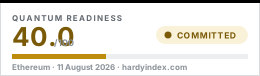
Tier 3: Committed. A funded roadmap with public dates and active research exists, but no post-quantum signature is live on mainnet.
| No. | Dimension | Score | Weight | Contribution |
|---|---|---|---|---|
| 1 | Signature scheme | 0 | 30% | 0.0 |
| 2 | Deployment stage | 5 | 25% | 12.5 |
| 3 | NIST alignment | 7 | 15% | 10.5 |
| 4 | Migration path | 7 | 15% | 10.5 |
| 5 | Exposure | 2 | 10% | 2.0 |
| 6 | Verification | 9 | 5% | 4.5 |
| Hardy Score | 40.0 | |||
Band 0: Classical signatures only on mainnet, with nothing post-quantum protecting live funds. Short-lived devnets and one-off benchmarks sit here: they demonstrate research rather than something a user can hold keys on.
Mainnet accounts use ECDSA on secp256k1 and validators use BLS, both broken by Shor's algorithm. leanXMSS validator signatures run in weekly interoperability devnets but nothing post-quantum protects funds or consensus on mainnet. source
Band 5: Tier 3: Committed.
Tier 3: Committed. A dedicated Ethereum Foundation team, public research at pq.ethereum.org, weekly devnets with more than ten client teams, and structured fork milestones targeting approximately 2029 constitute a funded roadmap with active research and no mainnet deployment. source
Band 6 to 8: The scheme is NIST-selected but the standard is not yet final, or a NIST-approved scheme is named but not yet deployed.
The roadmap references ML-DSA (FIPS 204) and SLH-DSA (FIPS 205), and the schemes chosen for consensus are hash-based, the same family NIST approves in SP 800-208 and FIPS 205. The specific constructions, leanXMSS and leanSPHINCS, are Ethereum-tailored variants rather than the standardised parameter sets. source
Placement in the band Not an 8: leanXMSS and leanSPHINCS are Ethereum-tailored variants rather than the standardised parameter sets, so the constructions actually chosen would not themselves be covered by a NIST standard.
Band 6 to 8: A credible published plan exists with a mechanism identified, but key parts are unbuilt or undated.
Account abstraction gives Ethereum a genuinely credible per-user migration route: signature agility lets individual accounts adopt a post-quantum scheme without a protocol-wide change or a contentious fork. The deductions are for timing, with core infrastructure targeted around 2029, and for the unsolved problem of externally owned accounts whose keys are already exposed. source
Placement in the band Not an 8: the mechanism is credible but the schedule is not, with core infrastructure targeted around 2029, and externally owned accounts whose keys are already exposed have no route at all.
Band 0 to 2: Public keys are exposed for effectively all accounts, or a large, measured share of total supply sits in exposed addresses.
Ethereum addresses are hashes of public keys, so a funded account that has never sent a transaction keeps its key private. In practice nearly every economically meaningful externally owned account has signed at least once and therefore published its key, so effectively all active supply is harvestable today. source
Placement in the band At the top of the band rather than a 0 or a 1, because the hashed-address model genuinely protects never-signed accounts, a structural advantage over the account-model chains alongside it here, even though almost no meaningful balance still enjoys it.
Band 9 to 10: Open source, independently audited, with the claim checkable on-chain or in public research.
Everything is open: a named Ethereum Foundation team, public research at pq.ethereum.org, weekly interoperability devnets with more than ten independent client teams, and open-source implementations. Ethereum Foundation researchers were also co-authors on the March 2026 Google Quantum AI resource-estimate paper that reset the threat timeline. source
Placement in the band Not a 10: what is open and checkable is the research programme, not a deployed post-quantum component. Nothing post-quantum runs on mainnet for an auditor to examine.
The deployment dimension is not a separate judgement. It is Tier 3 expressed as a number. See the tier mapping.
The 9 chains Ethereum sits among, out of 31 rated. The last column is the gap in Hardy points from Ethereum.
| Rank | Chain | Tier | Hardy | vs ETH |
|---|---|---|---|---|
| 12 | Stellar | 3: Committed | 41.0 | +1.0 |
| 13 | Zcash | 3: Committed | 41.0 | +1.0 |
| 14 | Aptos | 3: Committed | 40.5 | +0.5 |
| 15 | Polkadot | 3: Committed | 40.5 | +0.5 |
| 16 | Ethereum this chain | 3: Committed | 40.0 | |
| 17 | Cardano | 3: Committed | 37.5 | -2.5 |
| 18 | Tron | 4: Debating | 34.5 | -5.5 |
| 19 | BNB Chain | 4: Debating | 22.5 | -17.5 |
| 20 | Monero | 4: Debating | 21.0 | -19.0 |
NIST finalises its first post-quantum signature standards, giving Ethereum's research a standardised base to build against. source
The Ethereum Foundation forms a dedicated Post-Quantum Security team, with work tracked publicly at pq.ethereum.org. source
Vitalik Buterin publishes a roadmap identifying four areas of Ethereum cryptography requiring post-quantum upgrades: consensus signatures, account signatures, data availability and the application layer. source
Google Quantum AI publishes resource estimates, co-authored with Ethereum Foundation researchers, cutting the logical-qubit requirement for breaking secp256k1 roughly twentyfold. source
Weekly interoperability devnets with more than ten client teams testing hash-based validator signatures (leanXMSS) with leanVM aggregation. source
Structured fork milestones target completion of core post-quantum infrastructure. source
Exposure measures how much of the chain's value already sits behind a public key that an attacker can record today and break later. This is the part of the threat that a future upgrade cannot undo.
An Ethereum address is the last twenty bytes of the Keccak256 hash of the public key, so a funded account that has never signed a transaction has not published its key and is not harvestable. That protection evaporates on first use, and in practice almost every externally owned account holding meaningful value has signed. Smart contract accounts are a different case and are where account abstraction gives Ethereum its migration route: a contract account can change its verification logic to a post-quantum scheme without any protocol change at all.
What this rating means for you
Ethereum has a funded roadmap but no post-quantum signature protecting funds on mainnet yet. Until it ships, your exposure is the ordinary one, and the steps that reduce it cost nothing.
Editorial guidance from the Hardy Index. Nothing on this profile is sponsored and nothing on it is an affiliate link. The guides carry disclosed affiliate links, which never affect a rating. How we make money.
We will email you the day this rating moves, with the changelog note that explains why. Nothing else, and nothing in between.
No. Ethereum accounts use ECDSA on the secp256k1 curve and validators use BLS signatures, and both are broken by Shor's algorithm on a sufficiently large quantum computer. Ethereum has a funded, public post-quantum roadmap but targets completing core post-quantum infrastructure around 2029.
Lean Ethereum is the direction of travel toward simpler cryptographic building blocks that are both SNARK-friendly and quantum-resistant. In practice that means replacing BLS validator signatures with leanXMSS, a hash-based scheme, and compressing the resulting much larger signatures through leanVM, a minimal zkVM used for aggregation.
Through account abstraction, which gives Ethereum signature agility. Rather than forcing a protocol-wide signature change, account abstraction lets an individual account define its own verification logic, so a user can voluntarily move to a post-quantum scheme without a contentious fork. The harder unsolved case is externally owned accounts whose public keys are already exposed on-chain.
Because Ethereum's published roadmap states that its structured fork milestones target completion of core post-quantum infrastructure by approximately 2029. That is a target for infrastructure completion, not a guarantee that every account will have migrated by then.
It sharpened the urgency rather than changing the plan. In March 2026, Google Quantum AI published resource estimates, co-authored with Ethereum Foundation researchers, putting the requirement to break secp256k1 at fewer than 1,200 logical qubits, roughly twenty times fewer than earlier estimates. Ethereum's roadmap cites that work directly as context for its timeline.
A rating is only true as of the day it was reviewed, so both forms below carry the review date and the methodology version. If you are quoting the score, quote those too.
The Hardy Index (2026). Ethereum: quantum readiness assessment. Hardy Score 40.0 of 100, Tier 3: Committed. Methodology v1.4. Reviewed 2 October 2026. https://hardyindex.com/chains/ethereum
@misc{hardyindex_ethereum_2026,
  author       = {{The Hardy Index}},
  title        = {Ethereum: quantum readiness assessment},
  year         = {2026},
  howpublished = {\url{https://hardyindex.com/chains/ethereum}},
  note         = {Hardy Score 40.0 of 100, Tier 3: Committed. Methodology v1.4},
  urldate      = {2026-10-02}
}
The whole dataset is reusable under the terms on the about page. A machine-readable version of this page is at /chains/ethereum.md.
This is a security-readiness assessment, not investment advice.