10 June 2026 shipped
Governance proposal 328, the Akash Mainnet 18 upgrade, passes and brings node v2.1.0 to mainnet on Akash's Cosmos SDK fork v0.53.7-akash.2. It changes no signature scheme. source
Chain profile
Akash runs its own fork of Cosmos SDK v0.53.7, with secp256k1 accounts and Ed25519 validators, and has published no post-quantum plan; the ML-DSA keys in Cosmos SDK v0.55 are not in its fork.
No. Akash Network is a proof-of-stake chain built on the Cosmos SDK that runs a marketplace for cloud compute. AKT accounts sign with ECDSA on secp256k1, and validators sign consensus votes with Ed25519, which the chain's consensus parameters make the one accepted validator key type. A sufficiently large quantum computer breaks both. Mainnet runs Akash's own fork of the Cosmos SDK, v0.53.7-akash.2, which adds no key type. The Cosmos SDK added ML-DSA-65 keys for accounts and validators in v0.55, released on 28 July 2026, but Akash has not moved to that release line, and none of its Akash Economic Proposals, governance proposals or node releases mentions quantum computing. AEP-79, a Final Akash Economic Proposal on Akash's 2026 roadmap with an estimated completion of 31 December 2026, would take Akash off its sovereign chain and onto another network; its detailed migration documents, a draft owned by Overclock Labs whose version 0.10 is dated 20 October 2026, record that the core team has selected Solana, with an Ethereum layer 2 kept as the alternative, a choice to be confirmed when a migration proposal passes on the chain. That proposal, number 346, passed on 2 November 2026: it approves the move to Solana and the launch of AKT as a Solana token through a one-way migration portal, but sets no cutover date, and akashnet-2 keeps running its own consensus until a separate cutover proposal passes. None of it addresses post-quantum signatures.
Where we are making a judgement call Three judgement calls. The first two concern the upstream framework. The tier and the NIST and verification scores treat the ML-DSA keys in Cosmos SDK v0.55 as framework work rather than work for Akash, because Akash maintains its own fork and nobody with authority over Akash has referred to them. The Cosmos Hub profile credits the same code because Cosmos Labs, which wrote it, says it is bringing the Hub's maintenance in-house; no such tie exists here. A reader who credits the upstream release as Akash's own would place it in Tier 4, with a deployment score of 2, and might score NIST alignment 5, migration 5 and verification 3 as the Cosmos Hub profile does, which would raise the Hardy Score from 8.5 to 23.5. The migration score of 2 rather than 1 credits that upstream mechanism and Akash's record of seventeen passed software upgrades; at 1 the Hardy Score would be 7.0. The third is scope. AEP-79, a Final AEP on Akash's 2026 roadmap with an estimated completion of 31 December 2026, would retire Akash's sovereign chain in favour of another network, and its draft migration documents record the core team's selection of Solana, with an Ethereum layer 2 as the alternative. Governance approved the migration to Solana on 2 November 2026 in proposal 346, but set no cutover date. We rate Akash because it is a layer 1 that still runs its own consensus on a live mainnet today, and the index rates what runs today rather than what a chain plans. When the cutover takes effect and akashnet-2 stops, Akash leaves the index's scope rather than changing score, and the removal will be logged on the changelog. Separately, our finding is that we could not locate a published post-quantum position, not that we have confirmed none exists.
ECDSA on secp256k1 for accounts; Ed25519 for validator consensus keys
None selected or proposed. ML-DSA-65 is in Cosmos SDK v0.55, which Akash's fork does not include.
None named
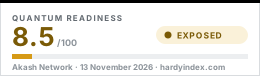
Tier 5: Exposed. The signatures securing funds on mainnet today are quantum-vulnerable, and no public post-quantum plan, proposal or research programme addressing them could be found.
A role not listed is not evidenced either way. Every scheme, and which other chains share it, is in the cryptography registry.
| No. | Dimension | Score | Weight | Contribution |
|---|---|---|---|---|
| 1 | Signature scheme | 0 | 30% | 0.0 |
| 2 | Deployment stage | 1 | 25% | 2.5 |
| 3 | NIST alignment | 0 | 15% | 0.0 |
| 4 | Migration path | 2 | 15% | 3.0 |
| 5 | Exposure | 2 | 10% | 2.0 |
| 6 | Verification | 2 | 5% | 1.0 |
| Hardy Score | 8.5 | |||
Band 0: Classical signatures only on mainnet, with nothing post-quantum protecting live funds. Short-lived devnets and one-off benchmarks sit here: they demonstrate research rather than something a user can hold keys on.
AKT accounts sign with ECDSA on secp256k1: all 279 transaction signers in mainnet blocks 29,178,700 to 29,178,740, read from the chain on 22 October 2026, carry secp256k1 keys. Validators sign with Ed25519. Akash's SDK fork adds no other key type, so nothing post-quantum protects AKT on mainnet. source
Band 1: Tier 5: Exposed.
Tier 5: Exposed. The signatures securing AKT are quantum-vulnerable, and we found no post-quantum plan, proposal or research programme from Akash: none in the Akash Economic Proposals repository, the 2026 roadmap, the node releases or the governance proposals the chain's API returns. The ML-DSA work in Cosmos SDK v0.55 belongs to the upstream framework, whose maintainers have no authority over Akash's fork. source
Band 0 to 2: No post-quantum scheme named for the chain’s fund-protecting signatures, or a proprietary scheme with no public cryptanalysis.
No post-quantum scheme has been named for Akash's accounts or validators. ML-DSA-65, from the final FIPS 204, exists in Cosmos SDK v0.55, but Akash pins its own fork of v0.53.7, and nobody with authority over Akash has referred to it. source
Placement in the band The floor of the band rather than a 1 or a 2: Akash itself has named no scheme at any point. Crediting the upstream ML-DSA option would score a framework Akash has not adopted rather than the chain.
Band 0 to 2: No agreed migration path, or the proposals on the table would strand or freeze holder funds.
No post-quantum migration plan has been published. A route exists upstream: under Cosmos SDK v0.55 a holder creates a new ML-DSA account and transfers funds to it, and a validator rotates its consensus key in place. None of it applies until Akash carries its fork onto that release line, and its governance does ship software upgrades routinely: seventeen software-upgrade proposals have passed since 2021, the latest bringing v2.1.0 in June 2026. source
Placement in the band The top of the band rather than a 1: a working mechanism exists in the framework Akash is built on, and its governance has a long record of coordinated software upgrades. It cannot reach 3, because Akash has not acknowledged quantum migration as a problem anywhere we could find.
Band 0 to 2: Public keys are exposed for effectively all accounts, or a large, measured share of total supply sits in exposed addresses.
A Cosmos SDK account address is a hash of the secp256k1 public key, so an account that has never signed keeps its key off the chain. The key is recorded with the account's opening transaction, and staking AKT or paying for a deployment needs a signed transaction, so actively held AKT sits behind a revealed key. Validator consensus keys are published by design. No measurement of the exposed share has been published. source
Placement in the band The top of the band rather than a 3: the address structure is the same as on other Cosmos SDK key-hash chains, where any send or delegation reveals the key. It is not a 0 or a 1 because never-used addresses do keep their keys hidden.
Band 0 to 2: No post-quantum component exists, or the claims rest on marketing.
No post-quantum component protects Akash, so there is nothing to verify. Its SDK fork carries the same key types as upstream v0.53, secp256k1, secp256r1, Ed25519 and multisig, and no ML-DSA. Under v1.8 the openness of the classical code earns nothing here. source
Placement in the band The top of the band rather than a 0 or a 1: there is no post-quantum component to verify, but nothing about the chain is marketed as quantum-safe, so its position does not rest on marketing.
The deployment dimension is not a separate judgement. It is Tier 5 expressed as a number. See the tier mapping.
The 9 chains Akash sits among, out of 80 rated. The last column is the gap in Hardy points from Akash.
| Rank | Chain | Tier | Hardy | vs AKT |
|---|---|---|---|---|
| 48 | Vaulta | 5: Exposed | 10.0 | +1.5 |
| 49 | Dogecoin | 5: Exposed | 9.0 | +0.5 |
| 50 | 0G | 5: Exposed | 8.5 | level |
| 51 | AIOZ Network | 5: Exposed | 8.5 | level |
| 52 | Akash Network this chain | 5: Exposed | 8.5 | |
| 53 | Arweave | 5: Exposed | 8.5 | level |
| 54 | Avalanche | 5: Exposed | 8.5 | level |
| 55 | Bitcoin SV | 5: Exposed | 8.5 | level |
| 56 | Celestia | 5: Exposed | 8.5 | level |
Governance proposal 328, the Akash Mainnet 18 upgrade, passes and brings node v2.1.0 to mainnet on Akash's Cosmos SDK fork v0.53.7-akash.2. It changes no signature scheme. source
Cosmos SDK v0.55.0 is released upstream with ML-DSA-65 keys for accounts and validators. It is a framework release; Akash's fork remains on the v0.53 line. source
AEP-79, by Greg Osuri, sets out Akash's move from its sovereign chain to another network. The AEP is marked Final and appears on Akash's 2026 roadmap with an estimated completion of 31 December 2026. The migration itself was not put to a governance vote until proposal 346, which passed on 2 November 2026. It does not address post-quantum signatures. source
Overclock Labs publishes version 0.9 of the AEP-79 migration document set, a draft for review that specifies the move to Solana or an Ethereum layer 2 and overrides the original AEP text where they conflict. That version left the target network to be chosen. It does not address post-quantum signatures. source
Version 0.10 of the AEP-79 document set, still a draft for review, records that the core team has selected Solana, to be confirmed when a migration proposal passes on akashnet-2, and specifies SPL AKT minted one-for-one through a one-way migration portal that opens seven days after that vote, with a two-year window. No migration proposal had been submitted by then. It does not address post-quantum signatures. source
Governance proposal 346, Migrate the Akash Protocol to Solana, passes with about 97 per cent of votes cast in favour. It approves the migration and the launch of AKT as a Solana token once the token and portal audits are complete, expected two to three weeks later, with a one-way migration portal open for two years. It sets no cutover date: live leases, staking and governance continue on akashnet-2 until a separate cutover proposal passes. It does not address post-quantum signatures. source
A post-quantum plan for Akash accounts or validators, including any move of its SDK fork to a release with ML-DSA keys. None was found. source
No stated policy
Akash has published nothing on accounts that never move to post-quantum keys. The draft AEP-79 migration documents propose a two-year window in which holders move AKT to the new chain through a one-way migration portal, authorised by the old key, but that concerns leaving the Cosmos chain, not quantum migration, and the destination keys it names are classical.
As of 4 November 2026. source Published beside the score, not in it. Every chain's stance is compared on the commitments page.
Exposure measures how much of the chain's value already sits behind a public key that an attacker can record today and break later. This is the part of the threat that a future upgrade cannot undo.
Akash uses the Cosmos SDK account model. An address is a hash of the account's secp256k1 public key, so a never-used address has not published its key, but the key goes on-chain with the account's opening transaction and stays there. Staking AKT needs a signed delegation and leasing compute needs signed deployment and escrow transactions, so the AKT that is actively held, staked or spent sits behind revealed keys. Validator consensus keys are Ed25519 keys published by design, and the chain's API listed 80 validators in the latest set on 22 October 2026. No measurement of the exposed share of supply has been published, so the score rests on the address model.
What this rating means for you
Akash runs quantum-vulnerable signatures with no published post-quantum plan that we could find. Nothing here is urgent today, and there is also nothing scheduled to change it.
Editorial guidance from the Hardy Index.
We will email you the day this rating moves, with the changelog note that explains why. Nothing else, and nothing in between.
No. AKT accounts sign with ECDSA on secp256k1 and validators sign with Ed25519, both of which a large enough quantum computer would break. Akash has published no plan to change either.
No. ML-DSA-65 keys arrived in Cosmos SDK v0.55. Akash runs its own fork of v0.53.7, which does not include them, so no AKT holder or Akash validator can use an ML-DSA key until Akash moves its fork to that release and passes a software upgrade, and neither has been proposed.
Not as drafted. The AEP-79 migration documents would have holders move AKT to the new chain through a migration portal using their existing secp256k1 key, and the destination accounts they describe use Ed25519 on Solana, which the core team has selected, or secp256k1 on Ethereum, both of which Shor's algorithm breaks. Governance approved the migration to Solana on 2 November 2026, but nothing in it changes the classical keys involved.
For actively held AKT, yes. An address is a hash of the key and hides it until the account signs, but sending, delegating or paying for a deployment reveals it. Those keys could be recorded now and attacked later by a quantum computer.
A rating is only true as of the day an editor last reviewed it, so both forms below carry that date and the methodology version, with the date its cited sources were last checked. If you are quoting the score, quote those too.
The Hardy Index (2026). Akash Network: quantum readiness assessment. Hardy Score 8.5 of 100, Tier 5: Exposed. Methodology v1.8. Last reviewed 4 November 2026; sources checked 13 November 2026. https://hardyindex.com/chains/akash
@misc{hardyindex_akash_2026,
  author       = {{The Hardy Index}},
  title        = {Akash Network: quantum readiness assessment},
  year         = {2026},
  howpublished = {\url{https://hardyindex.com/chains/akash}},
  note         = {Hardy Score 8.5 of 100, Tier 5: Exposed. Methodology v1.8},
  urldate      = {2026-11-13}
}
The whole dataset is reusable under the terms on the about page. A machine-readable version of this page is at /chains/akash.md.
This is a security-readiness assessment, not investment advice.