2 June 2026 shipped
ML-DSA-65 account keys are merged into the Cosmos SDK, following ML-DSA-65 validator keys on 27 May. source
Chain profile
The Cosmos SDK now ships ML-DSA-65 keys for accounts and validators, but the Cosmos Hub still runs an SDK release without them and has published no plan to upgrade.
No, not today. ATOM accounts on the Cosmos Hub sign with ECDSA on secp256k1 and validators sign consensus votes with Ed25519, and a sufficiently large quantum computer breaks both. The post-quantum work sits one layer down, in the framework the Hub is built on. Cosmos SDK v0.55, released on 28 July 2026 as part of Cosmos Labs' Ledger Security 2026.1 release, adds ML-DSA-65 from the final FIPS 204 standard as a key type for user accounts and for validator consensus keys, with in-place rotation for validators. The Hub's own node software, Gaia, still pins Cosmos SDK v0.53.8 in its v29.0.1 release of 23 October 2026 and in the v29.1.0-rc0 release candidate of 2 November 2026, and no Hub governance proposal, Gaia release note or Cosmos Labs statement commits the Hub to the upgrade. Until one does, the Hub has a post-quantum option available to it rather than a plan to use one.
Where we are making a judgement call Two judgement calls, which rest on the same question: whether Cosmos Labs' work on the Cosmos SDK counts as work for the Hub. The placement in Tier 4 reads Cosmos Labs, which maintains the Cosmos SDK and says it is bringing Hub technical maintenance in-house, as people with authority over the Hub's signatures, and reads its ML-DSA release as public post-quantum work on them. A reader who holds that authority over the Hub rests with its on-chain governance alone, and that framework code is not work on the Hub, would place the Hub in Tier 5, with a deployment score of 1 and a Hardy Score of 21.0 rather than 23.5. Second, the NIST and verification scores credit an implementation that lives in the Cosmos SDK, not in Gaia, and so turn on that same reading of Cosmos Labs' SDK work. Scored on the Hub's own code alone, verification would be 2 and NIST alignment 2 or lower, a Hardy Score of 18.5 or lower, and 16.0 or lower if the Tier 5 reading is taken as well. Gaia is a thin application on the SDK and adopting the code needs a software upgrade and no new design, which is why we credit it.
ECDSA on secp256k1 for accounts; Ed25519 for validator consensus keys
ML-DSA-65 for account and validator consensus keys, available in Cosmos SDK v0.55 but not adopted by the Hub
FIPS 204 (ML-DSA), finalised August 2024
Tier 4: Debating. Post-quantum work on the chain’s own signatures is documented by people with authority over it, in a formal improvement proposal or a public research programme, but no scheme is agreed and no timeline is published.
A role not listed is not evidenced either way. Every scheme, and which other chains share it, is in the cryptography registry.
| No. | Dimension | Score | Weight | Contribution |
|---|---|---|---|---|
| 1 | Signature scheme | 0 | 30% | 0.0 |
| 2 | Deployment stage | 2 | 25% | 5.0 |
| 3 | NIST alignment | 5 | 15% | 7.5 |
| 4 | Migration path | 5 | 15% | 7.5 |
| 5 | Exposure | 2 | 10% | 2.0 |
| 6 | Verification | 3 | 5% | 1.5 |
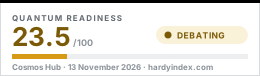
| Hardy Score | 23.5 | |||
Band 0: Classical signatures only on mainnet, with nothing post-quantum protecting live funds. Short-lived devnets and one-off benchmarks sit here: they demonstrate research rather than something a user can hold keys on.
Cosmos Hub accounts sign with ECDSA on secp256k1 and validators sign consensus messages with Ed25519. Both are broken by Shor's algorithm, and nothing post-quantum protects ATOM on mainnet: Gaia runs Cosmos SDK v0.53.8, which has no ML-DSA key type. source
Band 2: Tier 4: Debating.
Tier 4: Debating. Cosmos Labs, the Interchain Foundation subsidiary that maintains the Cosmos SDK and, by its own statement in June 2026, is bringing Hub technical maintenance in-house, has built and released ML-DSA-65 account and consensus keys in the Cosmos SDK, which is post-quantum work on exactly the signatures the Hub uses. It is not Tier 3 because nobody with authority over the Hub has published a plan to adopt it: no governance proposal, no Gaia release and no dated upgrade. source
Band 3 to 5: NIST schemes are referenced as candidates without a committed selection, or the work is bespoke research.
The one post-quantum scheme on the table for the Hub's signatures is ML-DSA-65, a parameter set of the final FIPS 204 standard, implemented in the Cosmos SDK for both account and consensus keys. It has been built for the framework, not proposed for the Hub. source
Placement in the band The top of the band rather than a 3 or a 4: the scheme is a single, specific parameter set of a final standard, already implemented for both roles the Hub needs. It cannot reach 6 because no one has proposed it for the Hub, so it is a framework option rather than the chain's selection.
Band 3 to 5: Migration is acknowledged as a problem with no agreed mechanism, or the mechanism is contested.
The mechanism exists in the framework. Under SDK v0.55 a validator rotates its consensus key to ML-DSA in place, and the chain counts as post-quantum once two thirds of voting power has rotated. Holders get no in-place migration: they create a new ML-DSA account with the command-line tool and send their funds to it, Ledger devices cannot sign with ML-DSA, and the Hub would need a governance-approved upgrade to v0.55 before any of it applies. source
Placement in the band The top of the band rather than a 4: a working route exists and the Hub's ordinary software-upgrade governance could deliver it. It is not a 6 because there is no published plan for the Hub, and account holders would have to move funds to a new address without hardware-wallet support.
Band 0 to 2: Public keys are exposed for effectively all accounts, or a large, measured share of total supply sits in exposed addresses.
A Cosmos account address is a hash of the secp256k1 public key, so an address that has never signed keeps its key hidden. The key is revealed with the account's opening transaction, and staking, which is how ATOM earns, needs a signed delegation, so nearly all actively held ATOM sits behind a revealed key. Validator consensus keys are public by design. source
Placement in the band The top of the band rather than a 3: the address structure is the same as on Ethereum-style key-hash chains, where staking or any send reveals the key, so effectively all ATOM in use is exposed. It is not a 0 or a 1 because never-used addresses do keep their keys hidden.
Band 3 to 5: A post-quantum component exists, on mainnet, on a persistent testnet or as a merged implementation, but is unreviewed.
A post-quantum component exists as merged code: ML-DSA-65 validator keys and account keys were merged into the Cosmos SDK on 27 May and 2 June 2026. Both pull requests were approved by two repository maintainers, aljo242 and mattac21, with comments from an automated reviewer, and we found no review from outside the maintaining team and no audit. The code is not in Gaia and protects no Hub funds. source
Placement in the band The floor of the band rather than a 4: the code is merged and released, but in a framework the Hub has not adopted, and it runs on no Hub network. It is not a 2 because a real, open source implementation of the Hub's replacement signatures exists.
The deployment dimension is not a separate judgement. It is Tier 4 expressed as a number. See the tier mapping.
The 9 chains Cosmos Hub sits among, out of 80 rated. The last column is the gap in Hardy points from Cosmos Hub.
| Rank | Chain | Tier | Hardy | vs ATOM |
|---|---|---|---|---|
| 22 | Polkadot | 3: Committed | 36.5 | +13.0 |
| 23 | Tron | 4: Debating | 34.5 | +11.0 |
| 24 | Cardano | 3: Committed | 34.0 | +10.5 |
| 25 | Sei | 4: Debating | 24.5 | +1.0 |
| 26 | Cosmos Hub this chain | 4: Debating | 23.5 | |
| 27 | Kaspa | 4: Debating | 20.5 | -3.0 |
| 28 | BNB Chain | 4: Debating | 20.0 | -3.5 |
| 29 | Monad | 4: Debating | 20.0 | -3.5 |
| 30 | XDC Network | 4: Debating | 20.0 | -3.5 |
ML-DSA-65 account keys are merged into the Cosmos SDK, following ML-DSA-65 validator keys on 27 May. source
Cosmos SDK v0.55.0 is released, with CometBFT v0.40, as part of Cosmos Labs' Ledger Security 2026.1, making ML-DSA-65 available to any chain built on the SDK. The release names no chain that has adopted it. source
A Cosmos Hub upgrade to Cosmos SDK v0.55, which would let holders and validators use ML-DSA-65 keys. No governance proposal or Gaia release for it was found; Gaia v29.0.1 of 23 October 2026 and the v29.1.0-rc0 release candidate of 2 November 2026 still pin SDK v0.53.8. source
No stated policy
Neither the Hub nor Cosmos Labs has said what happens to ATOM in accounts that never move to ML-DSA. The SDK documentation says there is no in-place migration: an account keeps its key for life, and moving means a new account and a transfer.
As of 22 October 2026. source Published beside the score, not in it. Every chain's stance is compared on the commitments page.
Exposure measures how much of the chain's value already sits behind a public key that an attacker can record today and break later. This is the part of the threat that a future upgrade cannot undo.
A Cosmos account address is a hash of its secp256k1 public key, encoded in Bech32, so an account that has never signed has not published its key. That protection ends with the account's opening transaction, and on the Hub almost every holder of consequence has signed one, because staking ATOM needs a signed delegation. Validator consensus keys are Ed25519 keys published by design. The practical position is close to full exposure for ATOM in use, with never-used addresses the exception.
What this rating means for you
Cosmos Hub has acknowledged the threat without agreeing a plan, so nothing is going to change for holders in the near term. That makes address hygiene the part worth attending to.
Editorial guidance from the Hardy Index.
We will email you the day this rating moves, with the changelog note that explains why. Nothing else, and nothing in between.
No. ATOM accounts sign with ECDSA on secp256k1 and validators sign with Ed25519, both of which a large enough quantum computer would break. The Cosmos SDK now supports ML-DSA-65 keys, but the Hub runs an older SDK release that does not.
Not yet. ML-DSA-65 arrived in Cosmos SDK v0.55. The Hub's node software, Gaia, still pins SDK v0.53.8, so no ATOM holder or Hub validator can use an ML-DSA key until the Hub passes a software upgrade that brings v0.55 in, and no such upgrade has been proposed.
Under the SDK's design, create a new ML-DSA account and send their ATOM to it, because an existing account keeps its key for life. Today that means the command-line tool: the documentation says wallet support is minimal and Ledger devices cannot sign with ML-DSA.
For nearly all ATOM in use, yes. An address is a hash of the key and hides it until the account signs, but staking needs a signed delegation, so active holders have revealed their keys. Those keys could be recorded now and attacked later by a quantum computer.
A rating is only true as of the day an editor last reviewed it, so both forms below carry that date and the methodology version, with the date its cited sources were last checked. If you are quoting the score, quote those too.
The Hardy Index (2026). Cosmos Hub: quantum readiness assessment. Hardy Score 23.5 of 100, Tier 4: Debating. Methodology v1.8. Last reviewed 4 November 2026; sources checked 13 November 2026. https://hardyindex.com/chains/cosmos-hub
@misc{hardyindex_cosmos_hub_2026,
  author       = {{The Hardy Index}},
  title        = {Cosmos Hub: quantum readiness assessment},
  year         = {2026},
  howpublished = {\url{https://hardyindex.com/chains/cosmos-hub}},
  note         = {Hardy Score 23.5 of 100, Tier 4: Debating. Methodology v1.8},
  urldate      = {2026-11-13}
}
The whole dataset is reusable under the terms on the about page. A machine-readable version of this page is at /chains/cosmos-hub.md.
This is a security-readiness assessment, not investment advice.