23 February 2024 shipped
A community member asks on the Agora governance forum how prepared MultiversX is for quantum computers and what the core team is doing about it. The thread has no reply. source
Chain profile
Accounts sign with Ed25519 behind addresses that encode the public key itself, validators finalise blocks with BLS multisignatures on BLS12-381, and no post-quantum proposal, plan or research programme for MultiversX could be found.
No. MultiversX, formerly Elrond, signs every transaction with Ed25519, and an account's address is the bech32 encoding of its Ed25519 public key, so the key behind every account is public from the moment the address exists. Validators finalise blocks in each shard and the Metachain by aggregating BLS signatures, and the node builds its block-signing keys on the BLS12-381 curve. A sufficiently large quantum computer running Shor's algorithm would break both schemes. We found no post-quantum position from the MultiversX core team or in its governance process: none of the MultiversX Improvement Documents mentions post-quantum signatures, and the one thread on the Agora governance forum that asks how prepared MultiversX is for quantum computers, opened by a community member in February 2024, has no reply. Guardians, the optional co-signer feature for accounts, add a second Ed25519 signature from another address and do nothing against a quantum adversary who can forge both.
Where we are making a judgement call Two judgement calls carry this profile. The first is exposure. The rubric's bottom band covers chains where keys are exposed for effectively all accounts, and an address that is the key meets it on structure alone. MultiversX is scored 2 on that reading, as Solana, Kaspa, Stellar, Algorand, Hedera, Polkadot and Bittensor are. A reader who holds that an unmeasured share belongs at the floor of the band above would score MultiversX 3, a gain of 1.0 point. The second concerns the record rather than a score. Statements about quantum computing attributed to people at MultiversX may exist on social media, which this index does not cite; nothing in the improvement documents, the Agora forum, the documentation or the code addresses post-quantum signatures, and the one Agora thread on the subject is a community question without an answer. A statement is not a plan in any case: a formal improvement proposal or a public research programme from the core team would be needed to reach Tier 4. Our finding is that we could not locate a published position, not that we have confirmed none exists, and a primary source is the quickest way to correct it.
Ed25519 for account and guardian signatures; BLS multisignatures on BLS12-381 for validator consensus
None. No post-quantum scheme has been proposed, selected or tested for MultiversX.
None adopted.
Tier 5: Exposed. The signatures securing funds on mainnet today are quantum-vulnerable, and no public post-quantum plan, proposal or research programme addressing them could be found.
A role not listed is not evidenced either way. Every scheme, and which other chains share it, is in the cryptography registry.
| No. | Dimension | Score | Weight | Contribution |
|---|---|---|---|---|
| 1 | Signature scheme | 0 | 30% | 0.0 |
| 2 | Deployment stage | 1 | 25% | 2.5 |
| 3 | NIST alignment | 0 | 15% | 0.0 |
| 4 | Migration path | 2 | 15% | 3.0 |
| 5 | Exposure | 2 | 10% | 2.0 |
| 6 | Verification | 2 | 5% | 1.0 |
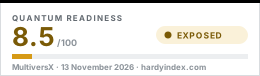
| Hardy Score | 8.5 | |||
Band 0: Classical signatures only on mainnet, with nothing post-quantum protecting live funds. Short-lived devnets and one-off benchmarks sit here: they demonstrate research rather than something a user can hold keys on.
The node's crypto components sign and verify transactions with an Ed25519 single signer and generate block-signing keys on the BLS12-381 suite, which the consensus aggregates into one multisignature per block. Both are elliptic-curve or pairing schemes broken by Shor's algorithm. Nothing post-quantum protects EGLD or any asset on MultiversX today. source
Band 1: Tier 5: Exposed.
Tier 5: Exposed. The signatures protecting funds and finalising blocks are quantum-vulnerable, and no MultiversX Improvement Document, Agora proposal, core-team publication or research programme on post-quantum signatures was found. The single Agora thread on the subject is a community question that drew no answer. source
Band 0 to 2: No post-quantum scheme named for the chain’s fund-protecting signatures, or a proprietary scheme with no public cryptanalysis.
No post-quantum scheme has been named for MultiversX's account, guardian or validator signatures, so there is nothing to assess against a NIST standard. source
Placement in the band The floor of the band rather than a 1 or a 2: nobody with authority over the chain has named a post-quantum scheme, even as an example, so there is no choice to align with a standard.
Band 0 to 2: No agreed migration path, or the proposals on the table would strand or freeze holder funds.
No migration plan or published position exists. MultiversX does have a record of coordinated protocol upgrades: a run of named releases specified in mx-specs, among them Andromeda and Supernova, the second proposed on Agora as MIP-27 and live on mainnet, where the network now reports a 600 millisecond round. There is no way to rotate the key behind an account in place, because the address is the key, and nothing addresses accounts whose keys are already public. source
Placement in the band The top of the band rather than a 0 or a 1: the chain has repeatedly carried protocol-wide changes through proposal, release and activation, which is the route a new signature scheme would need. Not a 3, because nobody with authority over MultiversX has acknowledged the quantum problem in public, let alone described a route for holders.
Band 0 to 2: Public keys are exposed for effectively all accounts, or a large, measured share of total supply sits in exposed addresses.
A MultiversX account is identified by an address that its documentation describes as the bech32-encoded public key of the account. The key is therefore readable from the address alone, before the account has ever signed, so every user account's key can be collected today. Validator BLS public keys have to be known to the network for aggregated block signatures to be verified. source
Placement in the band The top of the band rather than a 0 or a 1: MultiversX meets this band on its structural limb, the address being the key itself, but no measured share of at-risk supply has been published, and funds held by smart contracts sit at addresses that are not keys. Not a 3, because no user account has a hidden key at all.
Band 0 to 2: No post-quantum component exists, or the claims rest on marketing.
No post-quantum component exists for MultiversX: no code, specification or testnet implementation was found in the node, the crypto library or the improvement documents. The node is open source, but under v1.8 the openness of classical code earns nothing on this dimension. source
Placement in the band The top of the band rather than a 0 or a 1: there is nothing post-quantum to verify, but MultiversX does not market the chain as quantum-safe, so its position does not rest on marketing.
The deployment dimension is not a separate judgement. It is Tier 5 expressed as a number. See the tier mapping.
The 9 chains MultiversX sits among, out of 80 rated. The last column is the gap in Hardy points from MultiversX.
| Rank | Chain | Tier | Hardy | vs EGLD |
|---|---|---|---|---|
| 64 | Injective | 5: Exposed | 8.5 | level |
| 65 | KCC (KuCoin Community Chain) | 5: Exposed | 8.5 | level |
| 66 | Kite | 5: Exposed | 8.5 | level |
| 67 | Mina Protocol | 5: Exposed | 8.5 | level |
| 68 | MultiversX this chain | 5: Exposed | 8.5 | |
| 69 | Polygon PoS | 5: Exposed | 8.5 | level |
| 70 | Provenance Blockchain | 5: Exposed | 8.5 | level |
| 71 | Theta Network | 5: Exposed | 8.5 | level |
| 72 | THORChain | 5: Exposed | 8.5 | level |
A community member asks on the Agora governance forum how prepared MultiversX is for quantum computers and what the core team is doing about it. The thread has no reply. source
No post-quantum improvement document, Agora proposal, roadmap, research programme or testnet implementation for MultiversX's signatures was found from the core team or in the governance process at the time of writing. source
No stated policy
Neither the MultiversX core team nor the governance process has said anything about post-quantum migration, so nothing has been said about accounts that never move to post-quantum keys.
As of 22 October 2026. Published beside the score, not in it. Every chain's stance is compared on the commitments page.
Exposure measures how much of the chain's value already sits behind a public key that an attacker can record today and break later. This is the part of the threat that a future upgrade cannot undo.
MultiversX's exposure is structural. Its documentation states that an account is identified by an address which is the bech32-encoded public key of the account, so an erd1 address is the Ed25519 key in another encoding and not a hash of it. There is no equivalent of an unspent hashed address whose key stays private until first use: every user account publishes its key when the address is created, and an adversary collecting keys today needs only a list of addresses. Guardians do not change this, since a guardian is another Ed25519 address whose key is public in the same way. Validator BLS public keys have to be known to the network for aggregated block signatures to be checked. Funds held by smart contracts sit at contract addresses rather than key addresses, and are reached through the keys of whoever controls those contracts. No measurement of at-risk supply has been published for MultiversX.
What this rating means for you
MultiversX runs quantum-vulnerable signatures with no published post-quantum plan that we could find. Nothing here is urgent today, and there is also nothing scheduled to change it.
Editorial guidance from the Hardy Index.
We will email you the day this rating moves, with the changelog note that explains why. Nothing else, and nothing in between.
No. MultiversX accounts sign transactions with Ed25519 and validators finalise blocks with aggregated BLS signatures on BLS12-381. A sufficiently large quantum computer would break both, and no post-quantum plan, proposal or research programme for the chain has been published.
Yes, for every user account. A MultiversX address is the bech32 encoding of the account's Ed25519 public key, so the key is readable from the address whether or not the account has ever sent a transaction. Those keys can be recorded now and attacked later.
No. A guardian is a second address whose signature a guarded account requires on its transactions, which helps when a secret key is stolen or phished. The guardian signs with Ed25519 too and its key is public in the same way, so an attacker able to forge one Ed25519 signature can forge both.
A MultiversX Improvement Document, an Agora proposal or a public research programme from the core team on post-quantum signatures for accounts or validators would meet the Tier 4 floor. A published plan from the core team or an adopted proposal naming the scheme to be used would meet Tier 3.
A rating is only true as of the day an editor last reviewed it, so both forms below carry that date and the methodology version, with the date its cited sources were last checked. If you are quoting the score, quote those too.
The Hardy Index (2026). MultiversX: quantum readiness assessment. Hardy Score 8.5 of 100, Tier 5: Exposed. Methodology v1.8. Last reviewed 22 October 2026; sources checked 13 November 2026. https://hardyindex.com/chains/multiversx
@misc{hardyindex_multiversx_2026,
  author       = {{The Hardy Index}},
  title        = {MultiversX: quantum readiness assessment},
  year         = {2026},
  howpublished = {\url{https://hardyindex.com/chains/multiversx}},
  note         = {Hardy Score 8.5 of 100, Tier 5: Exposed. Methodology v1.8},
  urldate      = {2026-11-13}
}
The whole dataset is reusable under the terms on the about page. A machine-readable version of this page is at /chains/multiversx.md.
This is a security-readiness assessment, not investment advice.