1 Signature scheme 0/10, weighted 30%
Band 0: Classical signatures only on mainnet, with nothing post-quantum protecting live funds. Short-lived devnets and one-off benchmarks sit here: they demonstrate research rather than something a user can hold keys on.
Spring defines exactly three public key and signature types, K1 (secp256k1), R1 (P-256) and WebAuthn (P-256), and every account permission is satisfied by one of them. Block producers sign with secp256k1 keys and finalizers vote with BLS12-381 keys. Nothing post-quantum protects A or any asset on Vaulta today.
source
2 Deployment stage 1/10, weighted 25%
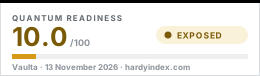
Band 1: Tier 5: Exposed.
Tier 5: Exposed. The signatures that authorise spends and finalise blocks are quantum-vulnerable, and no post-quantum roadmap, improvement proposal or research programme was found from the Vaulta Foundation, in the Spring repository or in the Vaulta Foundation's repositories.
source
3 NIST alignment 0/10, weighted 15%
Band 0 to 2: No post-quantum scheme named for the chain’s fund-protecting signatures, or a proprietary scheme with no public cryptanalysis.
No post-quantum scheme has been named for Vaulta's account keys, producer signatures or finalizer votes. The Spring repository and the Vaulta Foundation's repositories contain no post-quantum signature work, and the network's documentation does not mention one.
source
Placement in the band The floor of the band rather than a 1 or a 2: no one with authority over Vaulta has named a post-quantum scheme for any of its signatures, so there is nothing to place against a standard.
4 Migration path 3/10, weighted 15%
Band 3 to 5: Migration is acknowledged as a problem with no agreed mechanism, or the mechanism is contested.
Vaulta accounts are names, not hashes of keys, and the updateauth action replaces the keys behind any permission in place, so a holder can move to a new key without moving funds or changing the account. The network has also added a key type before: WebAuthn keys were activated as a protocol feature on 21 July 2021. But every key type accepted today is classical, a post-quantum one would need a new protocol feature, and none has been proposed.
source
Placement in the band The floor of the band rather than a 4 or a 5: the rotation mechanism is live and keeps the account, and adding a key type has a precedent, but no post-quantum key type has been proposed and no published plan or discussion of one was found. Above a 2, because the mechanism a migration would need already exists on mainnet.
5 Exposure 2/10, weighted 10%
Band 0 to 2: Public keys are exposed for effectively all accounts, or a large, measured share of total supply sits in exposed addresses.
A Vaulta account is a name, and the public keys that control it are stored in the account's permissions on-chain, readable by anyone through any API node before the account has ever signed. Every account controlled by a key has that key published from the moment it is set, so there is no unexposed share for hashing to protect.
source
Placement in the band The top of the band rather than a 0 or a 1: Vaulta meets the band on its structural limb, with keys readable from account permissions, but no measured share of exposed supply has been published. Not a 3, because the exposure covers effectively every key-controlled account, not only those that have signed.
6 Verification 2/10, weighted 5%
Band 0 to 2: No post-quantum component exists, or the claims rest on marketing.
No post-quantum component exists for Vaulta's signatures: no code, specification or testnet implementation was found in Spring or the Vaulta Foundation's repositories. Spring is open source, but under v1.8 the openness of classical code earns nothing here.
source
Placement in the band The top of the band rather than a 0 or a 1: there is no post-quantum component to verify, but nothing about Vaulta is marketed as quantum-safe, so its position does not rest on marketing.