15 December 2025 shipped
Neodyme completes its audit of revision 8bbe920 of Quantus's ML-DSA and HD wallet library, qp-rusty-crystals, reporting thirteen findings, two of them acknowledged rather than fixed. source
Chain profile
Quantus is a proof-of-work chain whose runtime accepts ML-DSA signatures and nothing else, so every account on the mainnet that began producing blocks on 9 September 2026 is protected by a FIPS 204 scheme.
Yes, on the measure this index uses. Quantus is a Substrate-based layer 1 with its own proof-of-work consensus, and its runtime replaces Substrate's usual MultiSignature, which would allow sr25519, Ed25519 and ECDSA keys, with a Dilithium signature type that has two variants and no classical one: ML-DSA-87 and ML-DSA-65, both parameter sets of NIST's FIPS 204. An account address is a Poseidon hash of the ML-DSA public key, so there is no classical key anywhere in the path that authorises a spend. We checked this on the chain itself: on 23 October 2026 the mainnet RPC reported block 274,955 produced at 05:34 UTC, and its signed transfer carries a 3,309-byte ML-DSA-65 signature and a 1,952-byte public key, while a batch two blocks earlier carries a 4,627-byte ML-DSA-87 signature and a 2,592-byte key. Block 1 is timestamped 9 September 2026. Three things qualify the picture. Most new coins enter through the wormhole, a second route that releases funds against a zero-knowledge proof rather than a signature, and the only review of it is a draft. Neodyme audited an earlier revision of the ML-DSA library, before the ML-DSA-65 code now signing mainnet transfers was added. And a ten-member Tech Collective set at genesis holds the Root governance track, which can replace the runtime, including its signature scheme, in about thirty minutes.
Where we are making a judgement call Quantus qualifies on the deployment test, a post-quantum signature running on its mainnet, and its size plays no part in the score. Its mainnet began on 9 September 2026, so it is six weeks old at the time of writing, and several readings are ours. One: we score the wormhole as part of what protects funds, as the Zcash and Mina profiles score their proving systems, because every mining reward is paid to a wormhole address and leaves it against an unsigned zero-knowledge proof; the soundness counters that once capped those exits were removed on 7 August 2026, so the circuits alone guard issuance. Leaving it out of scope would give NIST 10 and verification 7, a Hardy Score of 96.0 rather than 94.0. Two: Quantus's documentation says every transaction is signed with ML-DSA-87 and its home page names "Dilithium-5", but the runtime also accepts ML-DSA-65 and we read an ML-DSA-65 transfer on mainnet; both are FIPS 204, so no score changes. Three: exposure is 9 for Poseidon2's shorter record; a 10 gives 95.0. Four: migration is 9 because no holder has anything to migrate, but the governance record behind a future change is six weeks and one upgrade long; an 8 gives 92.5. Separately from the score, control is concentrated. Only the ten Tech Collective members seeded at genesis can propose and vote; there are no community referenda. The Root track they hold can force a transfer or set any balance, and the fast upgrade track can replace the runtime, signature scheme included, in about thirty minutes.
ML-DSA-87 or ML-DSA-65 (FIPS 204) for every account, through the runtime's DilithiumSignatureScheme; proof-of-work consensus with no validator signatures
ML-DSA itself, in both parameter sets, since genesis. Wormhole transfers, which carry every mining reward, are authorised by Plonky2 zero-knowledge proofs over Poseidon2 rather than by a signature.
FIPS 204 (ML-DSA-87 and ML-DSA-65)
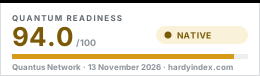
Tier 1: Native. Post-quantum secure at mainnet today, with quantum-resistant signatures built in from genesis.
A role not listed is not evidenced either way. Every scheme, and which other chains share it, is in the cryptography registry.
| No. | Dimension | Score | Weight | Contribution |
|---|---|---|---|---|
| 1 | Signature scheme | 10 | 30% | 30.0 |
| 2 | Deployment stage | 10 | 25% | 25.0 |
| 3 | NIST alignment | 9 | 15% | 13.5 |
| 4 | Migration path | 9 | 15% | 13.5 |
| 5 | Exposure | 9 | 10% | 9.0 |
| 6 | Verification | 6 | 5% | 3.0 |
| Hardy Score | 94.0 | |||
Band 10: A post-quantum signature is the mandatory scheme for all accounts on mainnet.
The runtime defines its transaction signature as DilithiumSignatureScheme, an enum of ML-DSA-87 and ML-DSA-65 signatures each carried with its public key, with the line that would have used Substrate's MultiSignature commented out. No sr25519, Ed25519 or ECDSA variant exists, so every account on mainnet signs with a post-quantum scheme. source
Band 10: Tier 1: Native.
Tier 1: Native. The runtime tagged for launch, v1.0.0-gm on 9 September 2026, already used DilithiumSignatureScheme, and block 1 of the mainnet is timestamped 08:51 UTC that day. Post-quantum signatures have protected every unit of supply from genesis, and blocks were still being produced on 23 October 2026. source
Band 9 to 10: The scheme in use is covered by a final NIST standard (FIPS 204, FIPS 205, or SP 800-208).
Both signature variants are FIPS 204 parameter sets, ML-DSA-87 and ML-DSA-65, implemented in Quantus's own pure-Rust library qp-rusty-crystals, and transactions read from mainnet carry signatures and keys of exactly the FIPS 204 sizes for each set. The second route by which funds move, the wormhole, rests on Plonky2 proofs over Poseidon2, which no NIST standard covers; every mining reward is paid to a wormhole address. source
Placement in the band A 9 rather than a 10: the signatures are FIPS 204 and in use, but the wormhole path that carries most issuance rests on a proof system outside any NIST standard. Not an 8, because the scheme protecting every signed spend is a final standard in use on mainnet.
Band 9 to 10: Holders can migrate today, or the published plan is dated, specific, and executable under the chain’s existing governance.
Holders have no quantum migration to make, because no Quantus account has ever had a classical key. The chain has also carried a runtime upgrade since launch, from spec version 152 in the launch release to the 153 the mainnet reported on 23 October 2026, under the governance process its upgrade guide sets out. source
Placement in the band A 9 rather than an 8: nothing is outstanding, where Mochimo and Abelian sit at 8 for an operational or standards migration still ahead of them. Not a 10, because a move between post-quantum schemes, should one ever be needed, would run through a ten-member collective with six weeks of upgrade record.
Band 9 to 10: No quantum-vulnerable public keys are exposed on-chain, or the exposed keys protect nothing.
No Quantus public key is a quantum liability. An address is the Poseidon hash of an ML-DSA public key, and the key a spend reveals is a lattice key that Shor's algorithm does not break. Funds sent to wormhole addresses are released by a Plonky2 proof over Poseidon2 hashes, which carries no elliptic-curve key either. source
Placement in the band A 9 rather than a 10: addresses and the wormhole rest on Poseidon2, a hash with a shorter cryptanalytic record than SHA-2 or SHA-3, and Eiger's review of Quantus's Poseidon code found a weak generator for its round constants and undocumented domain separation. That is the kind of reason Abelian holds at 9. Not lower, because no public key on the chain is one Shor's algorithm breaks.
Band 6 to 8: The post-quantum component is open source with public review or a named audit.
The ML-DSA library is open source under Apache 2.0 and was audited by Neodyme between 1 November and 15 December 2025, which reported one critical, two high, five medium and five low-severity findings; two of the low findings are recorded as acknowledged rather than fixed. That audit reviewed revision 8bbe920. Mainnet runs version 4.1.1 of the library, 73 commits later, including the change that added the ML-DSA-65 code now signing mainnet transfers. The wormhole circuits, which release most new coins, have one review, Eiger's draft v0.1 of 20 March 2026, whose remediation is marked to be completed. source
Placement in the band A 6 rather than a 7: a named audit exists, but of an earlier revision, and the wormhole, which is part of what protects funds, has only a draft review. Leaving the wormhole out of scope would give 7. Not a 5, because the audit is named and published and the scheme is checkable on-chain.
The deployment dimension is not a separate judgement. It is Tier 1 expressed as a number. See the tier mapping.
The 9 chains Quantus sits among, out of 80 rated. The last column is the gap in Hardy points from Quantus.
| Rank | Chain | Tier | Hardy | vs QTC |
|---|---|---|---|---|
| 1 | Quantus Network this chain | 1: Native | 94.0 | |
| 2 | Dilithion | 1: Native | 93.5 | -0.5 |
| 3 | Quantum Resistant Ledger | 1: Native | 92.5 | -1.5 |
| 4 | Mochimo | 1: Native | 89.0 | -5.0 |
| 5 | Tidecoin | 1: Native | 89.0 | -5.0 |
| 6 | QoreChain | 2: Shipping | 84.5 | -9.5 |
| 7 | Abelian | 1: Native | 84.0 | -10.0 |
| 8 | NEAR Protocol | 2: Shipping | 80.0 | -14.0 |
| 9 | Algorand | 2: Shipping | 77.0 | -17.0 |
Neodyme completes its audit of revision 8bbe920 of Quantus's ML-DSA and HD wallet library, qp-rusty-crystals, reporting thirteen findings, two of them acknowledged rather than fixed. source
Eiger delivers a draft, v0.1, of its review of the wormhole circuits, covering code from February 2026, with remediation still to be completed. source
Quantus mainnet begins producing blocks from release v1.0.0-gm, with ML-DSA as the signature scheme for every account. source
Quantus CLI v2.3.0 is released, a wallet holders can install to create ML-DSA accounts and sign transfers and governance actions. source
Eiger's audit of the wormhole zero-knowledge circuits, prover, verifier and aggregator, listed by Quantus as in progress. source
Not applicable
Every Quantus account has been protected by ML-DSA since the mainnet began on 9 September 2026, so there are no classical-key coins to migrate.
As of 23 October 2026. Published beside the score, not in it. Every chain's stance is compared on the commitments page.
Exposure measures how much of the chain's value already sits behind a public key that an attacker can record today and break later. This is the part of the threat that a future upgrade cannot undo.
Quantus has no harvest-now-decrypt-later exposure in the sense this index usually means. An address is a Poseidon hash of an ML-DSA public key, and when a spend reveals that key, what an attacker records is a lattice public key that Shor's algorithm does not help with. The second way funds move, the wormhole, releases coins against a Plonky2 proof of knowledge of a hashed secret, and that path holds no elliptic-curve key either. Both ML-DSA parameter sets are stateless, so there is no one-time key whose reuse could leak the private key.
What this rating means for you
Quantus already runs post-quantum signatures for every account on mainnet, so there is no migration for you to make here. The habits that still matter are address hygiene and keeping your own keys.
Editorial guidance from the Hardy Index.
We will email you the day this rating moves, with the changelog note that explains why. Nothing else, and nothing in between.
On the measure this index uses, yes. The Quantus runtime accepts ML-DSA-87 and ML-DSA-65 signatures, both FIPS 204 parameter sets, and has no classical signature type an account could use instead. Addresses are hashes of ML-DSA public keys, and we read ML-DSA signatures of the standard sizes from mainnet transactions on 23 October 2026.
No. Substrate chains normally use MultiSignature, which accepts sr25519, Ed25519 and ECDSA. Quantus replaced it: the runtime's Signature type is DilithiumSignatureScheme, which has an ML-DSA-87 variant and an ML-DSA-65 variant and nothing else, and the MultiSignature line is left commented out in the source. Account identifiers are derived by hashing the ML-DSA public key.
Both. Quantus's documentation and home page describe ML-DSA-87, also called Dilithium-5, but the runtime accepts either, and the mainnet carries both: a transfer in block 274,955 is signed with ML-DSA-65 and a batch in block 274,953 with ML-DSA-87. Both are parameter sets of FIPS 204, so the difference does not change the rating. The Neodyme audit reviewed an earlier revision of the library, before the ML-DSA-65 code was added.
A Tech Collective set at genesis. Quantus's own upgrade guide says a runtime upgrade needs eight aye votes from the ten genesis members, and the collective also holds the Root track, which can force a transfer, set any balance or, on the fast track, replace the runtime in about thirty minutes. There are no community referenda. That is recorded in the caveat rather than in the score, because it does not change which signature protects funds today.
A second way coins move. Every mining reward is paid to a wormhole address, and coins leave it when the owner submits a Plonky2 zero-knowledge proof over Poseidon2 hashes rather than a signature. Because that route carries most new supply, the profile treats it as part of what protects funds. Its only review so far is Eiger's draft of March 2026.
A rating is only true as of the day an editor last reviewed it, so both forms below carry that date and the methodology version, with the date its cited sources were last checked. If you are quoting the score, quote those too.
The Hardy Index (2026). Quantus Network: quantum readiness assessment. Hardy Score 94.0 of 100, Tier 1: Native. Methodology v1.8. Last reviewed 23 October 2026; sources checked 13 November 2026. https://hardyindex.com/chains/quantus
@misc{hardyindex_quantus_2026,
  author       = {{The Hardy Index}},
  title        = {Quantus Network: quantum readiness assessment},
  year         = {2026},
  howpublished = {\url{https://hardyindex.com/chains/quantus}},
  note         = {Hardy Score 94.0 of 100, Tier 1: Native. Methodology v1.8},
  urldate      = {2026-11-13}
}
The whole dataset is reusable under the terms on the about page. A machine-readable version of this page is at /chains/quantus.md.
This is a security-readiness assessment, not investment advice.